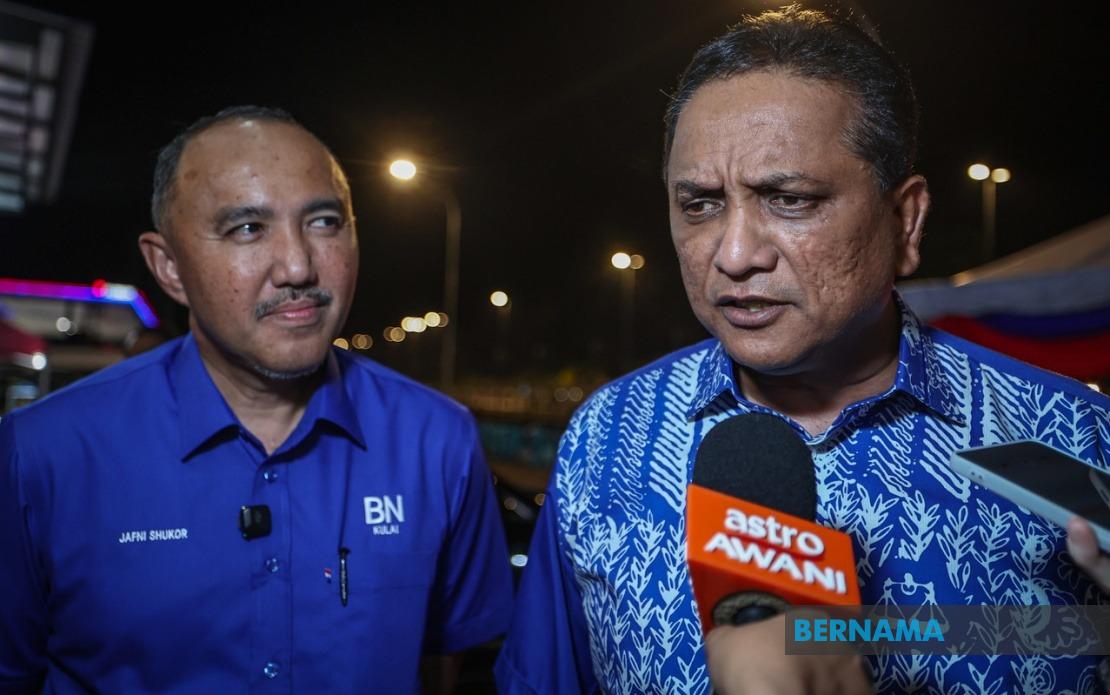
The assertion that Johor's Regent, Tunku Mahkota Ismail, has transformed the state administration into a "palace puppet" lacks substance and represents a gross distortion of reality, according to prominent party figure Datuk Seri Reezal Merican Naina Merican. The UMNO Supreme Council member made the remarks in Johor Bahru on June 25, rejecting what he characterised as misleading interpretations of the Regent's involvement in state affairs during a period of significant political flux in the peninsula's southern state.
Reezal Merican framed the Regent's interventions on matters concerning Johor's development trajectory as a legitimate exercise of constitutional authority rather than overreach into executive governance. He emphasised that the monarch's forthright commentary on state progress reflects the Regent's obligation to safeguard the interests of Johor's population, a duty inherent to the position. The UMNO leader's defence comes at a sensitive moment, with state elections scheduled and questions surfacing regarding the balance of power between palace and elected government.
The UMNO politician stressed that any directive or pronouncement from Tunku Mahkota Ismail constitutes an appropriate expression of both his prerogative and constitutional obligation in his capacity as Regent. He articulated that such oversight of the Menteri Besar, the State Secretary, and other officials represents a fundamental institutional mechanism—a system of checks and equilibrium—rather than any form of administrative capture. This framing attempts to normalise what critics have presented as an unusual concentration of royal influence over elected administrators.
Drawing on his position within UMNO's top echelon, Reezal Merican asserted that party leadership has never discussed concerns that the state branch operates under palace direction. His statement serves as an implicit rebuttal to dissident voices within the party and a reassurance that UMNO's autonomous decision-making capacity in Johor remains intact. The assertion assumes significance given the party's dominance in Johor politics and its traditional role as kingmaker in state governance structures.
The controversy intensified when Datuk Dr Mohd Puad Zarkashi, a former Speaker of the Johor State Legislative Assembly, departed UMNO with allegations that Menteri Besar Datuk Onn Hafiz Ghazi had become a figurehead beholden to palace interests. The departure represented a rare act of public dissent within party ranks, signalling underlying fractures regarding the proper relationship between monarchical institutions and elected representatives. Reezal Merican's rebuttal attempted to contain the political damage such internal criticism could inflict ahead of electoral contests.
Reezal Merican questioned the timing and motives behind Mohd Puad's decision to inject the royal institution into Johor's partisan political discourse, particularly as the state prepared for elections. The insinuation carried weight: introducing constitutional monarchy into electoral narratives risks destabilising long-standing conventions that insulate royal institutions from partisan contestation. In the Malaysian political system, such breaches of convention carry substantial symbolic and practical consequences for institutional stability and democratic norms.
The Election Commission's scheduling of June 27 as nomination day and July 11 as polling day marked the formal commencement of electoral activities, ensuring that Reezal Merican's defence of the Regent's role occurred within an intensely competitive political environment. Candidates were preparing platforms, and party messaging underwent careful calibration to address emerging vulnerabilities. The palace-government relationship dispute thus became weaponised within the electoral context, with implications for voter perceptions regarding governance competence and institutional integrity.
For Malaysian observers, the dispute reflects broader tensions within electoral monarchies regarding the boundaries between constitutional authority and political neutrality. While Johor's Sultan institution has historically maintained a visible involvement in state affairs compared to ceremonial roles in other jurisdictions, the explicit framing of this involvement as potentially problematic signalled evolving expectations about institutional restraint. The generational transition within the Johor monarchy, with Tunku Mahkota Ismail increasingly visible in policy discussions, has heightened sensitivity to questions of appropriate scope.
The controversy also illuminates internal UMNO dynamics as the party navigates post-pandemic challenges and generational change within leadership structures. Dissidents like Mohd Puad represent pressure points where traditional party unity fractures under strain from changing political expectations and leadership transitions. Reezal Merican's forceful dismissal aimed to prevent the palace-government dispute from becoming a rallying point for anti-establishment sentiments that might disadvantage UMNO competitors in electoral contests.
For Southeast Asian political analysts, the Johor situation demonstrates how constitutional monarchies manage the tension between formal authority and democratic expectations. Unlike republics where executive power derives solely from electoral mandates, constitutional monarchies in the region retain substantial reserve powers that operate differently during political transitions or crises. How these powers are deployed during ordinary governance periods determines whether citizens perceive the monarchy as a stabilising force or as an impediment to elected government accountability.

