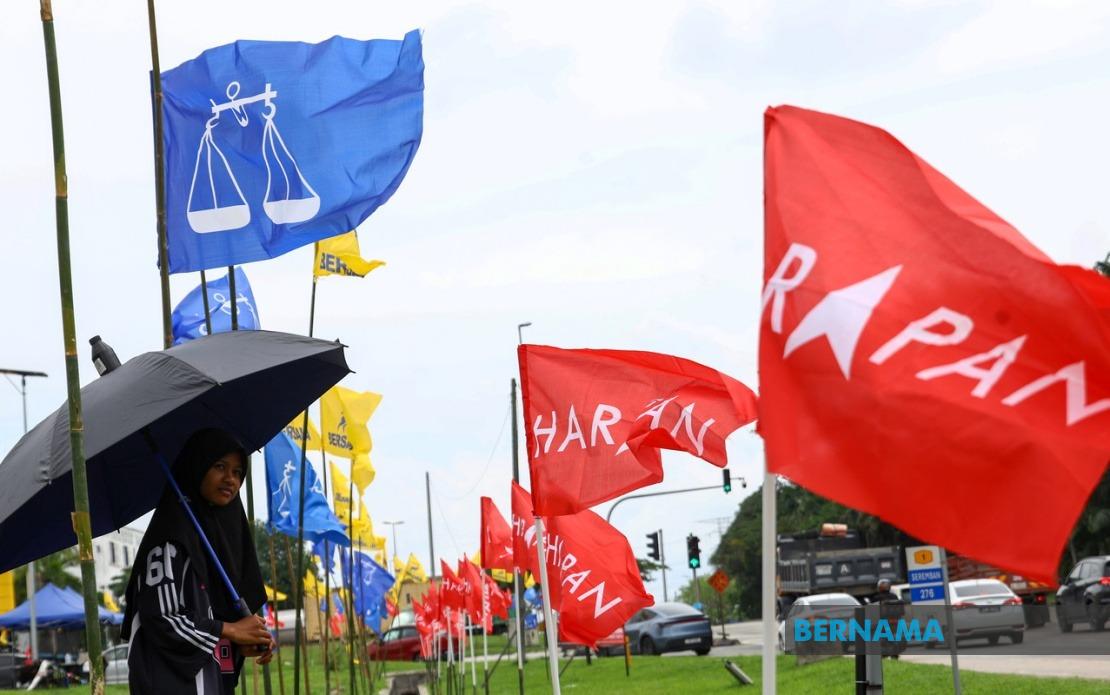
The 16th Johor State Election campaign has crystallized into a battle of contrasting philosophies, with Pakatan Harapan and Barisan Nasional pursuing markedly different paths to victory as polling day approaches on Saturday, July 11. Both coalitions fielded candidates in all 56 contested seats, yet their campaign architecture reveals fundamental disagreements about what voters prioritize and how best to win them over. The contest has exposed deeper shifts in Malaysian electoral behaviour, particularly regarding what resonates with different demographic segments in an increasingly complex political environment.
Pakatan Harapan has anchored its campaign around substantive policy platforms designed to tackle the everyday pressures facing ordinary Johoreans. The coalition's strategy zeroes in on issues that directly shape household wellbeing: managing the rising cost of living, creating pathways for income growth, expanding access to affordable housing, building human capital through education and skills development, and ensuring that economic gains are distributed more equitably across society. This approach reflects a deliberate effort to reframe how development success should be measured. Rather than celebrating investment inflows or gross domestic product expansion, PH argues that Johor's progress must ultimately materialize as concrete improvements in living standards that residents can experience directly. The coalition's manifesto, titled Johor For All, operationalizes this philosophy through an integrated agenda that emphasizes wage competitiveness, translating foreign investment into quality employment, and constructing social safety nets that genuinely protect vulnerable populations.
Universiti Malaya political analyst Dr Mohammad Tawfik Yaakub characterizes PH's strategy as one fundamentally rooted in persuasion through substantive governance. He observes that the coalition is attempting to shift voter consciousness away from macro-economic indicators toward micro-economic realities. The underlying logic is straightforward: citizens care less about whether multinationals are setting up factories in their state and more about whether those operations generate decent wages, whether landlords are being constrained from pricing out ordinary families, and whether young people can build careers without leaving the state. This pivot represents a recognition that two decades of development initiatives emphasizing foreign direct investment have not always translated into broadly shared prosperity, particularly for wage earners and young families navigating Malaysia's intensifying cost-of-living pressures.
Barisan Nasional, by contrast, has adopted a fundamentally different strategic calculus centered on leadership visibility and party organizational depth. The coalition has aggressively mobilized the return of two prominent UMNO figures through the 'Rumah Bangsa' initiative that brought former party vice-president Datuk Seri Hishammuddin Tun Hussein and ex-Youth chief Khairy Jamaluddin back into active politics. This decision signals BN's belief that restoring familiar faces to campaign platforms can rekindle enthusiasm among disillusioned party loyalists and signal to uncertain voters that the coalition's leadership bench has been replenished with credible, experienced figures. The strategy recognizes that for segments of the electorate who abandoned UMNO or BN in recent years, seeing prominent figures return to prominent roles may function as a reassurance that the coalition has course-corrected and is worthy of reconsideration.
Hishammuddin's prominence in particular is thought to carry significant weight in Johor, where his political capital remains substantial. His active participation in the campaign is designed to target UMNO supporters who drifted away during periods when the coalition's standing eroded or when internal party turbulence created uncertainty. By deploying Hishammuddin as a visible advocate, BN aims to communicate stability and continuity while simultaneously signaling that the party remains controlled by figures whom existing supporters recognize and trust. For this demographic, the personal credibility of the messenger may matter more than the specific policy content being conveyed.
Khairy Jamaluddin's deployment serves a different but complementary purpose within BN's overall strategy. Ilham Centre researcher Assoc Prof Dr Mohd Yusry Ibrahim notes that Khairy has maintained consistent appeal among younger voters, a segment that has historically proven difficult for BN to mobilize effectively. Young Malaysians increasingly exhibit fluid voting patterns, demonstrating weak partisan loyalty compared to their parents' generation. Instead, this demographic responds more strongly to individual political personalities they recognize, follow through social media, and feel personally connected to, even across ideological lines. Khairy represents one of the few UMNO figures who has sustained positive resonance with voters under 40, making his return to campaigning a calculated attempt to reverse BN's weakness among youth. His presence at campaign events functions less as a policy signal and more as a celebrity endorsement designed to draw younger voters to campaign rallies and create the impression that supporting BN does not require abandoning contemporary sensibilities or supporting hidebound traditionalism.
Dr Tawfik's assessment suggests, however, that the political landscape has matured in ways that complicate BN's celebrity-dependent strategy. Voters today, he argues, have become more discerning consumers of political messaging. They do not simply absorb whatever candidates and leaders communicate; instead, they evaluate holistically whether parties offer clear policy platforms, whether candidates possess genuine credibility and local rootedness, and whether party positions meaningfully address their specific concerns. The mere presence of a famous politician at a ceramah, however popular that figure might be, no longer automatically sways voters if the coalition cannot articulate why its policies would improve their lives. This evolution in voter sophistication suggests that BN's strategy of leveraging returning leaders must be accompanied by substantive policy messaging to achieve maximum effect.
The generational dimension of voting behaviour deserves particular attention for understanding Johor's political future. As Mohd Yusry emphasizes, younger voters operate according to different decision-making logics than older cohorts. They lack the party loyalty forged through decades of exposure to single-party dominance. They navigate a multiplicity of political parties and candidates through digital platforms rather than traditional community structures. They demand that political figures demonstrate contemporary relevance and authentic engagement with issues affecting their generation—precarious employment, education costs, digital-era opportunities and risks. For BN, reaching this cohort requires not simply deploying popular figures but ensuring those figures articulate visions of governance that young people find compelling. Khairy's presence matters, but only if it is accompanied by policy offerings that young voters perceive as genuinely addressing their circumstances.
The Johor contest encompasses 172 candidates competing for 56 seats, with early voting scheduled for July 7 preceding the Saturday, July 11 general poll. The election will test empirically which coalition's strategic assumptions prove more aligned with current voter preferences. A victory anchored in PH's policy-focused approach would suggest that Malaysian voters have become sufficiently sophisticated and economically pressured that substantive governance platforms matter more than traditional appeals to party loyalty or leadership personality. Conversely, a BN victory leveraging Hishammuddin and Khairy would indicate that personal credibility and organizational depth remain formidable political assets, particularly when deployed to reclaim space the coalition had surrendered.
For Malaysian and regional observers, Johor's result carries implications beyond the state itself. The campaign has illustrated how major political coalitions are adapting to evolving electoral dynamics, shifting away from purely personality-driven campaigns toward more policy-intensive platforms while simultaneously recognizing that leadership appeal remains consequential. The outcome will likely inform how both coalitions approach future contests in other states, making Johor's strategic experiments particularly instructive for understanding Malaysian politics in an era of volatile voter preferences and weakening traditional loyalties.

