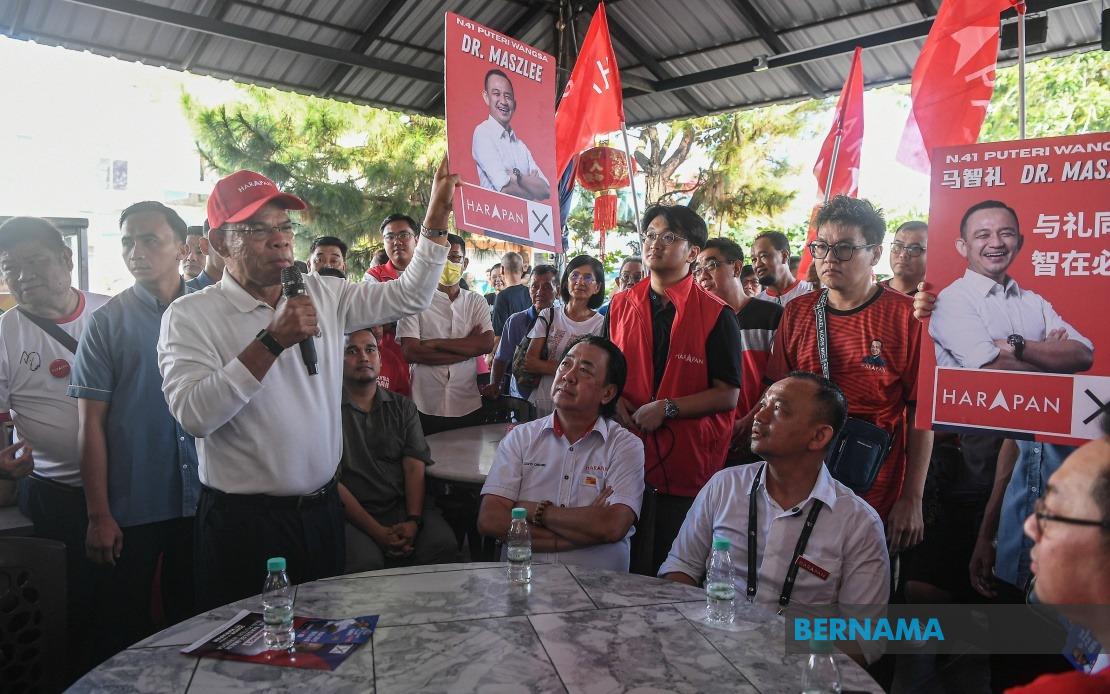
Pakatan Harapan's growing momentum in the Johor state election campaign reflects a carefully calibrated approach to resource allocation and messaging, according to the coalition's top strategists. Datuk Seri Saifuddin Nasution Ismail, PH secretary-general and PKR's joint election director, outlined how the coalition has structured its campaign to capitalise on emerging voter sentiment across the state's 56 contested seats. Speaking after engaging with the Chinese community in Johor Bahru, Saifuddin Nasution suggested that the coalition's expanding support base stems from both internal strategic choices and external political developments that have advantaged PH's position heading into polling day.
The cornerstone of PH's campaign methodology involves a nuanced classification system applied across all state constituencies. Rather than adopting a one-size-fits-all approach, the coalition has evaluated each of the 56 seats according to internal priority assessments based on current ground sentiment and demographic characteristics. Saifuddin Nasution explained that constituencies receive different "grades" or ratings to reflect their varying political profiles, voter concerns, and organisational challenges. This granular approach enables the coalition to deploy campaign resources more efficiently, concentrating efforts where they are most likely to yield electoral gains while maintaining a presence in challenging strongholds.
The distinction between different seat categories proved crucial to PH's tactical framework. Saifuddin Nasution illustrated the principle by noting that urban constituencies such as Puteri Wangsa present entirely different campaign requirements compared to traditional seats like Johor Lama, just as Larkin's demographics and voter priorities diverge significantly from the rural Endau constituency. By clustering constituencies into distinct priority tiers, PH has created a system that acknowledges these variations and enables targeted messaging tailored to local concerns rather than broadcasting generic appeals across the entire state. This methodology reflects broader lessons learned from recent Malaysian elections, where ground-level sophistication in campaign execution has become increasingly decisive.
Beyond internal campaign mechanics, PH has benefited substantially from strategic missteps by opposition parties, particularly within the Islamist coalition. Saifuddin Nasution identified PAS's decision to contest only 11 of the 56 seats while explicitly urging their supporters to back Barisan Nasional candidates elsewhere as a significant factor that has redirected voter sentiment toward PH. By fractionalising the opposition vote and creating confusion about their own electoral commitment, PAS inadvertently clarified the choice before voters: a divided opposition with competing agendas, or a unified coalition offering comprehensive governance. This dynamic has proven especially consequential in constituencies where PAS previously held substantial support, as voters confronted with the party's reduced candidacy have reconsidered their political allegiances.
In contrast, PH has emphasised transparency and inclusivity in its seat distribution and campaign promises. Saifuddin Nasution characterised the coalition's approach as fundamentally more forthright than competitors, citing clear public announcements about seat allocations among the three component parties and a manifesto presented as realistic and implementable rather than aspirational. This positioning carries particular weight in Johor, a state where economic concerns predominate and voters have grown wary of unfulfilled campaign pledges. The coalition is fielding candidates across all 56 seats through an equitable distribution of nominations: PKR contesting 20 seats, Amanah 19, and DAP 17. This complete coverage sends a symbolic message that PH seeks a genuine mandate to govern the entire state rather than settling for selective representation.
The presence of former UMNO Supreme Council member Datuk Dr Mohd Puad Zarkashi at recent public forums alongside Prime Minister Datuk Seri Anwar Ibrahim has further amplified PH's campaign narrative. Saifuddin Nasution characterised Zarkashi's participation in community engagement sessions at Felda Ulu Tiram as adding substantial value to PH's broader momentum and signalling the coalition's appeal across traditional UMNO constituencies. The symbolic weight of senior UMNO figures endorsing the PH-led government carries particular significance in rural and Felda-based constituencies where UMNO has traditionally exercised strong influence. Such crossovers represent not merely individual defections but rather public validations of PH's governance competence and inclusive political vision.
The coalition has also invested considerable attention in candidate quality and representation. Saifuddin Nasution highlighted Dr Maszlee Malik, the PH candidate contesting the Puteri Wangsa constituency, as exemplifying the calibre of individuals the coalition is fielding. Maszlee's positioning as both a qualified professional and strategically important asset underscores PH's emphasis on candidate credentials alongside electoral mathematics. The selection of candidates capable of articulating sophisticated policy positions and demonstrating genuine expertise in their respective fields appeals particularly to urban and semi-urban voters concerned with governance substance rather than purely factional considerations.
The competitive landscape for the Johor election reflects the state's continued political volatility following the 2018 general election upheaval and subsequent state government transitions. A total of 172 candidates are contesting the 56 seats, indicating intense competition across multiple constituencies and suggesting that no seat can be taken for granted by any coalition. The concentration of competition means that marginal swings in voter sentiment can produce significant seat-count variations, amplifying the importance of both strategic campaign execution and opposition stumbles. For PH, maintaining organisational discipline while capitalising on opposition vulnerabilities has become essential to translating ground sentiment into legislative majorities.
The timing of the Johor election, scheduled for July 11 with early voting conducted on July 7, compressed the campaign period and elevated the importance of pre-election momentum. Saifuddin Nasution's public articulation of PH's strategic logic served the dual purpose of reassuring party members while signalling to floating voters that the coalition possessed coherent governing vision beyond mere electoral competition. By framing the campaign in terms of systematic planning, transparent allocation, and opposition disarray, PH sought to position itself as the serious governance choice for voters prioritising stability and delivery of campaign promises.
For Malaysian political observers, the Johor contest represents a significant test of coalition cohesion and ground-level campaign competence following the complex federal political adjustments of preceding months. The outcome will provide crucial indicators regarding voter appetite for PH governance in major states, the sustainability of opposition party strategies, and the degree to which traditional UMNO constituencies remain responsive to BN messaging. The state's economic importance and demographic diversity make Johor results particularly consequential for national political trajectories, as state-level electoral outcomes increasingly influence federal political bargaining and coalition stability in Malaysia's evolving multiparty system.

