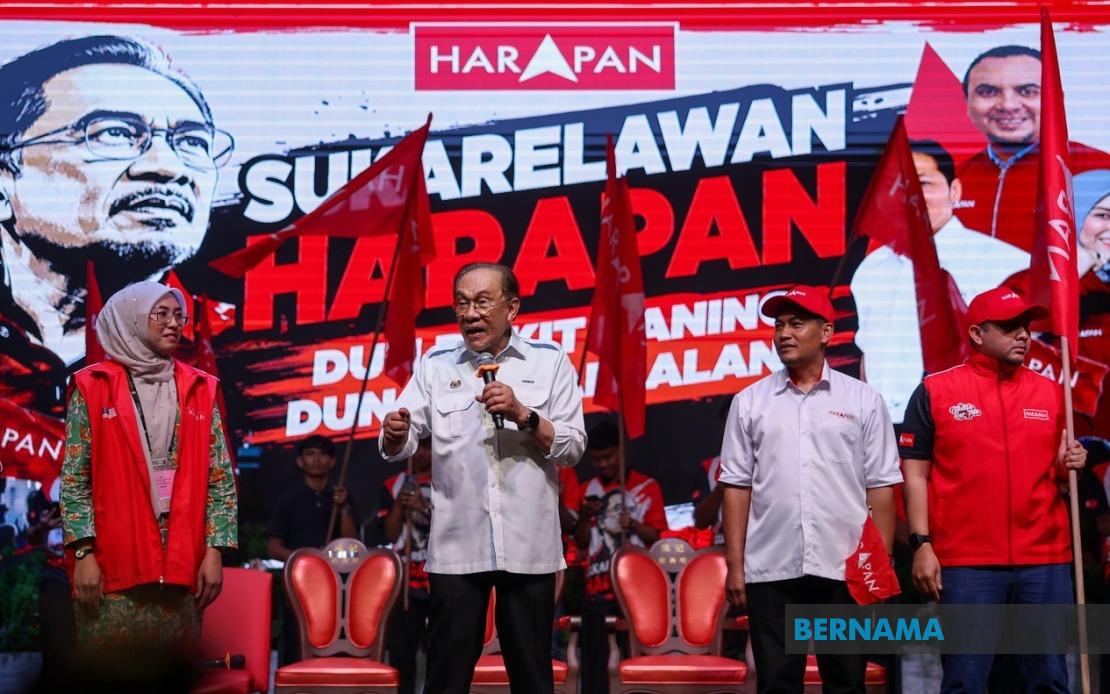
Prime Minister Datuk Seri Anwar Ibrahim has made a direct appeal to young voters in Johor to set aside racial grievances and instead support candidates who demonstrate genuine commitment to addressing the everyday challenges facing ordinary Malaysians. Speaking at the launch of a volunteer campaign for the Bukit Naning state constituency in Muar, Anwar framed the forthcoming state election as a critical opportunity for the younger generation to take control of their political destiny rather than allow themselves to be manipulated by outdated sectarian narratives.
Calling for a fundamental shift in how Malaysians evaluate their political choices, the Pakatan Harapan chairman stressed that voters should judge leaders based on their track record and capacity to deliver tangible improvements in areas directly impacting people's quality of life. Education standards, job creation prospects, and overall state development initiatives should form the basis of electoral decisions, he argued, rather than allowing emotion-driven appeals to ethnic identity or unfounded fears about other communities to dictate voting behaviour. This message represents a strategic repositioning by the ruling coalition ahead of the July 11 polling day, signalling an effort to build a broader, more inclusive political movement beyond traditional communal voting blocs.
Anwar drew attention to what he characterised as deliberate attempts by certain political actors to manufacture divisions within Malaysian society by stoking fears of Chinese citizens, resentment towards Indians, and animosity between ethnic Malay and Chinese communities. He questioned the logic and utility of such divisive tactics, suggesting that while ordinary citizens waste energy quarrelling amongst themselves along ethnic lines, political elites exploit the resulting chaos to consolidate personal wealth and power unchecked. This observation touches on a persistent critique of Malaysian politics: that ethnic polarisation serves as a smokescreen enabling corrupt practices and misgovernance to flourish with minimal public scrutiny or accountability.
Directing his remarks specifically towards young Malay voters alongside their Chinese and Indian counterparts, Anwar implored them to recognise a historic moment requiring decisive collective action. He challenged young Malaysians to reject what he termed the "rotten political system" that has long trapped the nation in cycles of racial animosity and stagnation. The language employed here carries weight within Malaysia's political context, where appeals to generational change and systemic renewal have proven effective in mobilising youth-driven voter coalitions, as evidenced in recent elections where younger demographics showed higher propensity to cross traditional ethnic and party lines.
The Prime Minister expressed considerable satisfaction at witnessing the substantial participation of young people at the Bukit Naning volunteer programme launch, interpreting their presence as confirmation of shifting political consciousness among Malaysia's younger generation. Drawing on his extensive experience across more than a decade of electoral campaigns, Anwar declared the turnout exceptional and symbolic of a momentous historical juncture. He positioned the youth engagement as evidence of increasingly sophisticated political awareness, suggesting that younger voters are beginning to see through populist rhetoric and are prioritising substantive policy positions over sectarian appeals.
Anwar encouraged assembled volunteers to undertake grassroots mobilisation efforts extending across villages, residential areas, and districts throughout Johor, armed with a clear message that meaningful political change remains achievable through coordinated collective action. He stressed that realising this transformative agenda demands exhaustive effort from party activists and sympathisers, urging them to maximise the electoral opportunity presented by the Johor state polls. This call for intensive ground-level campaigning reflects the Pakatan Harapan coalition's strategic focus on direct voter engagement, a tactic particularly effective in converting youth voters who increasingly prefer authentic community interaction to traditional media-dominated campaign formats.
The Johor state election represents a significant electoral contest, with 172 candidates competing across 56 state seats. Voting will occur on July 11, with early voting scheduled for July 7, giving the electorate multiple opportunities to participate. The election carries implications extending beyond state-level governance, as results will provide crucial indicators of broader voter sentiment regarding the Anwar-led federal administration's performance and the viability of the Pakatan Harapan coalition's political strategy moving forward into future national elections.
Anwar articulated a forceful critique of what he characterised as poisonous political narratives circulating within Malaysian public discourse, labelling such rhetoric as fundamentally incompatible with national unity and stability. He emphasised that messaging designed to discourage Malaysians from befriending those of different ethnic backgrounds, fostering hatred towards specific communities, or breeding distrust across ethnic lines represents outdated thinking that belonged to a previous era of Malaysian politics. Such narratives, he suggested, originated from an older generation of political operators whose influence should be declining as Malaysian society matured and younger, more cosmopolitan voters gained electoral power.
Underscoring Malaysia's pluralistic composition and the peaceful coexistence that communities have maintained despite periodic tensions, Anwar expressed optimism grounded in observation of the country's actual lived reality. He highlighted the demonstrated capacity of Malays, Chinese, Indians, and Orang Asli to cohabitate with mutual respect and reciprocal care, suggesting that this foundation exists upon which to build even more cohesive national structures. His particular optimism regarding the younger generation reflected confidence that coming cohorts of voters would prove less susceptible to ethnic polarisation strategies and more committed to inclusive, development-focused governance models.
The Prime Minister concluded his remarks by challenging young Malaysians to transcend passive bystander status and instead embrace active responsibility for constructing a more inclusive national future. He framed youth political engagement not merely as voting activity but as fundamental democratic participation requiring courage and commitment to progressive values. This framing transforms electoral participation from a discrete event into a broader commitment to ongoing civic engagement and democratic renewal, appealing particularly to younger voters who increasingly view politics as inseparable from questions of social justice, environmental sustainability, and generational equity.
The Johor election thus acquires significance beyond its immediate state-level implications, functioning as a potential referendum on whether Malaysian voters, particularly younger ones, are prepared to embrace more inclusive political orientations or whether traditional communal voting patterns will reassert themselves. The results will offer important data for political analysts assessing the trajectory of Malaysian democracy and the Anwar administration's ability to consolidate support across diverse constituencies while maintaining its governing coalition's stability.

