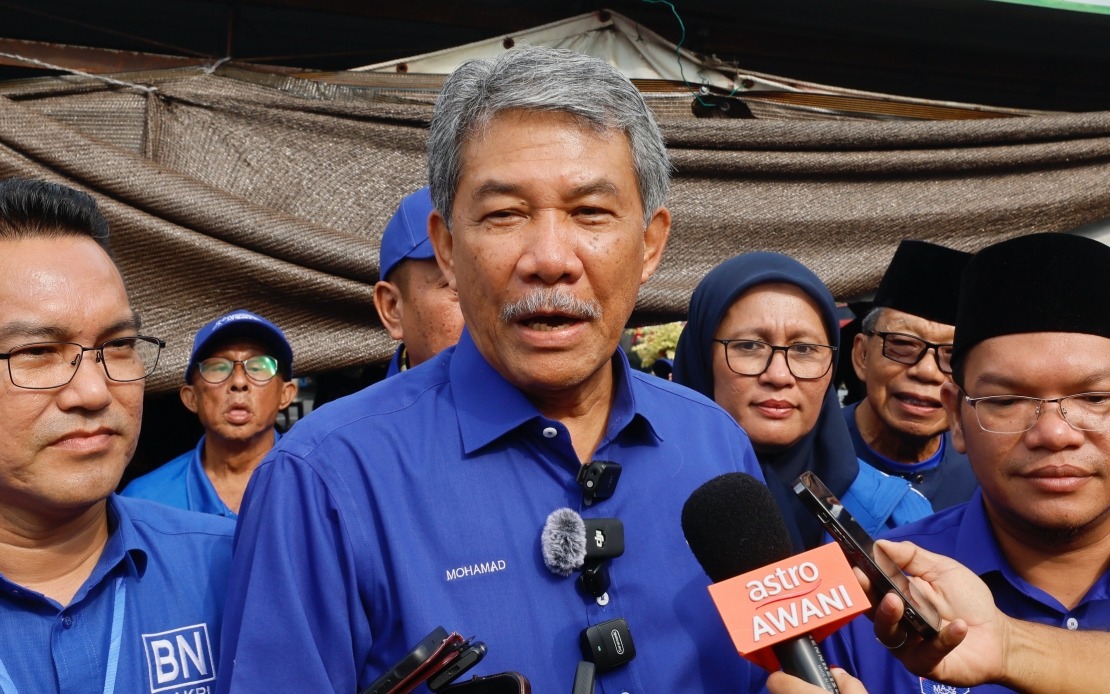
With polling day approaching on July 11, UMNO deputy president Datuk Seri Mohamad Hasan has issued a strong call for Johor's competing political parties to elevate the tenor of their campaigns, emphasising the importance of policy-focused discourse over personality-driven attacks. Speaking during a voter engagement session in the Tiram constituency, the Foreign Minister stressed that while political competition is healthy and expected, the way parties conduct themselves during the election period carries implications beyond the state itself, affecting the broader stability of the nation's governance structures.
Mohamad's intervention reflects growing concerns within the governing coalition about maintaining cohesion at the federal level even as component parties battle for supremacy in the state arena. The Johor state election involves 56 seats with 172 candidates vying for positions in the State Legislative Assembly, but the campaign has become a focal point for testing political dynamics within Malaysia's Unity Government arrangement. His message that parties remain "free to present their policies and offers to the people" establishes the legitimate boundaries of electoral competition while simultaneously drawing a firm line against tactics that could undermine the delicate balance of federal governance.
The nuance in Mohamad's position lies in his recognition that state and federal politics operate on different planes. He acknowledged that friendly ribbing between political opponents is inevitable and ultimately harmless, but cautioned against crossing into deeply personal territory that could fracture working relationships essential for running the country at the national level. This distinction matters significantly for Malaysia's political landscape, where state governments and the federal administration often comprise overlapping personnel and coalition structures. A campaign that descends into personal acrimony could poison interactions that officials must maintain across multiple governance levels.
The timing of Mohamad's remarks also addresses a persistent narrative circulating in political circles linking the Johor election to efforts to secure a pardon for former Prime Minister Datuk Seri Najib Tun Razak, who faces ongoing legal proceedings. By explicitly rejecting this characterisation, the UMNO leader attempted to reframe the election as a straightforward exercise in state-level democracy rather than a calculated move serving other political objectives. He pointed out the logical impossibility of such a connection: a state Menteri Besar possesses no authority to grant pardons, which fall exclusively within the purview of the Federal Government and ultimately rest as the absolute prerogative of the Yang di-Pertuan Agong.
This clarification carries particular weight given Malaysia's constitutional framework and the sensitive position of the monarchy within it. By emphasising the Yang di-Pertuan Agong's singular authority over pardons, Mohamad implicitly warned against any attempt to use the state election results as leverage for pressuring federal action on matters that are constitutionally and politically separate. The statement reinforces Malaysia's commitment to the rule of law and institutional boundaries, principles that have become increasingly important in maintaining public confidence in governance structures.
Mohamad's invocation of legal supremacy—"Malaysia is a country anchored on the supremacy of the law and UMNO always respects this principle"—serves multiple functions within his argument. It positions his party as a guardian of constitutional propriety while simultaneously suggesting that any deviation from this principle would violate fundamental national commitments. For regional observers, this framing underscores how Malaysian politics, despite its competitive intensity, remains tethered to institutional constraints that prevent the complete instrumentalisation of elections for purposes beyond their constitutional remit.
The Foreign Minister's emphasis on preserving cooperative relations within the Unity Government reflects the practical challenges of Malaysia's current political arrangement. Unlike previous administrations where one coalition dominated comprehensively, the present structure requires ongoing negotiation and compromise among diverse parties holding significant leverage. An election campaign that becomes too corrosive in tone or too personally damaging could complicate future coalition management, making Mohamad's call for prudence not merely an appeal to civility but a defence of the operational foundation for federal governance.
From a Malaysian and Southeast Asian perspective, the Johor election carries broader significance beyond state boundaries. As one of Malaysia's most economically dynamic and politically influential states, Johor's electoral outcome will reverberate through national political calculations. The composition of its state government will affect not only local policymaking but also the balance of power within federal coalitions and potentially influence decisions on matters ranging from economic policy to infrastructure development affecting the broader region.
The early voting scheduled before polling day, combined with the substantial number of candidates and constituencies, indicates a high-stakes electoral exercise anticipated to generate significant turnout and interest. Managing such a contest while maintaining federal stability requires the kind of discipline and institutional awareness that Mohamad advocated. His message essentially asks political actors to compartmentalise their competition—vigorous in the state arena but bounded by respect for national governance imperatives.
Mohamad's position also reflects calculations about UMNO's own interests. As the largest component of the ruling coalition at federal level and a major player in Johor politics, UMNO benefits from an environment where state and federal politics do not completely collapse into each other. Compartmentalisation allows the party to compete fiercely at the state level while preserving the coalition relationships essential for controlling the Federal Government, a balancing act that requires both sides to exercise restraint.
The broader implication of his remarks concerns how Malaysian democracy navigates the tension between competitive politics and cooperative governance. The challenge becomes particularly acute in federal systems where multiple levels of government operate simultaneously with overlapping personnel and coalition structures. Mohamad's intervention suggests that political maturity in Malaysia increasingly means developing the capacity to compete strenuously in one arena while maintaining professional and institutional relationships across others—a delicate equilibrium that neither comes naturally nor persists without active management from experienced political hands.

