The Johor state election has become embroiled in controversy over allegations that a vocational training event was repurposed for political canvassing, with opposition parties demanding accountability from the ruling administration. Johor DAP chairman Teo Nie Ching on July 7 challenged Menteri Besar Datuk Onn Hafiz Ghazi to provide a public explanation regarding complaints that students and parents were compelled to attend a Johor MARA TVET Roadshow held at the Inland Revenue Board Hall in Kluang on July 4, only to find themselves exposed to campaign messaging for the Barisan Nasional candidate.
The controversy centres on the blurred boundaries between government service delivery and partisan politics. According to Teo, who holds the position of Deputy Communications Minister, multiple parents and students lodged grievances indicating they had received directives to participate in the vocational education programme, with warnings that non-attendance would be recorded as absenteeism. What distinguishes this from routine government programming, according to the DAP leadership, is the allegation that the occasion was subsequently converted into a platform for political recruitment, with Onn Hafiz purportedly using the gathering to advocate for the BN candidate by publicly naming the candidate's election number.
The core objection raised by Teo articulates a fundamental principle about the separation of government functions from electoral activities. She emphasised that her party harbours no inherent opposition to the Menteri Besar participating in official government events, but rather disputes the alleged conversion of such an event into a campaigning platform. The critical question Teo posed concerns institutional responsibility: if the gathering was genuinely a government programme, it ought not to have been weaponised for political purposes. Conversely, if the event was fundamentally a party activity, the propriety of utilising a government facility for such partisan purposes becomes deeply questionable and potentially violates electoral protocols.
To substantiate their concerns, the DAP claims to possess documentary and audiovisual corroboration. They reference possession of the official programme schedule, written correspondence demanding mandatory attendance, and video footage purportedly capturing campaign-focused statements. These materials, the party suggests, provide concrete evidence rather than mere anecdotal complaints, lending credibility to their assertion that an improper intermingling of government and electoral activities occurred.
Teo reframed the controversy through the lens of parental concern, emphasising that this issue transcends partisan bickering and touches upon the rights of young citizens. She posed a rhetorical question designed to resonate with broader public sentiment: how would any parent react to learning their child was compelled to attend an official government function that subsequently transformed into a vehicle for political recruitment? This framing shifts the debate away from abstract procedural questions toward emotional and ethical dimensions likely to resonate with voters.
Regarding potential responses, Teo indicated that the decision to escalate matters formally rests with Pakatan Harapan candidates, including lodging official complaints with the Election Commission. This measured approach suggests the opposition is prepared to pursue institutional remedies rather than engage in public recriminations, though the continued assertion of the allegations maintains political pressure on the BN administration.
Simultaneously, Teo broadened her critique to encompass the broader political strategy deployed by the state government. She responded to Onn Hafiz's recent calls for federal policy reviews by contending that the Menteri Besar inconsistently attributes credit for successful initiatives to state-level administration while deflecting blame for unpopular measures toward federal leadership, DAP, or PKR. She underscored that major policy determinations undergo Cabinet-level approval processes, thereby distributing responsibility across the federal administrative structure rather than residing solely within state purview.
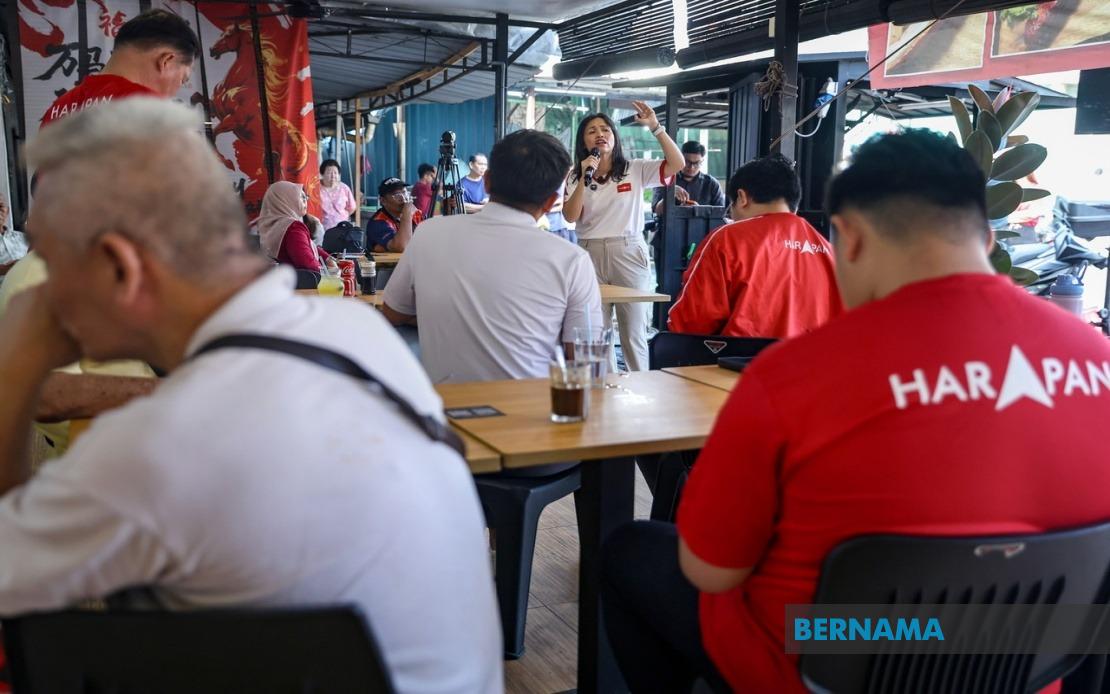
Tan Sri Lim Kit Siang, the veteran DAP strategist accompanying Teo at the forum in Kulai, transcended the immediate controversy to articulate a broader political vision. He exhorted voters to repudiate what he characterised as racially divisive politics and instead consolidate support behind what he termed the Malaysian Dream—a political project anchored in principles of equality, inclusive freedom, economic prosperity, and institutional respect for human rights protections. Lim acknowledged that constructing a genuinely unified Malaysia constitutes a multiyear undertaking that cannot be accelerated through electoral cycles alone, appealing instead for voters to maintain cohesive support rather than fragment their ballots across competing platforms.
The Johor state election represents a significant political competition within Malaysia's electoral calendar. The ballot encompasses 56 legislative assembly seats contested by 172 candidates, indicating competitive races across most constituencies. The election timeline had already commenced, with early voting occurring on July 7 and the main polling event scheduled for July 11, meaning the campaign allegations emerged during the final campaign period.
For Malaysian voters and observers, this controversy illuminates persistent tensions within contemporary electoral politics regarding institutional impartiality. The allegations, if substantiated, would suggest that government resources and facilities are being leveraged to provide incumbent parties with unfair electoral advantages. Such practices, whether actual or perceived, undermine democratic principles that theoretically insulate government machinery from partisan weaponisation. The incident also underscores how Malaysian politics increasingly involves disputes over administrative propriety and institutional neutrality rather than solely policy disagreements.
The controversy carries particular significance within Johor's political landscape, where BN has traditionally maintained dominance. Any suggestion that the ruling coalition relies upon administrative coercion to mobilise electoral support potentially signals vulnerability or overconfidence. Conversely, the opposition's willingness to publicise such allegations demonstrates their capacity to challenge incumbent narratives and frame elections around governance ethics rather than development performance. For voters evaluating their electoral choices, the incident contributes to broader assessments of administrative integrity and the degree to which state institutions operate independently of partisan interests.

