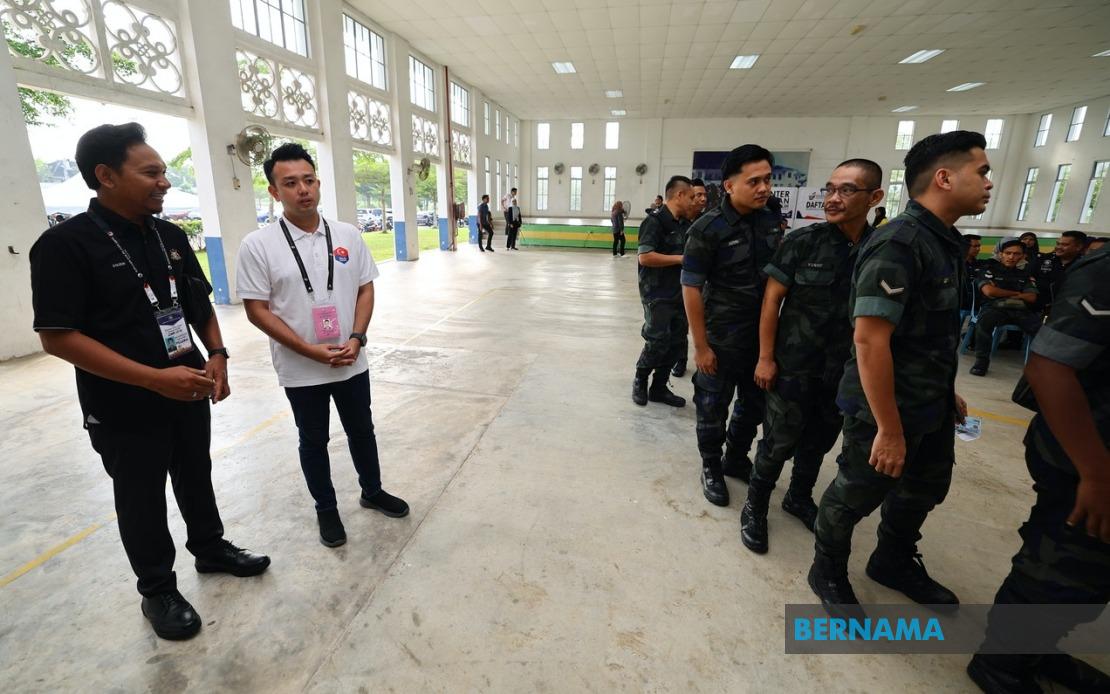
With the Johor state election set for this Saturday, candidates competing for seats in the 56-seat State Legislative Assembly made time in their campaigns on Thursday to witness the early voting process at various polling centres designated for members of the security forces and their spouses. The move reflects the importance all three major political coalitions—Pakatan Harapan, Barisan Nasional and Perikatan Nasional—place on monitoring electoral integrity and engaging with the voting process at grassroots level.
Representatives from the three main coalitions were conspicuously present at multiple voting venues across the state. At the 5th Battalion General Operations Force Camp in Simpang Renggam, all three candidates competing for the Layang-Layang seat turned out to observe proceedings: Guna Balakrishnan from Pakatan Harapan, Chua Jian Boon representing Barisan Nasional, and Abd Mutalip Abd Rahim of Perikatan Nasional. This same pattern of three-way representation occurred in other constituencies as well, indicating the contested nature of the 16th Johor State Election and the genuine competition across the state.
The Tenggaroh seat, situated in Mersing, also attracted candidate observers from all three coalitions. Muhamad Amerul Muhamad from Perikatan Nasional, Mohd Youzaimi Yusof from Barisan Nasional, and Md Yusof Dawam from Pakatan Harapan each visited the Iskandar Camp early voting centre to monitor the process. Beyond these constituencies, individual candidates from different parties were scattered across other polling venues, such as Lim Chin Eng of Perikatan Nasional at Johor Contingent Police Headquarters, Muhammad Faezuddin Mohd Puad of Pakatan Harapan at Kempas Police Station, and Datuk Jafni Md Shukor of Barisan Nasional at Kulai District Police Headquarters. Notably, Lim Chin Eng holds the distinction of being the oldest candidate in this election cycle.
Beyond the political representatives, senior military and security officials also made appearances at the early voting centres, underscoring the significance of the process. Army Chief General Tan Sri Azhan Md Othman visited Iskandar Camp in Mersing alongside Major General Datuk Ahmad Shuhaimi Mat Wajab, commander of the 21st Special Service Group. Additionally, Johor police chief Datuk Ab Rahaman Arsad cast his own ballot at Dewan Dato Onn at the Johor IPK, participating in the democratic process he was helping to oversee.
The early voting mechanism itself operated with considerable efficiency despite challenging weather conditions. Bernama's on-ground observations confirmed that security personnel and their spouses approached the voting process in an orderly fashion, respecting the protocols established by Election Commission officials from the moment centres opened at 8 am. Although several locations experienced brief rainfall, this did not impede the steady flow of voters moving through the designated centres in staggered groups throughout the day.
The scale of early voting participation reflected the substantial portion of the electoral base represented by security forces in Malaysia. A total of 20,607 voters were registered for early voting purposes, comprising two distinct groups: 8,544 members of the Malaysian Armed Forces together with their spouses, and 12,063 police personnel along with their spouses. This combined figure represents a significant voting bloc that the Election Commission has long granted special provisions to accommodate, given the operational demands that may prevent their participation on the main polling day.
To facilitate this expanded voting window, the Election Commission opened 64 distinct early voting centres across Johor, with operations commencing at 8 am and concluding in phases between noon and 6 pm depending on location-specific factors and voter registration numbers. This staggered closure approach reflected careful electoral planning to accommodate varying operational schedules across different security agencies and geographic areas within the state.
The broader electoral context involves a substantial candidate field competing for representation. In total, 172 candidates are contesting the 56 available seats in the Johor State Legislative Assembly, indicating an average of more than three candidates per constituency. This competitive landscape explains the visible presence of multiple candidate representatives at the early voting centres—each campaign sought visibility and assurance of fair processes affecting a critical voter segment.
For Malaysian and Southeast Asian observers, the conduct of early voting in Johor demonstrates the procedural maturity of the nation's electoral system in managing specialised voting scenarios. The involvement of candidates from opposing coalitions in observing the same process reflects an underlying consensus around electoral mechanics, even amid intense political competition. This institutional strength in maintaining transparent voting procedures, despite partisan differences, has long distinguished Malaysia's electoral framework within the broader regional context.
The Johor state election itself carries significance beyond the state boundaries, as Johor remains one of Malaysia's largest and most economically developed states. The electoral outcome may provide insights into broader voter sentiment heading into potential national-level contests, making the procedural integrity of this ballot particularly noteworthy for political analysts. The visible engagement of candidates and security officials in witnessing early voting processes serves as a public signal of commitment to democratic principles and fair electoral conduct throughout the campaign and voting period.

