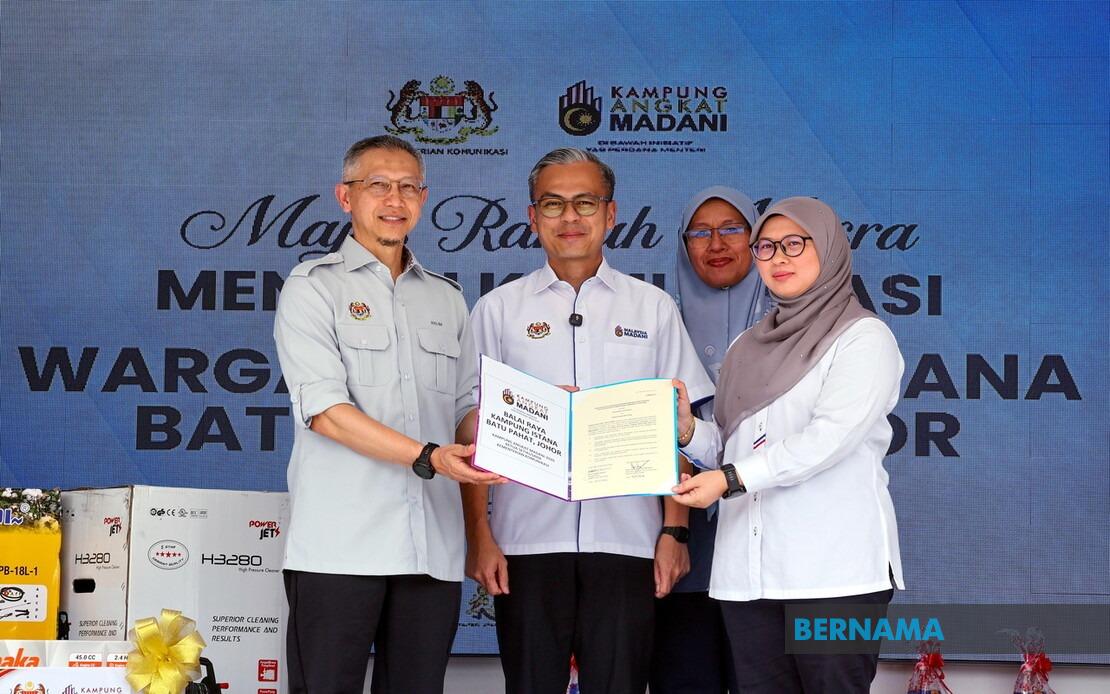
The Johor state election campaign entered a critical phase as Pakatan Harapan sought to reframe the electoral narrative away from personalities and towards substantive governance. Speaking at Kampung Istana in Batu Pahat, Communications Minister Datuk Fahmi Fadzil rejected suggestions that a Barisan Nasional victory would constitute public endorsement of former Prime Minister Datuk Seri Najib Razak's potential pardon. His remarks came in direct response to comments by Datuk Nazifuddin Mohd Najib, who had framed a BN triumph as a mandate to grant his father a presidential reprieve. For Malaysian observers, this exchange illustrated the competing interpretations of electoral mandates that have long characterised the nation's political discourse.
Fahmi's intervention highlighted a growing tension within Malaysian politics regarding the separation of individual personalities from institutional mandates. The Communications Minister contended that voters casting their ballots should be driven by considerations of statewide development, economic management, and service delivery rather than sentiment towards particular figures. His position reflected Pakatan Harapan's broader strategic objective of shifting public focus from personalities towards policy performance. The framing carried particular significance for Johor, a state that has undergone substantial demographic and economic changes in recent years, with voters increasingly diverse in their political preferences and less inclined towards traditional loyalties.
Central to Fahmi's argument was the proposition that no political party should regard public support as permanent or owed by any demographic group. He specifically addressed concerns about the Democratic Action Party's traditional support base, acknowledging that non-Malay voters increasingly made independent electoral calculations rather than voting reflexively for any single party. This acknowledgment represented a significant departure from conventional Malaysian political discourse, which has long treated certain communities as reliable voting blocs. By asserting that support must be earned continuously rather than assumed, Fahmi implicitly conceded that the political landscape had become more fluid and unpredictable than previous patterns suggested.
The Communications Minister pointed to several defections or cross-partisan endorsements as evidence of Pakatan Harapan's expanding appeal. Former Rengit assemblyman Datuk Dr Mohd Puad Zarkashi's public backing of the PH candidate represented a particularly notable breach in the United Malays National Organisation's traditionally dominant position in Johor. Fahmi interpreted such developments as indicators that the state's Malay-Muslim electorate, long considered Barisan Nasional's safest reservoir of support, was now willing to consider alternatives. The significance of such individual switches lay not merely in their electoral mathematics but in their symbolic implications for the viability of opposition politics in Malaysia's most strategically important states.
Fahmi also highlighted support from Bersatu members for Pakatan Harapan candidates in constituencies such as Sri Medan and Rengit. These endorsements suggested that even within the fractious coalition politics of the Perikatan Nasional alliance, individual leaders and activists remained willing to cross party lines when presented with compelling alternatives. The minister framed such switches as confirmation that Prime Minister Anwar Ibrahim's leadership was generating sufficient confidence to overcome longstanding partisan divisions. For Malaysian political observers, these developments indicated that the traditional architecture of coalition politics—where loyalty to party machinery typically overrode individual judgement—was beginning to erode under pressure from electoral volatility and demographic change.
The underlying argument presented by Fahmi rested on a compelling but contested premise: that voters, when presented with clear information and alternatives, would prioritise state development and institutional competence over personal attachments or dynastic considerations. This assumption underpinned his critique of attempts to leverage an election result as a mandate for presidential action regarding any individual's legal status. Such framing positioned Johor voters as rational actors capable of distinguishing between electoral expression of democratic will and collateral benefits accruing to particular figures. Whether Malaysian voters genuinely perceived elections in such terms remained an open question, as political behaviour typically reflected complex mixtures of policy preference, personality affinity, patronage networks, and community identity.
The timing of Fahmi's remarks deserved scrutiny, arriving at a moment when Barisan Nasional appeared to enjoy structural advantages in the Johor contest. The ruling coalition retained command of vast bureaucratic and financial resources, traditional networks of local leadership, and the presumption of incumbency that benefited most sitting governments in Malaysia. By emphasising that any BN victory should not be misinterpreted as a personal mandate, Fahmi attempted to establish an intellectual framework that would constrain how Barisan and its allies might subsequently deploy whatever electoral authority they secured. This represented a form of pre-emptive argument designed to shape post-election political discourse regardless of the actual result.
For Southeast Asian context, Johor's electoral dynamics reflected patterns visible across the region where traditional patronage networks faced pressure from rising education levels, internet connectivity, and younger voters' diminished attachment to party machinery. The state's status as Malaysia's second-largest economic centre, coupled with its proximity to Singapore and importance to regional supply chains, meant that governance quality directly affected regional competitiveness. Fahmi's emphasis on future-oriented governance rather than personality-driven politics aligned with broader regional trends toward technocratic legitimacy and institutional accountability.
The 56-seat contest scheduled for July 11 represented the first significant electoral test of Anwar Ibrahim's administration's domestic standing independent of federal institutional advantages. With polling day approaching and 172 candidates competing across the state, the campaign had intensified substantially. Early voting scheduled for July 7 would provide initial indicators of voter enthusiasm and turnout patterns, offering clues about the electorate's receptiveness to competing narratives about the election's fundamental meaning. The outcome would largely determine whether Fahmi's assertion that elections concern states' futures rather than individuals' fortunes would prove politically prescient or merely aspirational rhetoric.

