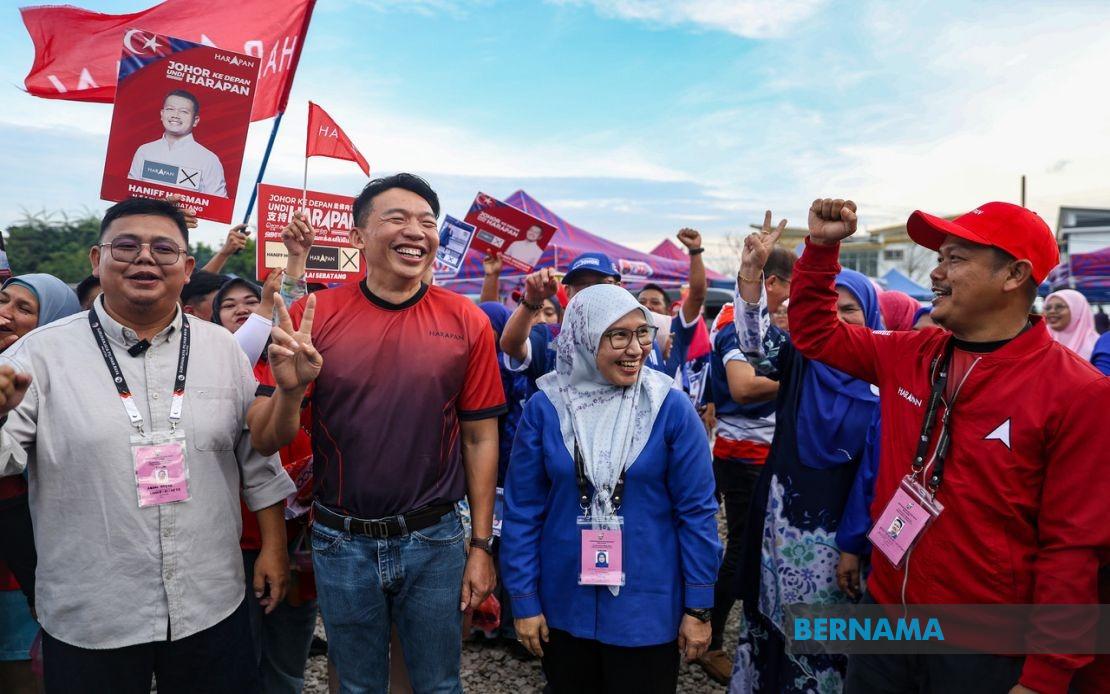
The Johor state election campaign took on a notably civilised tone this week when candidates from rival political coalitions crossed paths at the Taman Megah night market in Pontian, demonstrating that electoral competition need not preclude personal courtesy or mutual respect. The encounter brought together three Pakatan Harapan representatives—Haniff @ Ghazali Hosman contesting Pulai Sebatang, Abd Razak Ismail standing in Benut, and Cheah Chee Hong running in Kukup—who were conducting a joint campaign walkabout when they encountered Barisan Nasional's Hasrunizah Hassan, the opposing candidate for Pulai Sebatang. The moment, which could have felt tense as the teams carrying their respective red and blue campaign flags converged at a market junction, instead unfolded as a straightforward and friendly greeting, drawing the notice of shoppers who paused in their evening browsing to observe the exchange before the candidates resumed engaging with traders and visitors.
When speaking to assembled journalists following the encounter, Haniff characterised the meeting as emblematic of how Malaysia's political system functions at its best. He underscored that the campaign environment in Pontian has remained peaceful and orderly, with candidates from different parties competing vigorously yet respectfully for voter support. Such interactions, he suggested, represent the natural workings of a mature democracy where political opponents can acknowledge one another as fellow citizens and competitors rather than adversaries to be avoided. His remarks reflected a perspective increasingly common among younger and more progressive politicians across Malaysia's political spectrum, who view healthy political competition as compatible with personal civility.
Cheah, representing the PH campaign in the Kukup constituency, expressed satisfaction at being able to campaign alongside his coalition partners and took the opportunity to encourage voters in the three contested seats to continue supporting Pakatan Harapan in the upcoming election. His statement emphasised the importance of coalition unity while implicitly suggesting that the friendly nature of the encounter with BN candidates reflected confidence in his side's message and campaign performance.
From the Barisan Nasional perspective, Hasrunizah normalised such meetings between candidates from opposing parties, viewing them as routine aspects of the contemporary Malaysian electoral process. She argued that these encounters actually underscore the maturity that Johor's political culture has achieved, where intense campaigning can coexist with personal civility and the absence of hostility. Despite characterising the campaign period as increasingly heated—a natural feature of competitive elections—Hasrunizah expressed confidence that Johor remained stable and free from serious incidents or disruptions. She added that such meetings energised BN's campaign efforts for both Barisan Nasional and its associated Maju Johor coalition partner, suggesting that friendly encounters with opponents need not diminish campaigners' determination or organisational zeal.
The July 11 Johor state election represents a significant moment in Malaysian politics, with early voting scheduled for July 7, drawing considerable attention from observers monitoring the state's political trajectory. The peaceful nature of campaigns like that in Pontian contrasts sharply with more fraught electoral contests that have occasionally marked Malaysian political history, and may indicate that voters increasingly value civility in how candidates conduct themselves during campaigns. This development carries implications not only for Johor but for broader Malaysian politics, suggesting that the electorate rewards politicians who demonstrate that they can compete without descending into personal animosity or inflammatory rhetoric.
The night market setting itself—a quintessential feature of Malaysian urban and suburban life—made the encounter particularly symbolic. Night markets serve as genuine communal spaces where voters from across the political spectrum naturally congregate, and the candidates' ability to navigate such spaces together without tension demonstrates how electoral democracy can function in real-world Malaysian settings. For voters moving between stalls and making purchasing decisions, seeing candidates from opposing parties greeting each other respectfully may reinforce the notion that elections remain contests of ideas and policy approaches rather than zero-sum tribal conflicts.
The incident also illustrates how contemporary Malaysian campaigns increasingly involve direct engagement with voters in informal settings rather than relying solely on formal rallies or media appeals. By conducting walkabouts at night markets, candidates demonstrate attentiveness to where ordinary citizens spend their time and conduct their daily lives, an approach that bridges the sometimes-perceived gap between politicians and the communities they seek to represent. The candidates' willingness to remain engaged with shoppers and traders even after encountering rivals showed that campaign activity in such venues prioritises genuine interaction over theatrical displays of strength.
For the constituencies involved—Pulai Sebatang, Benut, and Kukup—such encounters may influence voter perceptions of individual candidates' personal qualities and temperament, dimensions that often weigh significantly in local elections. Voters contemplating their choices may draw positive inferences from candidates who conduct themselves with dignity and restraint, viewing such comportment as indicative of how they might behave in state assembly proceedings and while representing their constituents' interests. The friendly exchange thus potentially benefits all four candidates involved by demonstrating their commitment to democratic norms and personal integrity.
As campaigning intensifies ahead of July 11, the Pontian encounter sets a tone that suggests Johor's electoral process can remain competitive without becoming acrimonious. This precedent may influence how other candidates throughout the state conduct themselves during walkabouts and public appearances, creating an expectation that professional rivalry and personal courtesy are not mutually exclusive. The contrast between such measured campaigns and more polarised political environments elsewhere underscores the particular contribution that individual candidates and local political cultures make to shaping the overall tenor of electoral competition. For Malaysian observers, the incident offers a reminder that democratic processes ultimately depend on the choices and conduct of countless individual candidates and voters, each of whom determines through their actions whether elections will strengthen or strain the bonds of civic community.

