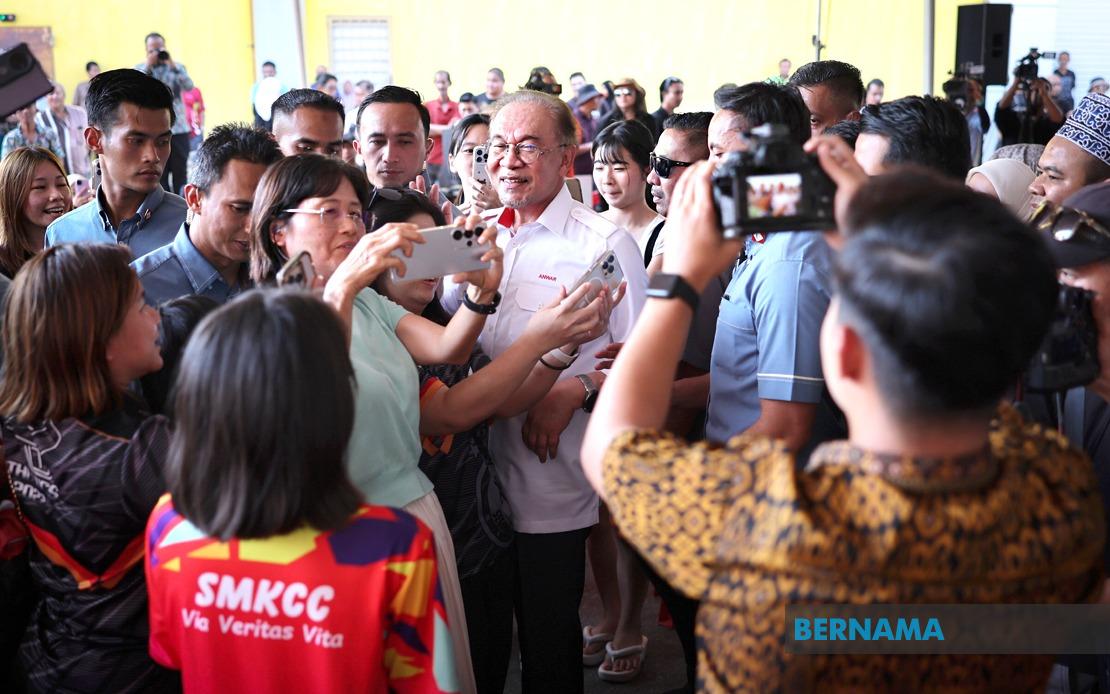
With campaigning for Johor's 16th state election set to conclude tonight at 11:59 pm, all major political coalitions have intensified their final voter outreach efforts across the state. The contest to determine who will lead Johor for the next five years has reached its climactic stage, with candidates and party leaders employing diverse strategies to secure public confidence before voters head to the polls tomorrow.
Pakatan Harapan has mobilised its entire leadership structure to energise its support base during these critical final hours. Prime Minister Datuk Seri Anwar Ibrahim, who chairs the coalition, embarked on an ambitious multi-location tour designed to provide a tangible demonstration of leadership presence and commitment to the electorate. His schedule encompassed strategic constituencies including Bukit Gambir, Bukit Batu, and Layang-Layang, culminating in the 'Johor Ke Depan, Undi Harapan Grand Finale Programme' scheduled for Pasir Gudang this evening. Through social media channels, the Prime Minister also conveyed spiritual sentiments, seeking divine assistance for his coalition's campaign efforts as voters prepare to cast their ballots.
At the grassroots level, PH's approach has reflected pragmatism alongside ambition. Larkin state seat candidate Suhaizan Kaiat adopted a personable campaigning style by conducting informal walkabouts at commercial venues, accompanied by Amanah Vice President Datuk Seri Dr Dzulkefly Ahmad. This ground-level engagement strategy contrasts with high-profile rally appearances, allowing candidates to interact directly with ordinary Johoreans in their everyday settings. Suhaizan emphasised throughout the two-week campaign period that the feedback and perspectives gathered from constituents represent responsibilities he would carry into office should voters grant him the mandate.
Barisan Nasional has charted a markedly different final campaign trajectory, one emphasising moral and spiritual dimensions. Chairman Datuk Seri Dr Ahmad Zahid Hamidi participated in a 'BN Grand Supplication & Doa Selamat' event in Kulai, reflecting the coalition's attempt to connect campaign messaging with religious and ethical values. This approach appears calculated to appeal to voters concerned with governance standards and leadership integrity. Meanwhile, incumbent Johor Menteri Besar Datuk Onn Hafiz Ghazi, contesting the Machap seat under BN's banner, issued a public apology to Johoreans through video messaging for any perceived shortcomings during his tenure in office. Such humility represents a strategic acknowledgment of public sentiment regarding BN's track record in state administration.
Within the Barisan Nasional framework, Bersatu has sought to position itself as a decisive force for voter consideration. Party President Tan Sri Muhyiddin Yassin encouraged Johoreans to make informed electoral choices based on information gathered throughout the campaign fortnight. His appeal emphasised the availability of data regarding competing parties' platforms and records, positioning voters as rational decision-makers rather than passive recipients of political messaging. This intellectual framing suggests Bersatu believes its policy agenda and governance vision merit serious comparative evaluation.
Meanwhile, the Bersama party orchestrated its campaign finale through a high-profile lecture featuring dual leadership from Datuk Seri Rafizi Ramli and Nik Nazmi Nik Ahmad. Rafizi's final campaign speech promised to comprehensively address election issues raised throughout the campaign period, offering both synthesis and counter-arguments to propositions presented by rival coalitions. This rhetorical strategy positions Bersama as intellectually engaged with substantive policy debates rather than relying purely on populist appeals.
Youth-oriented political movement MUDA has similarly concluded its campaign with a headline event dubbed the 'Puteri Wangsa Grand Finale Lecture.' Party President Amira Aisya Abd Aziz utilised the platform to emphasise voter agency and democratic empowerment, reminding Johor's electorate of the ultimate power they exercise through ballot choices. MUDA's messaging throughout this election has centred on generational renewal and fresh approaches to governance, targeting voters seeking alternatives to established political machinery.
The competitive landscape itself reflects significant fragmentation within Malaysia's political system. A total of 172 candidates are contesting across 56 state seats, indicating robust multi-party participation beyond the traditional two-coalition framework. This fragmentation creates complex dynamics whereby smaller parties and independent candidates compete for voter attention while major coalitions attempt to consolidate existing support bases. The presence of multiple viable political options means campaigns must address not only rival coalitions but also emerging political alternatives.
Weather considerations add a practical dimension to campaign planning and voter expectations. The Malaysian Meteorological Department has forecast clear conditions during morning hours, with potential afternoon rainfall or thunderstorms. Such weather patterns may influence voter turnout patterns, with implications for campaign strategies designed to mobilise specific voter constituencies. Parties accustomed to evening rallies and outdoor events may need to adjust mobilisation tactics accordingly.
The 16th Johor State Election represents a significant democratic exercise within Malaysia's federal system, as Johor remains one of the country's economically and demographically significant states. Results tomorrow will provide insights into voter sentiment regarding national political alignments and state-level governance performance. For Malaysian political observers and regional analysts, the Johor election serves as a barometer of public confidence in current federal and state leadership, particularly following the 2022 general election that produced Malaysia's first truly hung parliament and subsequent political volatility.
As the campaign formally concludes this evening, all contesting parties have deployed their available resources and personnel to maximise voter engagement during these final critical hours. The diversity of campaign approaches—from spiritual events to intellectual forums to grassroots mall interactions—illustrates how contemporary Malaysian electoral politics encompasses multiple communication strategies and voter engagement philosophies. Tomorrow's results will determine whether these varied approaches successfully mobilised sufficient electoral support to deliver mandates to their respective parties and candidates.

