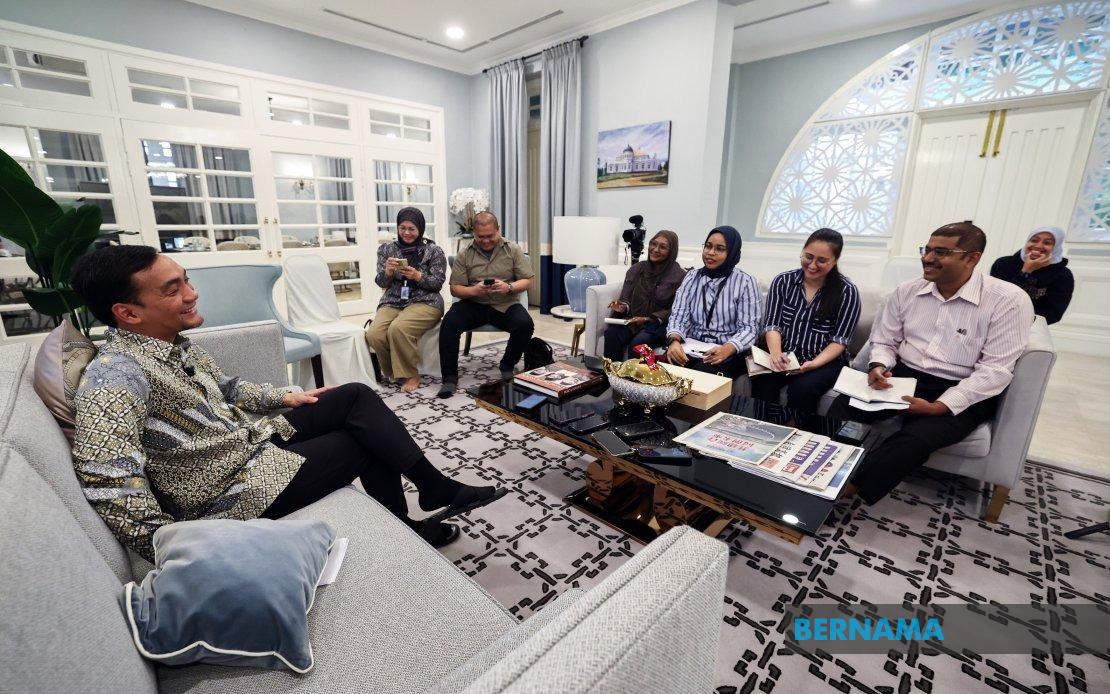
Johor Menteri Besar Datuk Onn Hafiz Ghazi has appealed to party members denied candidacy in the upcoming state election to persist in their dedication to Barisan Nasional's broader objectives, emphasising that rejection from the ballot does not diminish opportunities for meaningful contribution to the coalition's cause. Speaking at his official residence in Saujana, Onn Hafiz articulated a message of continuity and purpose, framing the candidate selection process as merely one chapter in a longer political journey where various roles remain available within the party structure.
The Menteri Besar's remarks come as the Johor BN coalition navigates the delicate task of finalising its slate for the July 11 state election. With nomination day set for June 27, the coalition faces the familiar challenge of balancing internal party aspirations with electoral viability. Onn Hafiz indicated that candidate selection had reached approximately eighty per cent completion at the time of his statement, leaving room for adjustments before the definitive watikah, or official appointment letters, are issued to contestants. This procedural flexibility underscores the provisional nature of preliminary selections in Malaysian politics, where circumstances can shift significantly in the weeks leading to formal candidacy confirmation.
The Menteri Besar drew particular attention to the reality that many overlooked individuals may still find meaningful roles within the political apparatus beyond legislative representation. He suggested that opportunities exist within the parliamentary sphere and in party administrative functions, highlighting that the finite number of available seats necessarily prevents all aspiring politicians from securing electoral contests. This framing attempts to reconceptualise disappointment as redirection rather than elimination, encouraging party loyalists to view setbacks as temporary repositioning rather than categorical rejection from political participation.
Onn Hafiz articulated the BN's candidate selection framework as deliberately inclusive across professional backgrounds and age demographics, abandoning rigid categorisation in favour of merit-based assessment. The selection criteria prioritise local connections and community acceptability, reflecting the coalition's adoption of the WALI standard—winnable, acceptable, and likeable candidates—as the governing principle for identifying suitable representatives. This approach theoretically democratises the selection process by removing arbitrary barriers and emphasising organic community endorsement as a primary qualification metric rather than seniority or traditional hierarchies within party structures.
Remarkably, the Menteri Besar downplayed age as a decisive factor in candidate selection, arguing that capability and genuine commitment to constituent welfare transcend generational considerations. This rhetorical stance positions BN as forward-thinking and pragmatic, willing to evaluate candidates on substantive performance capacity rather than demographic categories. However, this declaration carries particular weight given that youth representation and engagement remain critical vulnerabilities for established coalitions seeking to maintain electoral dominance against potentially more dynamic opposition alternatives in an increasingly youth-conscious political landscape.
Onn Hafiz emphasised that candidate selection decisions do not emanate from individual discretion but require approval from BN Chairman and UMNO President Datuk Seri Dr Ahmad Zahid Hamidi, alongside senior party leadership echelons. This hierarchical consultation process reflects the coalition's structural complexity and the necessity of balancing factional interests within its multi-party framework. The invocation of collective decision-making legitimises outcomes while distributing political accountability across multiple institutional layers, potentially mitigating dissatisfaction among rejected aspirants by attributing outcomes to broader organisational imperatives rather than personal assessment.
The Menteri Besar identified voters aged below forty as representing between twenty and forty per cent of Johor's demographic composition, constituting a pivotal electoral segment whose engagement directly influences government formation outcomes. This demographic reality underscores why mobilising youth participation has become strategically paramount for established coalitions attempting to retain power against potentially more youthful-oriented opposition movements. Onn Hafiz asserted that BN representatives have invested considerable effort in youth engagement, implying that the coalition understands its dependence on younger voters for electoral sustainability.
In mobilising support for the July 11 election, Onn Hafiz issued a particular appeal to Johoreans employed across the border in Singapore, acknowledging the substantial numbers of cross-border commuters whose voting participation could meaningfully influence results. This geographic consideration reflects modern Malaysian electoral realities where economic interdependencies with neighbouring jurisdictions create dispersed constituencies whose engagement requires targeted messaging and logistical accommodation. The explicit invitation to Singapore-based voters demonstrates awareness that electoral outcomes increasingly depend on mobilising geographically dispersed populations rather than simply engaging resident populations.
The Menteri Besar positioned the forthcoming election as an opportunity for Johoreans to evaluate incumbent performance and render judgement on the state government's stewardship during its previous mandate. His assertion that the BN-led Johor administration has endeavoured to deliver tangible benefits to constituents frames the election as a continuation referendum rather than a competitive challenge, appealing to satisfaction with existing governance arrangements as grounds for re-endorsement. This defensive positioning suggests BN recognises the necessity of emphasising proven track record given that electoral contests increasingly turn on voter assessments of administrative effectiveness rather than party historical dominance.
Onn Hafiz invoked democratic principles as justification for encouraging maximum voter participation, arguing that heightened turnout strengthens legitimate representation and government accountability. His invocation of democratic ideals and the Islamic phrase "insya-Allah" (God willing) blends secular procedural language with faith-based rhetoric, appealing to multiple constituencies within Johor's religiously diverse population. The statement that a re-elected BN administration would continue prioritising development and service delivery articulates a straightforward compact: voter endorsement receives reciprocal governmental commitment to constituent welfare.
The early voting provision scheduled for July 7 represents an administrative accommodation for populations unable to vote on the primary election day, reflecting recognition that contemporary electoral participation requires logistical flexibility to accommodate diverse voter circumstances. This scheduling consideration indicates that BN strategists understand that rigid voting arrangements potentially disadvantage constituencies with particular occupational or geographic constraints, potentially suppressing turnout among populations whose engagement could prove electorally consequential.
The timing of Onn Hafiz's appeal to rejected candidates merits analytical attention, as the statement simultaneously reassures disappointed party members while signalling that BN has finalised its strategic candidate prioritisation. By publicly articulating selection rationale and emphasising alternative opportunity channels, the Menteri Besar potentially mitigates internal party friction that frequently accompanies candidate announcements. The careful calibration of his messaging acknowledges that cohesion among rejected aspirants influences volunteer mobilisation, campaign energy, and grassroots activism that ultimately determines election day outcomes across marginal constituencies where volunteer intensity frequently proves decisive.