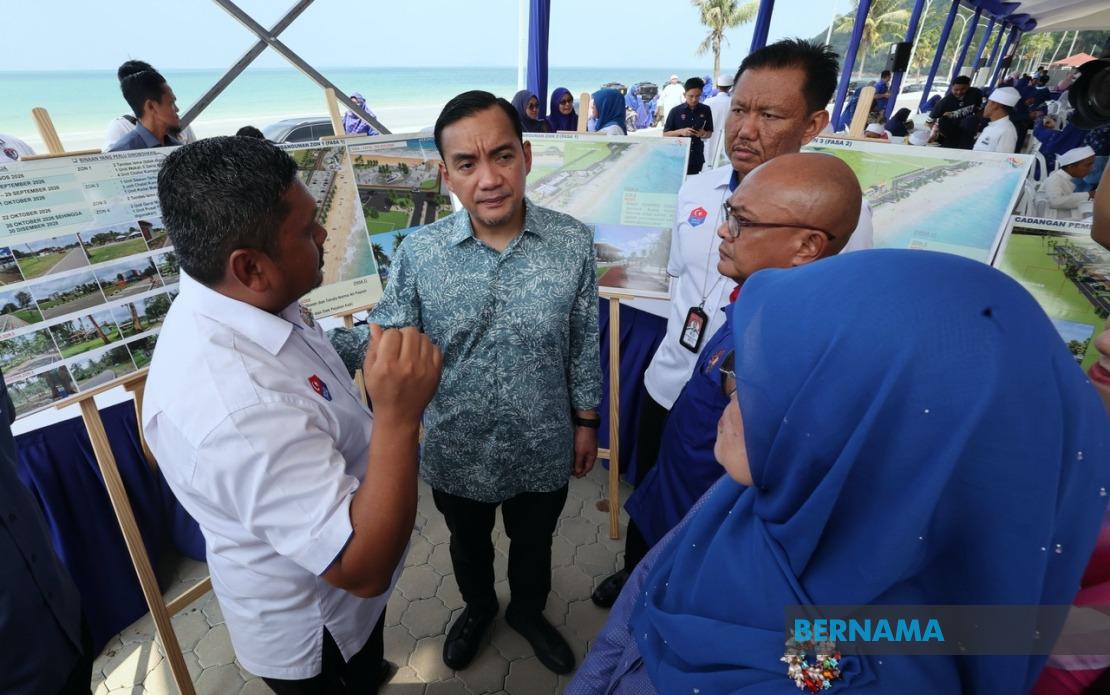
Johor's state government has unveiled a RM1.5 million development initiative for Mersing, signalling an effort to extend the prosperity generated by the state's economic expansion beyond major urban centres to peripheral districts. The funding commitment encompasses infrastructure improvements, sports facilities, healthcare enhancements, and essential public utilities designed to benefit Mersing's 80,000 residents. The announcement represents a strategic pivot by the state leadership to demonstrate that economic growth can be inclusive rather than concentrated in traditional economic hubs.
Menteri Besar Datuk Onn Hafiz Ghazi framed the investment within a broader vision of replicating the development model that has transformed Johor Bahru into a regional economic powerhouse. By applying similar strategies across Johor's constituent districts, the state aims to create a more evenly distributed pattern of prosperity that reaches into areas historically overshadowed by the capital district. This approach acknowledges growing expectations among Malaysians outside major cities that development dividends should extend beyond metropolitan areas, a sentiment increasingly reflected in electoral dynamics across the nation.
The initiative sits within the Johor Economic Transformation Plan (JETP), a comprehensive development blueprint establishing short, medium, and long-term objectives to strengthen the state's economic foundation. Rather than focusing solely on gross economic metrics, the JETP emphasizes translating growth into tangible improvements in residents' living standards and employment prospects. This framing is particularly significant for Mersing, where economic opportunities have traditionally been limited despite the district's tourism potential and natural resources.
Onn Hafiz articulated a critical concern underlying the development push: the disconnect between touristic appeal and local economic benefit. He noted that Mersing's various tourism attractions hold little meaning for residents if they do not generate employment and economic participation opportunities for the local population. This observation highlights a common challenge in Malaysian regions with tourism potential, where infrastructure and attractions often exist primarily to serve external visitors rather than creating sustainable livelihoods for nearby communities.
Youth employment emerges as a central priority within the allocation strategy. The JETP explicitly targets job creation for younger Malaysians, addressing both structural unemployment in peripheral regions and the risk of youth migration to urban centres. Mersing, like many districts in Malaysia's more remote areas, faces the demographic challenge of retaining young talent in the face of limited local opportunities. By emphasizing employment generation alongside physical infrastructure, the state government signals recognition that sustainable development requires economic dynamism, not merely amenities.
The RM1.5 million allocation reflects careful prioritization across diverse community needs. Healthcare receives the largest single commitment, with RM500,000 directed toward upgrading the Mersing Hospital's haemodialysis unit, addressing chronic disease management for a population segment requiring ongoing care. Religious and cultural institutions receive RM200,000 to enhance the Kampung Sri Lalang Mosque's facilities, acknowledging the role of community gathering spaces in social cohesion. Sports infrastructure claims RM400,000 combined across futsal courts in Taman Sri Mersing and Felda Nitar, investments reflecting grassroots interest in recreational facilities.
Specialized allocations address specific community segments often overlooked in standard development programmes. The Orang Asli villages of Kampung Peta and Kampung Tanjung Tuan receive RM100,000 each for solar-powered street lighting, addressing both infrastructure deficits and environmental sustainability concerns. The Felda communities, representing a distinct demographic group with particular needs, benefit from RM100,000 for a KAF building upgrade in Felda Tenggaroh Timur and RM80,000 for a sepak takraw court in Felda Tenggaroh 6. This granular approach suggests responsiveness to feedback from local elected representatives including Tenggaroh assemblyman Mohd Youzaimi Yusof and Endau assemblywoman Alwiyah Talib.
Beyond the immediate RM1.5 million commitment, the state government has proposed several strategic initiatives with longer-term implications for Mersing's development trajectory. A proposed petrol station at Camp Iskandar for Special Forces Group personnel represents coordination between state and federal security infrastructure, potentially generating ancillary economic activity. Plans to establish a Religious Affairs Office would enhance administrative capacity for religious affairs management, while a Technical and Vocational Education and Training campus would address skills development and youth employment prospects simultaneously.
The TVET initiative carries particular significance for Malaysia's broader economic diversification strategy. As the nation seeks to reduce dependence on lower-skilled foreign workers and position itself in higher-value manufacturing and services, vocational training becomes increasingly critical. Establishing such facilities in peripheral districts like Mersing could address regional skills gaps while retaining youth in their communities, creating positive feedback loops where employment opportunities reduce outmigration.
Mersing's development within the JETP framework reflects evolving priorities in Malaysian state governance. Recognizing that electoral support increasingly depends on demonstrating tangible benefits across diverse constituencies, state governments have begun examining how regional development can be accelerated beyond traditional urban-focused models. Johor's approach, emphasizing both hard infrastructure and soft factors like employment creation and community engagement, represents a more sophisticated development philosophy than previous top-down models.
The initiative's success will depend substantially on implementation quality and genuine commitment to employment creation beyond infrastructure completion. Malaysian development history contains numerous examples of facilities constructed but underutilized due to inadequate funding for operations, maintenance, or programming. The state government's continued involvement in coordinating initiatives like the Special Forces petrol station suggests awareness that infrastructure alone proves insufficient without supporting ecosystem development.
For Malaysian observers beyond Johor, this development package offers instructive lessons about inclusive growth strategies. As regional inequality becomes an increasingly salient political issue nationwide, state governments seeking electoral success must demonstrate that economic expansion benefits residents across geographic and demographic categories. Mersing's experience over the coming years will provide evidence regarding whether such targeted allocation strategies can effectively redistribute growth's benefits while supporting employment and livelihood improvements for peripheral communities.

