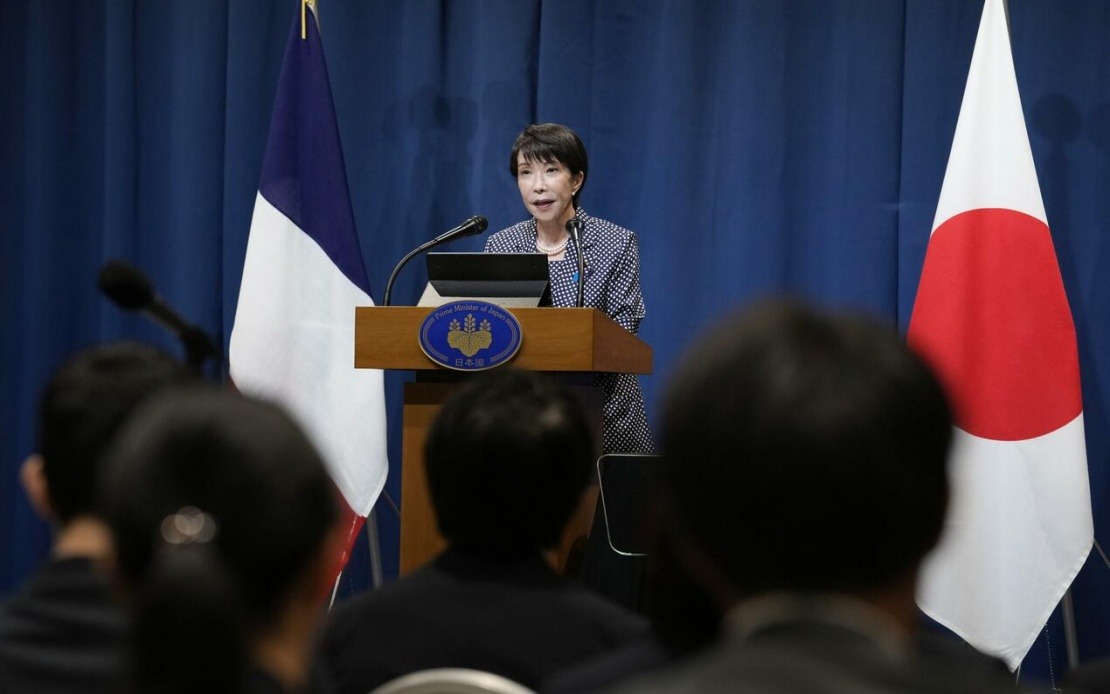
Japanese Prime Minister Sanae Takaichi's administration has experienced a notable decline in public support, with Cabinet approval slipping to 55.8 per cent according to a Kyodo News poll conducted over the weekend. This figure represents the weakest performance since Takaichi assumed office in October, signalling growing public dissatisfaction with her government's direction as Japan navigates economic headwinds and regional uncertainties.
The timing of the approval decline coincides with persistent concerns about Japan's vulnerability to external shocks, particularly those stemming from geopolitical tensions in West Asia. For a resource-dependent nation like Japan, fluctuations in global energy markets and shipping security directly translate into domestic economic pressure. The recent preliminary peace agreement between the United States and Iran, which includes commitments to reopen the Strait of Hormuz, offers some relief to markets dependent on stable maritime commerce. However, the uncertainty that preceded this development appears to have eroded confidence in the government's handling of national economic interests.
Regional security considerations feature prominently in the public's assessment of the Takaichi administration. The Kyodo News survey posed direct questions about Japan's potential military involvement in protecting commercial shipping lanes through contested waters. A substantial majority, comprising 54.7 per cent of respondents, expressed opposition to deploying the Japanese Self-Defence Forces to ensure safe passage for merchant vessels, while 36.6 per cent supported such action. This distribution reflects public wariness about military adventurism and the escalating costs of regional engagement, concerns that resonate across Southeast Asia where multiple nations maintain delicate balancing acts between major powers.
The declining approval rating must be understood within the context of Japan's persistent inflation challenges, which continue to squeeze household budgets across income levels. Consumer prices remain elevated relative to wage growth, creating genuine economic anxiety among voters who feel the government has yet to articulate a comprehensive response. Takaichi's administration has inherited an economy where purchasing power erosion affects daily purchasing decisions, particularly for essential items including food and beverages.
Food price inflation has emerged as a visceral political issue in Japan, and the government's tax policy on consumables reveals the tension between fiscal responsibility and political expediency. In the Kyodo News survey, 43.9 per cent of respondents found it acceptable to reduce the consumption tax on food and beverages from the current 8.0 per cent to 1.0 per cent, provided such measures could be implemented promptly without delay. This reflects a pragmatic willingness to support targeted tax relief if the government can demonstrate swift execution. An additional 22.6 per cent of survey participants advocated for eliminating this tax entirely, aligning with previous pledges made by Japan's ruling coalition parties.
The gap between these two positions—immediate partial relief versus comprehensive elimination—highlights the political challenge facing Takaichi's Cabinet. Implementing rapid tax cuts requires careful fiscal planning to avoid destabilising government finances, yet public patience for gradual implementation appears limited. The ruling parties' earlier commitments to zero consumption tax on food items have created expectations that the current administration must manage, whether through delivery or credible explanation of constraints.
For Malaysia and other Southeast Asian economies, Japan's experience offers instructive lessons about managing inflation's political fallout. Like several regional peers, Malaysia has grappled with elevated food and energy costs affecting household welfare. The Japanese case demonstrates how prolonged inflation, even at moderate levels, gradually erodes government approval ratings and creates political space for opposition movements. Takaichi's declining numbers suggest that public tolerance for economic discomfort has limits, even in a stable, wealthy democracy with strong institutions.
The interconnected nature of Japan's economic challenges—resource vulnerability, inflation's distributional effects, and defence spending pressures—reflects broader regional dynamics. Japan's struggle to balance fiscal discipline with targeted relief mirrors challenges faced by other developed and developing economies in Southeast Asia adjusting to new patterns of commodity prices and shipping security.
Looking forward, the Takaichi Cabinet faces a critical window to stabilise approval ratings through concrete policy delivery. Whether addressing food price inflation through consumption tax adjustments, articulating a coherent energy security strategy that reassures households without escalating military commitments, or demonstrating fiscal management competence will determine whether this downward trend reverses. The government's ability to act decisively on multiple fronts simultaneously will be closely watched both domestically and by regional observers assessing Japan's capacity to maintain economic stability and political cohesion amid external pressures.

