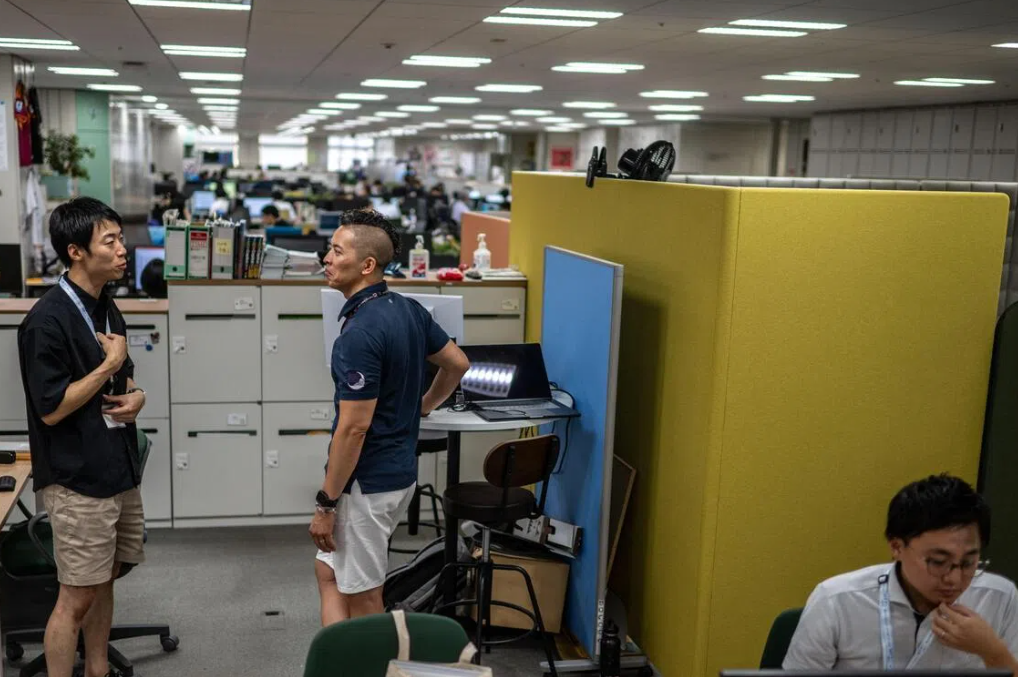
Tokyo authorities have encountered an unforeseen obstacle in their latest effort to help office workers endure Japan's sweltering summer conditions. The expanded Cool Biz campaign, which permits workers to abandon formal suits in favour of casual attire including T-shirts, trainers and shorts, has become unexpectedly contentious after women began voicing complaints about what online commentators have termed "leg hair harassment" or "sunehara" — essentially, discomfort at witnessing male colleagues' exposed shin hair in the workplace.
Initially conceived as a sensible response to the punishing heat and humidity that characterises Japanese summers, the Tokyo metropolitan government rolled out the relaxed dress code in April with straightforward intentions. Noboru Watanabe, an environmental official, articulated the philosophy underlying the initiative: authorities wanted to expand choices for workers struggling in severe heat rather than prescribe specific clothing requirements. From the government's perspective, any outfit that does not cause offense to colleagues should be acceptable, reflecting a pragmatic approach to workplace comfort during months when temperatures regularly exceed 30 degrees Celsius.
The gap between policy intent and public reception, however, has proven substantial. A June survey commissioned by Gorilla Clinic, a chain specialising in men's cosmetic treatments, revealed a near-even split in public opinion: 53.5 per cent of respondents opposed wearing shorts to work, while 46.5 per cent supported the practice. What distinguished these figures was the demographic composition of respondents. Women represented a significantly larger proportion among opponents, suggesting that female workers harbour greater reservations about viewing male colleagues in shorts. The survey identified concerns surrounding body shape and body hair as primary objections, pointing to an underlying anxiety about physical appearance standards in professional environments.
The controversy has triggered an unexpected consequence: growing numbers of Japanese men are now seeking professional hair removal services, not primarily for aesthetic reasons but as a form of "social etiquette" when contemplating shorts in the office. Akifumi Funatsu, a director at Gorilla Clinic, has observed this shift among the clinic's clientele, noting that men increasingly view visible leg hair as potentially discomforting to colleagues. This phenomenon reveals how social anxieties about appearance can manifest in unexpected ways; what began as an environmental and comfort initiative has inadvertently created new pressures around bodily presentation for male workers.
Japan's evolution toward more relaxed workplace dress standards extends back nearly two decades. In 2005, Yuriko Koike, then serving as environment minister and now Tokyo's governor, introduced the original Cool Biz concept specifically designed to reduce air-conditioning consumption by encouraging workers to shed jackets and ties in favour of short-sleeved shirts. The campaign gained significant momentum when then Prime Minister Junichiro Koizumi appeared in public without formal neckwear, lending political prestige to the casual approach. This initial programme succeeded in gradually shifting workplace norms, particularly in modernised sectors.
Following the devastating 2011 earthquake and tsunami that severely strained Japan's electricity infrastructure, the government implemented an even more aggressive version called "Super Cool Biz," which substantially liberalised workplace dress codes. Technology companies and start-ups embraced casual attire enthusiastically, and across urban centres, professional environments gradually became less formal. Shorts, however, represent a more dramatic departure from traditional workplace conventions, and their introduction into mainstream office settings appears to have triggered deeper social discomfort than previous relaxations.
The timing of this expanded campaign reflects Japan's genuine confrontation with extreme climate conditions. During the week of July 6 to July 12 alone, heatstroke claimed seven lives and hospitalised 4,580 individuals, according to the Fire and Disaster Management Agency. Government health advisories consistently emphasise hydration, air-conditioning use, and gradual heat acclimatisation. Beyond policy interventions, Japanese consumers have responded creatively to temperature extremes, adopting clothing embedded with cooling technology, specialised heat-reflective umbrellas, portable fans, and cooling wipes as standard summer equipment.
The leg hair controversy raises broader questions about workplace dress codes in contemporary Japan. Defining what constitutes "offensive" workplace attire remains contentious and culturally contingent. The shorts debate illuminates how changes in professional norms do not occur uniformly across society; substantial segments of the working population maintain traditional expectations about appropriate office presentation. For some female workers, exposure to male colleagues' body hair in professional settings represents a breach of established workplace decorum, while for others and for government officials, this objection seems unnecessarily restrictive in addressing legitimate health concerns during extreme heat.
The unintended consequence of men pursuing laser hair removal to satisfy perceived workplace expectations demonstrates how policy initiatives can generate unforeseen social pressures. Rather than simply expanding workers' clothing options, the campaign has created anxiety around bodily presentation standards. Some men now feel compelled to undergo cosmetic procedures not because they personally desire them, but because they fear their appearance might make colleagues uncomfortable — a striking example of how social expectations can drive consumer behaviour in unexpected directions.
Looking forward, the Cool Biz expansion will likely continue regardless of the leg hair controversy, given legitimate public health imperatives around extreme heat. However, the debate underscores enduring tensions between pragmatic environmental and health objectives and deeply embedded cultural norms surrounding professional appearance. As Japanese workplaces continue gradually modernising and casualising, how much physical informality remains acceptable will remain contested. The question of where precisely the boundary lies between appropriate workplace attire and excessive informality appears far from settled.

