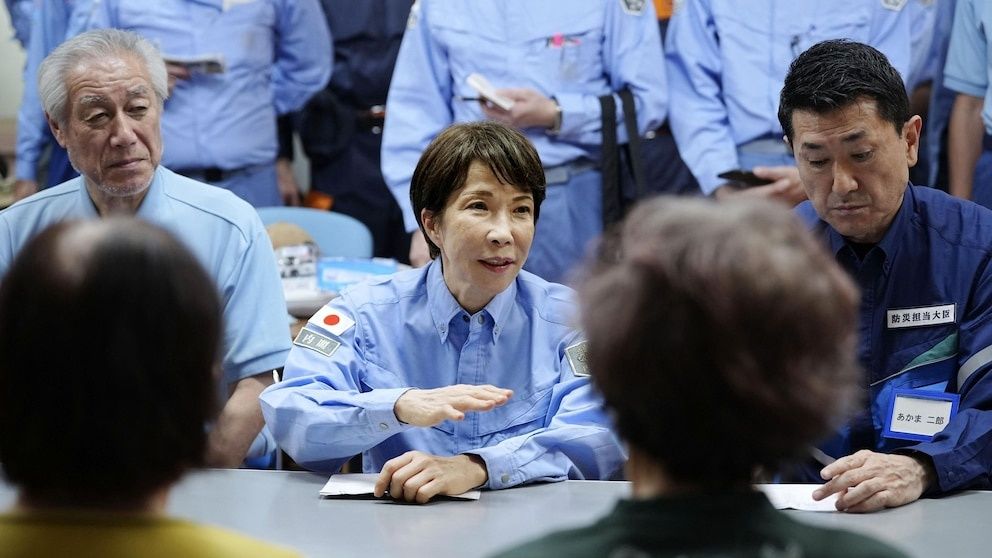
Prime Minister Sanae Takaichi flew into Kumamoto Prefecture on Monday to assess damage from a magnitude 7.1 earthquake that struck Japan's Kyushu island on Tuesday, August 4, leaving 38 people dead and more than 114 injured. The disaster has exposed the prefecture to a cascading crisis, as extreme weather conditions and infrastructure failures threaten to compound the initial tragedy of the tremor itself.
The death toll reflects not only the earthquake's immediate destructive force but also the harsh conditions that have followed. Among the fatalities was a person who died of apparent heat stroke while sheltering in a car, underscoring how environmental factors are proving as dangerous as structural collapse in the disaster's aftermath. Another death remains under investigation, though officials are evaluating whether heat-related complications may have played a role. This pattern—where post-disaster conditions become life-threatening in their own right—is a growing concern across Japan and Southeast Asia as climate patterns shift toward more extreme temperature swings.
The scale of physical destruction across the prefecture remains staggering. Approximately 700 homes have been completely destroyed, while damage extends to over 11,300 buildings. Across affected towns, residents have begun the grim work of sorting through wreckage, placing mountains of debris, broken furniture, and damaged appliances into collection piles that line streets. In the towns of Uki and Hikawa, construction of temporary housing has already commenced, representing the first steps toward providing permanent shelter for those who lost their homes. Some hotels and inns have opened their doors to evacuees, offering private rooms as alternatives to crowded public shelters.
Yet the earthquake's immediate aftermath has created a humanitarian crisis that extends beyond homelessness. More than 46,000 households lack access to clean water—a critical utility that remains essential for drinking, sanitation, and basic hygiene in the sweltering heat. Fuel shortages compound these difficulties, preventing people from operating generators to power cooling devices and limiting transportation for supply deliveries. The Japan Meteorological Agency predicted temperatures would climb close to 40 degrees Celsius (104 Fahrenheit) on Monday, creating an environment where dehydration and heat exhaustion pose immediate medical threats to vulnerable populations.
The shelter situation encapsulates the scope of the crisis. More than 8,500 people remain crowded into emergency facilities—converted community centres, school gymnasiums, and converted classrooms—the majority of which lack air-conditioning systems. Without proper climate control during extreme heat, these spaces become increasingly dangerous, particularly for children, elderly residents, and those with pre-existing health conditions. Others, unable to secure shelter space, have resorted to sleeping in vehicles parked at town halls, in parks, or outdoors near their damaged homes. These makeshift arrangements offer minimal protection from heat, insects, and the psychological stress of homelessness.
Governor Takashi Kimura used his Monday meeting with Takaichi to emphasise what he characterised as "abnormal heat" bearing down on residents already struggling with loss and displacement. The governor specifically requested expanded government support to upgrade conditions at evacuation centres, highlighting acute shortages of clean water and medical services at many facilities. His appeal underscores the gap between emergency response capacity and actual needs on the ground—a tension that frequently emerges in major disasters when systems designed for normal times suddenly face extraordinary demand.
Takaichi's visit itself became a subject of public scrutiny and criticism. She toured an exceptionally well-equipped shelter featuring cardboard beds, partition walls for privacy, and air-conditioning—a facility that represents conditions far superior to most of the 8,500 people still waiting in inadequate shelters. Social media users questioned whether the prime ministerial visit had been staged at an unrepresentative location, suggesting her brief helicopter survey and carefully curated shelter tour did not reflect the actual conditions facing most displaced residents. The criticism reflects broader frustrations about whether political leaders are truly grasping the scale of hardship occurring beyond photo opportunities.
In response to the governor's requests, Takaichi committed only to examining government options, promising to "move proactively" once options had been identified. The measured language suggests caution about new expenditures, even as the humanitarian situation deteriorates. She offered no specific pledges for additional resources, timeline for water restoration, or enhanced medical services at shelters.
Beyond the earthquake's immediate effects, a corporate negligence scandal has intensified public anger. Habita, operator of a general store inside the collapsed Aeon Mall in Kashima, instructed two employees to return to the building to secure sales proceeds in a safe—instructions that proved fatal. Both workers, including 22-year-old Kurumi Otake, were killed in a subsequent gas explosion that rocked the mall after approximately 3,000 shoppers had been evacuated but some staff remained inside. Two company executives attended the funeral of one victim and apologised, with Otake's mother tearfully asking, "I wish someone had stopped her."
The mall operator attributes the explosion to a gas leak occurring after the initial evacuation. Rescue teams recovered five survivors but also retrieved seven bodies from the rubble. This tragedy—workers sent back into a damaged building to retrieve company money—encapsulates questions about employer responsibility during disasters and reflects corporate cultures that sometimes prioritise financial assets over human safety.
For Malaysia and the broader Southeast Asian region, Kumamoto's unfolding crisis carries instructive lessons about disaster preparedness. As the region faces increasing seismic activity, extreme weather, and compound climate risks, the Japanese experience demonstrates how initial earthquake damage can be substantially amplified by secondary factors: inadequate shelter systems, water infrastructure vulnerability, heat stress during recovery, and gaps between emergency plans and actual implementation. The gap between the prime minister's carefully managed visit and ground-level conditions also reflects how political optics can diverge from operational realities—a pattern relevant across Southeast Asia, where natural disasters increasingly demand rapid, transparent, and adequately resourced responses.

