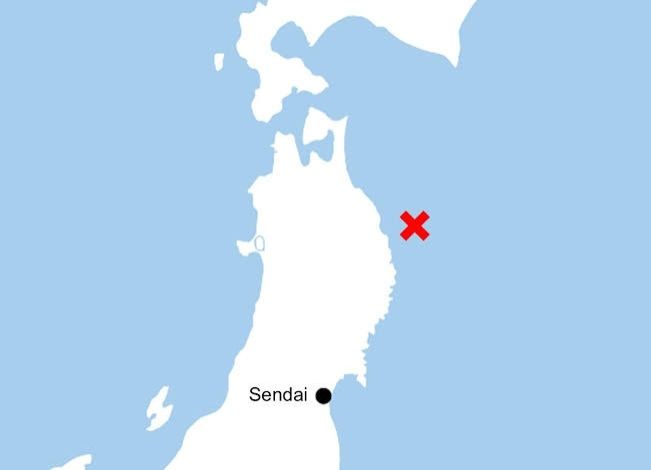
A powerful 7.2-magnitude earthquake rattled northern Japan on Thursday morning, sending saucepans clattering from kitchen cupboards and setting security cameras swinging, yet authorities reported no deaths or widespread structural damage in the aftermath. The seismic event, which struck at 7:30 am local time off the coast of Iwate prefecture, was initially measured at 6.9 magnitude by the Japan Meteorological Agency before being revised upward to 7.2. With its epicentre located 44 kilometres beneath the seafloor, the tremor demonstrated how depth plays a crucial role in determining the surface impact of underwater earthquakes, a lesson Japan has learned painfully from its recent seismic history.
The intensity of the shaking rippled across several hundred kilometres, reaching Tokyo and surrounding regions with sufficient force to trigger smartphone earthquake alerts across the country. No tsunami warning was issued following the event, sparing coastal communities the additional anxiety that often accompanies major submarine earthquakes in this tectonically restless region. In Aomori prefecture, where the shaking registered upper six on Japan's seven-level Shindo intensity scale, residents experienced conditions severe enough that standing without support became difficult for many people, though most structures proved resilient to the violent motion.
First-hand accounts from residents reveal the nature of the disturbance. Mutsumi Shimohata, a 61-year-old food processing employee in Hashikami, Aomori, described how her smartphone's earthquake alarm sounded virtually simultaneously with the shaking itself, providing that split-second warning that has become integral to Japan's disaster preparedness infrastructure. While her home suffered only minor damage—a single picture frame dislodged from its position—her workplace experienced more substantial disruption, with the office's automatic door mechanism failing and sections of ceiling material collapsing, forcing staff to remain home on standby for the day.
Television coverage documented scenes of domestic and commercial chaos captured in slow motion: kitchen cupboards spilling their contents across countertops, shop displays scattering merchandise across floors, and the general disorder that characterises the seconds following significant ground motion. The disruptions extended to transportation infrastructure, with some shinkansen bullet train services suspended as a precautionary measure while engineers conducted safety inspections. A primary school in Hashikami was temporarily shuttered following the earthquake, and emergency services responded to multiple calls, including reports of people temporarily trapped in a lift and a tanker truck that overturned on a roadway.
Despite these incidents, the response from authorities and the apparent resilience of modern Japanese infrastructure prevented what could have escalated into a serious humanitarian crisis. Government spokesman Minoru Kihara stated that investigations had uncovered no evidence of human casualties at that stage, though monitoring would continue. The Nuclear Regulation Authority confirmed that nuclear facilities throughout the affected region registered no abnormalities, a critical consideration given Japan's ongoing reassessment of nuclear safety protocols following the 2011 Fukushima disaster. Regular traffic flow was observed in Hachinohe city with traffic signals operating normally, indicating that basic urban functionality remained intact.
Prime Minister Sanae Takaichi issued directives ensuring coordinated response across government agencies and local authorities, while also issuing a cautionary advisory to residents in heavily affected areas. Her statement on social media urged citizens to remain vigilant for potential aftershocks of similar or comparable intensity, reflecting standard seismic safety protocol following significant earthquakes. This measured response reflects Japan's deeply embedded earthquake culture, where preparedness messaging has become routine government communication.
Japan's vulnerability to seismic activity stems from its geographic position astride the Pacific Ring of Fire, where four major tectonic plates converge and create constant geological tension. The archipelago, hosting approximately 125 million people, experiences roughly one-fifth of all global earthquake activity, with hundreds of tremors recorded annually. The vast majority prove harmless, but the nation remains acutely aware that magnitude and location combine to determine actual hazard levels. Ground depth particularly influences surface effects, as demonstrated by Thursday's 44-kilometre-depth quake, which dissipated much of its energy through the water column above.
Memory of the March 2011 catastrophe continues to shape Japanese disaster consciousness. That 9.0-magnitude undersea earthquake and its devastating tsunami claimed approximately 18,500 lives and triggered the Fukushima nuclear complex's catastrophic failure, an event that reshaped Japan's entire energy and safety policy framework. More recently, on April 20 this year, a 7.7-magnitude tremor struck northern Japan, injuring at least ten people and rattling large structures in Tokyo with sufficient force to trigger official warnings of elevated risk for magnitude 8.0 or stronger earthquakes—advisories that authorities lifted after one week of heightened monitoring.
For regional observers including Malaysian readers, Thursday's event underscores Japan's sophisticated earthquake detection and response infrastructure, built through decades of experience and investment. The minimal damage reported despite the earthquake's significant magnitude reflects decades of stringent building codes, public education campaigns, and technological innovation in structural engineering. However, the incident also reminds vulnerable Southeast Asian nations that seismic preparedness remains perpetually relevant. While Malaysia itself sits outside the Ring of Fire, the 2004 Indian Ocean earthquake and tsunami—which killed over 230,000 people across affected countries—demonstrated that distant subduction zone earthquakes can generate transnational hazards. Understanding how advanced economies like Japan manage seismic risk provides valuable lessons for regional disaster management protocols and emergency response coordination.
The incident also highlights the interconnected nature of modern infrastructure and how widespread disruption can result from disruptions to single systems. The closure of a school and the shutdown of business operations throughout an office facility based on structural damage assessments demonstrate how authorities now adopt comprehensive caution rather than waiting for confirmed injuries or casualties before implementing precautionary measures. This proactive approach, while sometimes appearing excessive when earthquakes prove relatively harmless, reflects the principle that prevention and preparedness offer superior outcomes to reactive emergency response.

