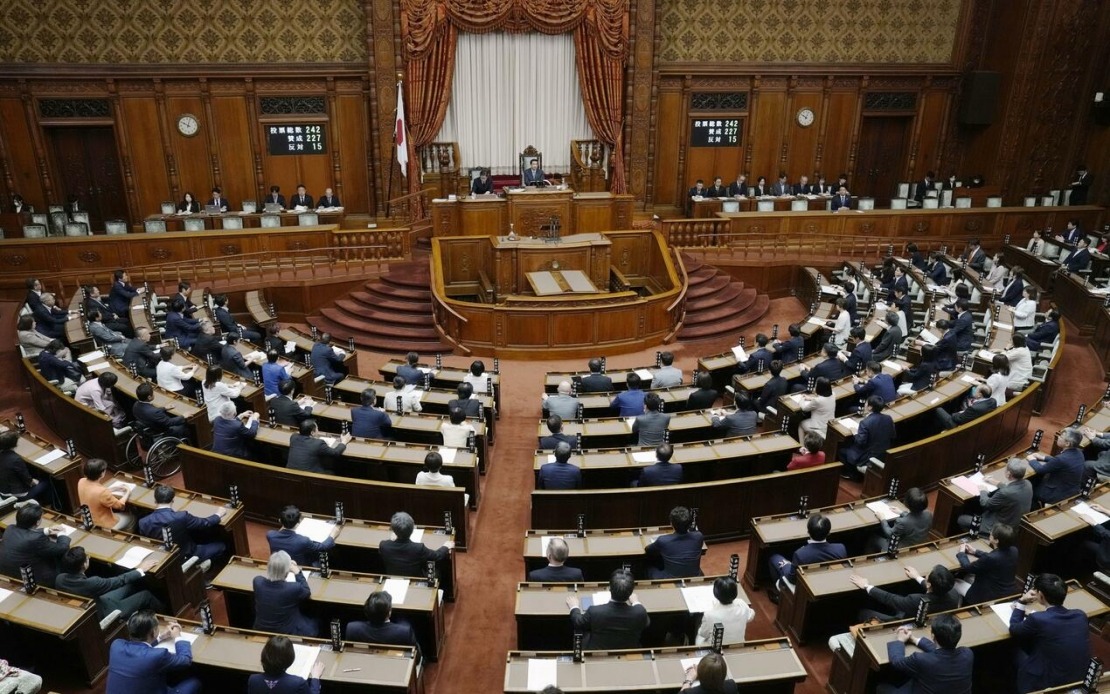
Japan's parliament enacted sweeping defence legislation on Friday that marks a fundamental shift in how the nation approaches military modernisation and space security. The newly approved restructuring will rename and reorganise the Air Self-Defence Force, incorporating space into its official mandate and creating institutional capacity to monitor and defend critical orbital assets. This structural overhaul arrives at a moment when space has become inseparable from conventional military preparedness, civilian infrastructure resilience, and economic stability across the region.
The centrepiece of the reform involves establishing a dedicated space operations group helmed by a lieutenant general, which will assume operational command beginning in the fiscal year ending March 2027. This command structure signals Japan's recognition that space domain awareness and satellite surveillance have become foundational to modern defence strategy. The move reflects not merely bureaucratic reorganisation but a strategic reorientation toward technologies that adversaries increasingly target during conflict. For Malaysia and other Southeast Asian nations watching regional military developments, Japan's explicit elevation of space operations demonstrates how established democracies are adapting to asymmetric threats and contested orbital environments.
Defence Minister Shinjiro Koizumi framed the reorganisation within a broader context, emphasising that space dependency now permeates civilian life across developed economies. Navigation systems, mobile applications, weather forecasting, and digital communications—services taken for granted by urban populations—all depend on satellite infrastructure. This civilian-military nexus explains why Japan's defence establishment views space capabilities as inseparable from national resilience. The minister's public emphasis on civilian applications suggests the government intends the restructuring to resonate beyond defence circles, building domestic political consensus for sustained investment in space technology and related research.
Beyond space operations, the legislation authorises the appointment of a second senior vice defence minister, a position expected to be filled as soon as summer of the current year. This administrative expansion serves multiple strategic objectives: it distributes decision-making responsibility during emergencies and natural disasters, enhances high-level diplomatic engagement with the United States and allied nations, and acknowledges the sheer complexity of managing contemporary defence challenges. For a nation managing both the China security challenge and regular natural disasters, the additional ministerial capacity addresses genuine operational requirements. The provision also signals to Washington and other regional security partners that Tokyo is institutionalising its commitment to coordinated defence planning and allied interoperability.
The legislation simultaneously addresses a persistent challenge confronting Japan's Self-Defence Forces: recruitment and retention of skilled personnel. The revised post-retirement benefits package reflects acknowledgment that mandatory retirement ages—which typically fall well short of civil service standards depending on rank—create competitive disadvantages when attracting and keeping experienced military professionals. This dimension touches a vulnerability common across developed democracies: demographic pressures and civilian sector competition for technical talent have made military service recruitment increasingly difficult. By enhancing retirement security for departing service members, Japan aims to cultivate a more stable professional cadre capable of managing sophisticated space and cyber operations.
The restructuring also includes upgrading the Ground Self-Defence Force's 15th Brigade, stationed in Naha, Okinawa Prefecture, to full divisional status. This elevation directly responds to China's expanding maritime presence and growing assertiveness across the East China Sea and beyond. Okinawa's strategic position, sitting astride vital sea lanes and facing the Taiwan Strait, makes strengthened ground capabilities essential to Japan's southwestern defence posture. The upgrade reflects calculations about how conventional military architecture must adapt to Chinese military modernisation and expanded operational reach. For regional observers, particularly in Southeast Asia, Japan's reinforced focus on southwestern island defences underscores how Beijing's maritime activities are reshaping allied defence investments across the Indo-Pacific.
The parliamentary approval demonstrates unusual political consensus within Japan regarding defence spending and military modernisation priorities. In a country where pacifist sentiment remains significant in some constituencies, securing legislative backing for substantial defence restructuring requires political sophistication and sustained leadership commitment. The bipartisan support evident in the House of Councillors vote suggests a maturing consensus that Russia's invasion of Ukraine and China's military trajectory demand institutional adaptation. This political environment enables longer-term defence planning that transcends electoral cycles—a capability that gives Japan advantages in implementing multi-year modernisation strategies that Southeast Asian nations sometimes struggle to execute amid domestic political volatility.
The timing of these reforms cannot be separated from broader geopolitical currents reshaping the Indo-Pacific security architecture. China's dual emphasis on military capabilities and civilian space programmes has prompted Japan, alongside the United States and other regional partners, to regard space as a contested domain requiring dedicated defensive posture. Unlike nuclear weapons or conventional platforms, space infrastructure remains somewhat ambiguous in international law and diplomatic protocols, creating additional complexity for nations seeking to deter hostile actions without triggering escalatory dynamics. Japan's institutional reforms represent an attempt to build deterrent capacity through demonstrated competence and technological sophistication.
The restructuring also positions Japan to deepen security cooperation with allied nations through joint space operations planning and satellite-based intelligence sharing. The United States has long emphasised space as critical operational domain, and Japan's structural reforms facilitate interoperability with American space command architectures and allied surveillance networks. This institutional alignment strengthens the technological and operational foundation of regional security partnerships, potentially enhancing collective deterrence against Chinese military adventurism. For smaller nations in Southeast Asia concerned about maintaining strategic autonomy while facing power imbalances, Japan's alliance deepening presents both reassuring examples of collective defence and cautionary reminders that formal security partnerships constrain independent manoeuvrability.
Beyond military applications, the legislation reflects anticipation of commercial space sector growth and the need for regulatory frameworks supporting private spaceflight operations, satellite launch services, and emerging space industries. Japan has substantial technical capabilities in satellite manufacturing and launch services, and government defence initiatives create demand and legitimacy for civilian space sector development. The institutional changes signal that space will receive sustained policy attention and funding, benefiting not only defence capabilities but also civilian research, commercial opportunities, and technical workforce development across the broader economy.
The parliamentary enactment of these reforms represents a watershed moment in how Japan institutionalises responses to security challenges that transcend traditional boundaries between space, cyber, and conventional domains. By formally integrating space operations into defence force structure, appointing additional senior oversight capacity, and strengthening southwestern island defences, Japan signals determination to sustain credible deterrence despite demographic decline and budgetary constraints. These moves carry implications far beyond Tokyo, demonstrating how regional powers adapt to evolving threats and shape the security environment within which smaller nations must navigate complex geopolitical terrain.

