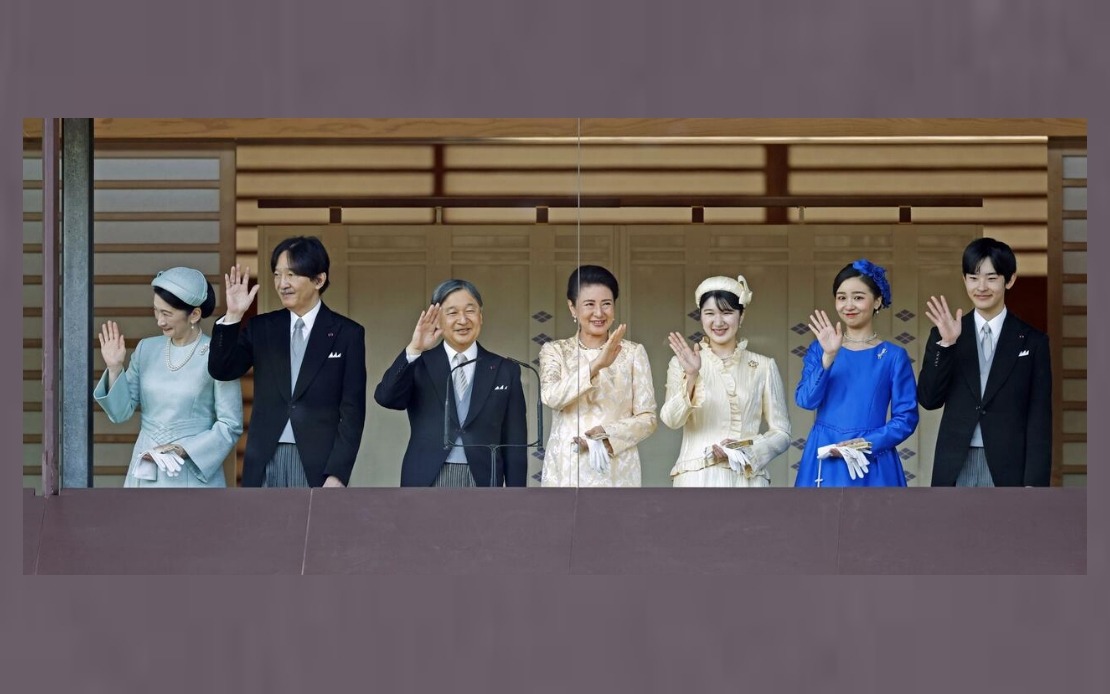
Japan's parliament has taken its most significant step in decades to ensure the stability of the imperial family by approving substantial amendments to the 1947 Imperial House Law, though the conservative ruling coalition has stopped short of addressing the thorniest question facing the world's oldest hereditary monarchy: female succession to the Chrysanthemum Throne. Prime Minister Sanae Takaichi's government successfully steered the revised legislation through the House of Councillors on Friday, introducing two major provisions designed to arrest the decline of the imperial household at a critical juncture when only three male heirs remain to Emperor Naruhito.
The centrepiece of the reform allows unmarried male descendants from 11 former imperial branch families to be formally adopted into the current 16-member imperial household, a practice that had long been considered legally unfeasible under the previous framework. These branch families, which trace their patrilineal descent from emperors, were stripped of their royal status in the years following the Second World War when Japan's imperial system was restructured under American occupation. The reopening of this pathway represents a pragmatic solution to the succession challenge, enabling the government to replenish the thinning ranks of eligible male heirs without fundamentally altering the hereditary principles that have governed imperial succession for centuries.
Complementing this provision is a second reform that permits female members of the imperial family to retain their status and privileges even after marrying outside the royal household, a change that acknowledges the reality of modern life and marriage patterns. Previously, women who married commoners automatically forfeited their imperial rank, contributing significantly to the shrinkage of the active imperial population. This modification allows daughters and sisters of emperors to maintain formal connections to the institution and could, in principle, create additional pathways for succession through their descendants should circumstances change in future decades. Together, these amendments represent a careful balancing act between institutional modernisation and the preservation of established protocols.
Yet the reforms have drawn sharp criticism from opposition parties and civil society groups who contend that the ruling coalition, comprising the Liberal Democratic Party and its junior partner the Japan Innovation Party, has deliberately sidestepped the more fundamental question that dominates public opinion. Multiple months of cross-party negotiations produced a parliamentary "consensus" document drawing input from 13 political parties and groups, but this exercise yielded no serious consideration of whether women should be permitted to ascend the throne directly or whether maternal-line descent should be recognised as valid for succession purposes. The government has framed the adopted male descendants' eligibility as preserving male-line continuity, a technicality that satisfies conservative constitutional scholars but leaves unresolved the broader succession question.
The disconnect between this legal framework and public sentiment has become increasingly evident. A Kyodo News poll conducted in May revealed that 83 percent of respondents support the idea of female emperors, with only 13.1 percent opposing such a possibility. This substantial majority support reflects generational shifts in attitudes toward women in positions of authority and governance, values increasingly prevalent across much of East Asia. The fact that public backing for female succession remains so overwhelming despite the government's evident reluctance to pursue it suggests a widening gap between official policy and popular expectation—a phenomenon that carries implications not only for Japan's constitutional evolution but for regional attitudes toward female leadership more broadly.
The historical context illuminates why this moment matters. The 1947 Imperial House Law, established when Japan remained under Allied occupation, crystallised succession rules stating that "the throne shall be succeeded to by a male offspring in the male line belonging to the Imperial Lineage." This formulation, rooted in centuries of tradition but codified during Japan's postwar transformation, has remained essentially unaltered for over seven decades. At that time, 51 members from 11 branch families were stripped of their imperial status, a culling that seemed sustainable given the larger imperial household of that era. The compound effect of this postwar restructuring and modern demographic trends—fewer births, women marrying later or pursuing careers, smaller family sizes—has now created genuine succession vulnerabilities that the government can no longer ignore.
Takaichi, who became Japan's first female prime minister, has made the imperial succession issue a personal priority, yet her administration's approach reflects the deep conservatism embedded within Japan's establishment on matters of tradition and constitutional practice. The decision to pursue adoption of male relatives rather than fundamental changes to succession rules demonstrates how institutional resistance to altering core constitutional principles can coexist with selective modernisation in peripheral areas. For Malaysia and other Southeast Asian democracies observing Japan's experience, the case illustrates the tension between responding to genuine institutional needs and managing powerful currents of cultural and historical attachment to established systems.
The practical implications of the revised law extend beyond Japan's borders, particularly for regional monarchical systems facing their own demographic challenges and succession uncertainties. Thailand, Malaysia, and Brunei, among others in Southeast Asia, maintain monarchical systems with varying degrees of constraint around female succession, making Japan's cautious incrementalism a relevant precedent. By addressing functional problems through lateral solutions—namely, re-admitting male descendants of collateral lines—rather than confronting fundamental rules, Japan's approach offers a temporary reprieve while deferring more substantive constitutional conversations to future generations. This strategy may prove durable if the adopted males produce sufficient male heirs, or it may merely postpone an inevitable reckoning.
Opposition lawmakers have mounted their critique not only on the grounds that the reforms fail to address female succession, but also that the deliberative process itself was inadequate for changes of such constitutional weight. The compressed timeframe and the apparent priority given to preserving male-line principles over genuine democratic deliberation have fuelled concerns that the government rushed toward predetermined conclusions rather than allowing parliament to fully explore the merits of alternative approaches. This procedural critique carries weight in mature democracies where institutional legitimacy depends partly on the perceived fairness and thoroughness of legislative processes, especially when decisions touch upon foundational constitutional matters.
Looking forward, the revised Imperial House Law creates a window of opportunity without foreclosing future change, even as it reflects the conservative instincts of Japan's current political leadership. The successful adoption of male descendants may stabilise the succession for several generations, buying time during which demographic patterns could shift or public opinion could evolve further. However, the massive gap between public support for female succession and government reluctance to pursue it suggests that this issue will resurface with renewed intensity should the male heir situation deteriorate or should generational shifts further accelerate acceptance of women in hereditary leadership roles. For regional observers, Japan's experience demonstrates both the power of institutional tradition to resist change and the potential for legal reforms to create new possibilities while maintaining formal continuity with established principles.

