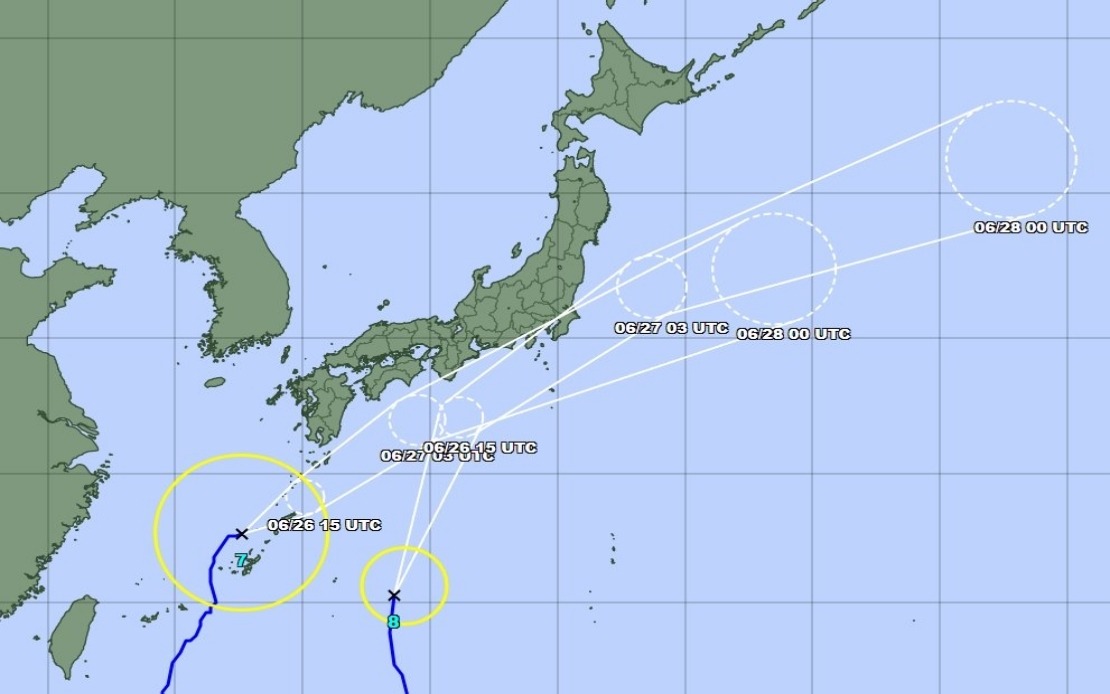
Japan's meteorological authorities escalated weather alerts on Friday as the country faced an unusual dual-typhoon threat, with Typhoon Higos expected to make landfall over the weekend while a second system, Typhoon Mekkhala, simultaneously advanced toward densely populated central regions. The Japan Meteorological Agency cautioned that conditions would remain treacherous through Saturday, with heavy precipitation already pounding western and eastern zones as the weekend approached.
The compound weather emergency forced unprecedented mass evacuations, with over 2 million residents across 13 prefectures in the Kinki and Kyushu regions under evacuation orders by Friday morning. The Fire and Disaster Management Agency coordinated the coordinated withdrawals from communities deemed at elevated risk from the converging storm systems. The evacuation scope underscores Japan's sophisticated disaster preparedness mechanisms, yet also reflects the genuine peril posed when multiple tropical cyclones affect the archipelago simultaneously—a scenario that challenges even well-resourced response infrastructure.
In Seika, Kyoto Prefecture, authorities issued the highest emergency safety alert level for parts of the municipality following an early-morning landslide, illustrating how saturated ground from preceding rainfall created immediate hazard conditions independent of the approaching typhoons. The incident demonstrated that risks intensified not merely from imminent storms but from existing geological instability exacerbated by antecedent precipitation. Between Tuesday and Friday morning, meteorologists recorded extraordinary rainfall totals: Goto in Nagasaki Prefecture accumulated 600 millimetres, while Aso in Kumamoto Prefecture and Ureshino in Saga Prefecture each received above 500 millimetres, establishing dangerous groundwater saturation levels across southwestern regions.
Typhoon Mekkhala, which approached the Amami region in Kagoshima Prefecture on Friday, presented an immediate concern as it traced a course toward the Kanto region—Japan's economic heartland encompassing Tokyo and surrounding prefectures with over 37 million inhabitants. As of 11 am local time Friday, the system moved northeast at 15 kilometres per hour from a position near Okinawa's Kume Island, with meteorologists projecting its trajectory would bring damaging rainfall to central Japan's most vulnerable population concentration. This track differentiated Mekkhala from Higos, which approached from the Pacific and would affect regions previously saturated by the week's deluge.
Meteorological projections indicated intensifying precipitation across the Tokai and Kanto regions through Saturday as Typhoon Higos moved northward off Japan's southern coast, with additional rainfall contributions from Mekkhala's moisture expanding the affected zone. The Tokai region faced forecasts of up to 300 millimetres by Saturday noon, while the Kanto-Koshin region was expected to receive 150 millimetres. These volumes, superimposed upon existing soil moisture from preceding days, would substantially elevate flooding and landslide probabilities, particularly across hillsides and drainage basins already near capacity. For Malaysian readers familiar with monsoon-season weather patterns, the convergence of two systems demonstrates how tropical cyclone timing occasionally produces compound hazards exceeding singular-event scenarios.
The Japan Meteorological Agency issued distinct warnings regarding strong storm potential across Okinawa Prefecture and eastern Japan, effectively alerting residents to prepare for degrading conditions throughout Friday and Saturday. The agency expectation that both typhoons would transition into extratropical cyclones after approaching offered some reassurance that the systems would ultimately weaken, yet meteorologists cautioned that this progression would not substantially diminish rainfall accumulation or associated hazards during the critical 24-48 hour window. Residents throughout affected prefectures received guidance to remain vigilant against secondary impacts including landslides, flooding, debris flows, and wind damage despite the eventual transition to post-tropical characteristics.
The geographic scale of the emergency underscores Japan's vulnerability to typhoon activity despite advanced warning systems and substantial infrastructure investment. The Kinki and Kyushu regions targeted by evacuation orders encompass ancient cultural centers, industrial zones, and agricultural areas integral to national economic functioning. The coordinated response reflects decades of typhoon-preparedness evolution following catastrophic historical events, yet the simultaneous approach of two systems illustrated how meteorological probability distributions occasionally produce scenarios that stress even optimized response protocols. For Southeast Asian nations similarly exposed to typhoon corridors, Japan's experience demonstrates both the feasibility of large-scale rapid evacuation and the persistent challenges posed by compound tropical cyclone scenarios.
The rainfall statistics themselves contextualize the emergency's severity. Accumulations exceeding 500 millimetres within 72 hours represent extraordinary precipitation volumes that exceed monthly averages across most temperate regions and approach annual totals in many subtropical areas. These concentrations, distributed across mountains and valleys with limited storage capacity, necessarily translated into accelerated streamflow, saturated hillslopes, and elevated flood risk across multiple jurisdictional boundaries. The Fire and Disaster Management Agency's decision to expand evacuation zones proactively reflected recognition that rainfall projections would continue breaching thresholds associated with landslide and flood initiation.
The forecast trajectory of Typhoon Mekkhala toward the Kanto region raised particular concern given the concentration of Japan's political leadership, financial systems, and transportation infrastructure in Tokyo and surrounding prefectures. Any significant disruption to Kanto-region functionality carries national economic ramifications extending beyond immediate casualty prevention to encompassing supply chain continuity and financial market operations. The meteorological agency's monitoring of Mekkhala's progression thus represented not merely disaster management but also critical infrastructure protection considerations that resonate throughout Japan's interconnected economic systems.

