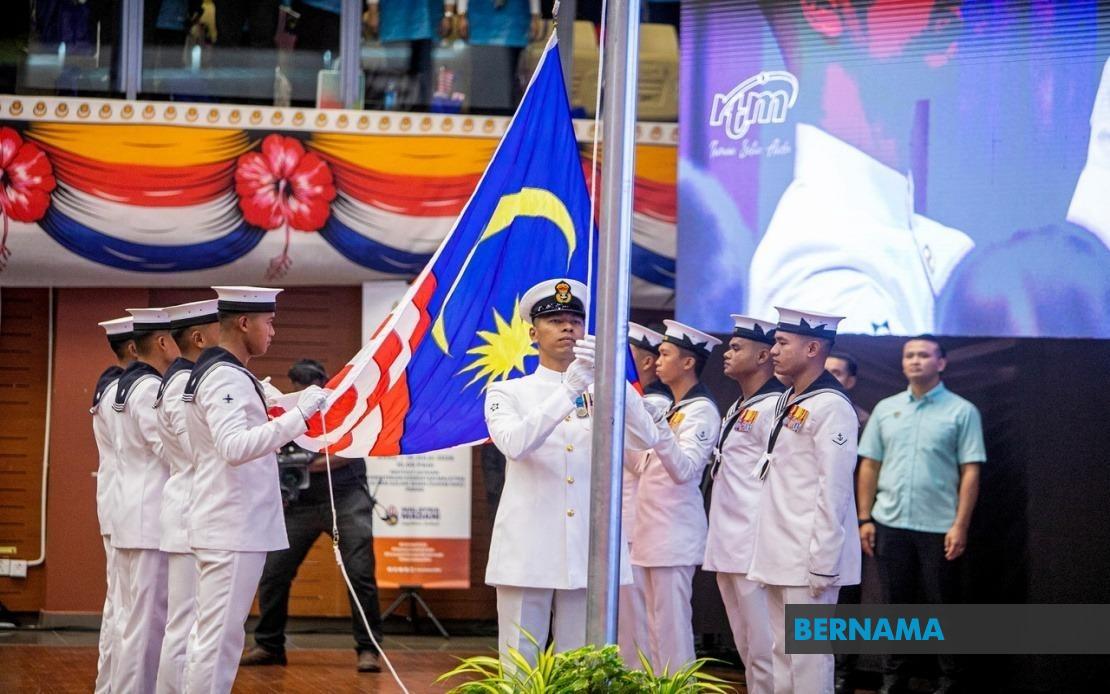
Prime Minister Datuk Seri Anwar Ibrahim presided over the revival of the Jalur Gemilang raising ceremony in Ipoh today, breathing new life into a cherished patriotic tradition that had lapsed for two years. Held at the Sultan Azlan Shah Ministry of Health Training Institute (ILKKM SAS) in Tanjung Rambutan, the event marked the official commencement of the 2026 National Month and Fly the Jalur Gemilang campaign, underscoring the government's commitment to reinvigorating national pride during the lead-up to August 31 National Day and September 16 Malaysia Day celebrations.
The ceremonial hoisting of the national flag, executed with traditional military precision, served as the centrepiece of the launch. A nine-member Royal Malaysian Navy contingent from the Lumut Base, commanded by Chief Petty Officer Mohamad Razif Aliff Md Yusof, received the Jalur Gemilang from Prime Minister Anwar in a symbolic passing of the torch that represented the nationwide campaign's inauguration. The flag itself, measuring 1.82 metres by 3.65 metres, was hoisted while participants sang Negaraku, creating a moment intended to crystallize the collective spirit of patriotism that organizers hope will permeate Malaysian society throughout the coming months.
The restoration of this ceremony reflects broader efforts to strengthen national unity and civic engagement. Having been absent from the public calendar for two years, its return signals an intentional recalibration of how the government wishes to frame the National Month period. Rather than treating it as a bureaucratic obligation, officials sought to reinvest the celebration with ceremonial gravitas and emotional resonance, recognizing that ritual and symbol remain powerful tools for fostering cohesion in an increasingly diverse nation.
Complementing the flag-raising was the recitation of the Rukun Negara pledge by ILKKM SAS trainee Muhammad Ammar Mohd Asri, a deliberate inclusion that connected participants to Malaysia's foundational values. The act of collectively standing in respect while singing the national anthem served multiple purposes: it grounded the event in constitutional patriotism, reinforced shared national identity across religious and ethnic lines, and provided a tangible expression of devotion to country that transcends political division.
The Fly the Jalur Gemilang campaign, renewed for 2026, encourages Malaysians to display the national flag prominently in homes, vehicles, and public spaces throughout the month. This grassroots dimension transforms the official ceremony into a decentralized movement, empowering ordinary citizens to participate actively in nation-building rather than remaining passive observers. The campaign recognizes that patriotism, to be genuine and sustainable, must find expression in everyday life rather than existing solely within state-orchestrated events.
A significant cultural element emerged with the unveiling of "Aku Berjanji" as the official theme song for the 2026 National Day and Malaysia Day celebrations. Composed and performed by Faizal Tahir, the track became available for public download via the Merdeka360 portal beginning at 12:30 pm today, enabling widespread accessibility and encouraging Malaysians to engage with the campaign's messaging through music. The selection of a contemporary artist rather than relying solely on traditional patriotic compositions signals an attempt to make the celebrations resonate with younger demographics who might otherwise feel disconnected from formal state ceremonies.
The timing of this revival carries particular significance in Malaysia's current political context. Following periods of internal party restructuring and coalition adjustments, the National Month campaign provides an opportunity to redirect public focus toward unifying themes that supersede partisan considerations. By positioning the Prime Minister as the figurehead presiding over these ceremonies, the government seeks to cultivate an association between national unity and its administration, a calculation that reflects the centrality of patriotic symbolism to contemporary Malaysian governance.
For Southeast Asia more broadly, Malaysia's emphasis on flag-raising ceremonies and national pride campaigns reflects regional trends in how post-colonial nations maintain social cohesion. Similar observances occur throughout the region, yet Malaysia's particular challenge involves reconciling its multicommunal character with unified national narratives. The Jalur Gemilang ceremony, by incorporating Islamic prayer recitations, secular patriotic songs, and military tradition, attempts to construct an inclusive framework within which diverse communities can express collective belonging.
The logistics of hosting the launch in Perak state, through the Sultan Azlan Shah Institute, also carries symbolic weight. By situating the event outside the federal capital, organizers avoided the perception of concentrated, centralized control over national narratives. Perak's historical significance in Malaysian nation-building, combined with the training institute's role in developing health professionals, created a venue that positioned patriotism as integral to public service and national development rather than as an abstract ideological construct.
Looking forward to the comprehensive National Month programming scheduled for the remainder of 2026, this ceremony establishes the emotional and ceremonial foundation upon which subsequent activities will build. Government ministries, state authorities, and community organizations will implement patriotic programmes and activities designed to maintain momentum established through this televised launch event. The campaign's success will ultimately depend on whether these subsequent initiatives manage to sustain public enthusiasm beyond the initial ceremonial moment.
The Merdeka360 portal, through which the campaign's theme song is distributed, represents an additional modernization of traditionally ceremonial observances. By incorporating digital platforms and enabling easy access to campaign materials, organizers acknowledge contemporary consumption patterns while attempting to democratize participation in National Month activities. This technological integration potentially expands reach beyond those who can physically attend official ceremonies, creating multiple entry points for civic engagement.
As Malaysia approaches the crucial dates of August 31 and September 16, the re-establishment of the Jalur Gemilang ceremony offers both continuity with past practices and a fresh opportunity to reimagine how national celebrations function in contemporary society. The ceremony's revival, after two years of absence, suggests that officials recognize the enduring power of symbolism and ritual in maintaining national cohesion. Whether this restoration can translate ceremonial moments into sustained engagement with the deeper values these symbols represent remains an open question for the coming months.

