Navigating George Town, Penang's UNESCO-listed heritage zone requires more than just following street signs. The city reveals itself in layers: the restored colonial architecture of Beach Street and Armenian Street, the warren of food courts and shophouses, and the arterial roads that once served practical purposes and now carry layers of historical significance. Jalan Burma exemplifies this convergence, functioning simultaneously as a working commercial thoroughfare, a repository of Penang's multicultural past, and an increasingly popular destination for visitors seeking authentic dining experiences beyond the mainstream tourist circuit.
The heritage zone that attracts most day-trippers encompasses several major arteries including Lebuh Pantai, Lebuh Armenian, Lebuh Carnavon, Lebuh Chulia and Pengkalan Weld, where meticulously maintained shophouses and galleries cater to souvenir hunters and art enthusiasts. Yet for discerning travellers, the real geography of George Town is not defined by preservation zones but by culinary categories and dining philosophies. The city's food culture transcends simple zoning—visitors can navigate by dietary preference, from halal establishments to pork-free options, street food stalls, cafes, and the ubiquitous nasi kandar restaurants that inspire passionate loyalty and equally fierce debate among locals and returning visitors alike. Penang's international recognition for its food scene has created a parallel navigation system entirely: the 74 Michelin-recommended eateries scattered throughout the city, of which two hold one-star status, 33 feature on the Bib Gourmand list celebrating excellent value, and 39 appear as Michelin Selected venues.
For many visitors, pursuing these Michelin designations provides a structured framework for exploring George Town without sacrificing authenticity. The appeal lies not in fine dining's formality but in accessible excellence—particularly the Bib Gourmand stalls nestled within food courts and traditional coffeeshops where the sensory experience of dining becomes part of the attraction. The aromas of multiple stalls mingling overhead, the visual engagement of watching cooks assemble noodles and curries, the casual camaraderie of shared tables: these elements create an atmosphere that no starched tablecloth can replicate. Such venues represent something deeper about Penang's culinary identity than polished presentations ever could.
Jalan Burma itself stretches nearly 5 kilometres, making it one of the city's longest arterial roads. It begins at the boundary of the heritage zone and extends through increasingly residential neighbourhoods toward the upscale Pulau Tikus district. The walk is generally safe and pleasant, though two sections lack dedicated pedestrian pathways—a minor inconvenience for those willing to navigate around the occasional parked motorcycle or vendor stall. For the energetic visitor, the full return journey from the heritage zone offers roughly 4 kilometres of urban exploration, feasible even during Penang's oppressive midday heat with adequate hydration and shade strategies.
The road's name carries multiple layers of linguistic and historical sediment. Original signboards and maps identify it as Burmah Road, reflecting anglicized colonial nomenclature. However, older designations reveal the road's original utilitarian purpose: Jalan Tarek Ayer (Water Cart Road) in Malay, or Gui Chia Chui in Hokkien—both references to the bullock carts that once transported water along this route in the pre-modern era. These names persisted until the 19th century, when a substantial Burmese community established itself in the Pulau Tikus area, prompting the road's renaming to acknowledge the demographic shift. Today, this historical transition remains visible in the Burmese-influenced nomenclature of surrounding lanes: Rangoon Road, Mandalay Road, and Moulmein Close preserve connections to that colonial-era migration.
The Dhammikarama Burmese Temple, established two centuries ago and situated on one of the lanes branching from Jalan Burma, stands as a physical anchor to this history. An information board positioned beneath the Komtar Octopus Pedestrian Bridge provides simplified historical context for those without deeper prior knowledge, making Jalan Burma accessible to casual visitors while rewarding those who take time to research the area's layers. The proximity of such historical monuments to working food stalls and residential spaces prevents the street from becoming a museum—instead, it functions as living heritage, integrated into ordinary Penang routines rather than cordoned off for preservation.
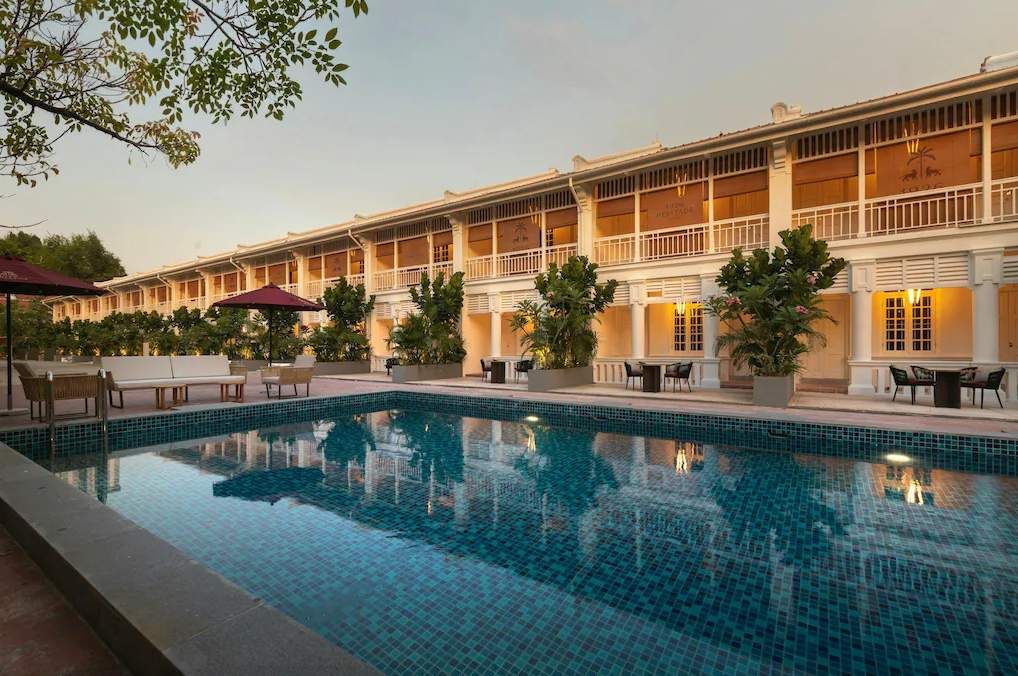
Within this context sits the recently renovated heritage hotel, a restored version of a building constructed in 1926 that marks its centennial during the current year. The original structure housed British colonial administrators and local government officials, embodying the Anglo-Malay architectural vocabulary common throughout 1920s George Town. The original 24 interconnected link houses underwent conversion into hotel accommodation when the Penang Development Corporation transformed the property in 1999, creating 78 rooms and suites distributed across six categories. The Heritage Room accommodates solo travellers in modest comfort, while the Straits Suite represents the building's most spacious offering. Modern amenities like WiFi-connected water filtration systems inhabit rooms whose bones reflect an earlier century, creating the characteristic tension between heritage preservation and contemporary hospitality.
The hotel's proximity to Michelin-listed food venues makes it a strategic base for food-focused exploration. Duck Blood Curry Mee operates just doors away, offering the aromatic white curry noodles that merit a visit despite the abundance of alternatives. More significantly, Restoran Old Green House houses the original operation of Green House Prawn Mee & Loh Mee, a Bib Gourmand-listed stall that draws locals and informed visitors in equal measure. A satellite operation called Green House Prawn Mee/Law Mee Corner operates elsewhere on Jalan Burma; locals consistently direct newcomers toward the original, recognizing that provenance matters in Penang's food culture even when product quality may be comparable. The distinction reflects deeper truths about how dining communities maintain hierarchies of authenticity and heritage within competitive food scenes.
From this food-focused base, visitors can easily access the broader heritage zone, traversing toward Lebuh Campbell, Lebuh Kimberley, and Beach Street through the central business district. The walk requires preparation—borrowed umbrellas, adequate hydration, and comfortable footwear—but rewards effort with unexpected discoveries and the physical sensation of understanding the city's spatial organization. This embodied navigation, moving through streets rather than observing them from vehicles or maps, creates lasting impressions unavailable to more passive tourism.
The immediate neighbourhood surrounding Jalan Burma offers additional attractions for weekend visitors. The Hin Bus Depot, a converted bus terminal, operates as a marketplace featuring local artisans, curio vendors, homemade food producers, and live music performances. The venue attracts primarily local clientele and culturally engaged tourists rather than mass-market visitors, maintaining an unpretentious atmosphere where original artworks and handmade goods can be evaluated and purchased directly from creators. The casual dining options available alongside performances create natural gathering spaces that feel organic to Penang's social rhythms rather than designed for external consumption.
Root House by Gen, the hotel's in-house modern Chinese restaurant, provides an alternative to street exploration for evenings when fatigue or weather discourages extended walking. The contrast between casual noodle stalls and more formally presented cuisine at the hotel's establishment creates a useful counterpoint—neither represents definitive Penang dining, yet both contribute genuine dimensions to understanding the city's food culture. The capacity to move between these registers within a single day or stay prevents the false dichotomy that sometimes presents street food and fine dining as opposing categories rather than complementary approaches to satisfying hunger and curiosity.
Jalan Burma ultimately functions as more than a convenient tourist corridor or a string of dining recommendations. The road embodies Penang's historical complexity, its layered multicultural demographics, its capacity to preserve heritage while accommodating contemporary commercial life, and its reputation as a destination where eating well requires neither excessive expense nor elaborate planning. Walking its length connects visible monuments like temples and hotels with ordinary working spaces where cooks prepare daily meals for regular customers who have chosen these stalls repeatedly across years. For visitors willing to move beyond curated heritage zones and into actual neighbourhoods, Jalan Burma offers what tourism marketing struggles to convey: the texture of a real place where history, food, community, and commercial exchange continue negotiating their coexistence.

