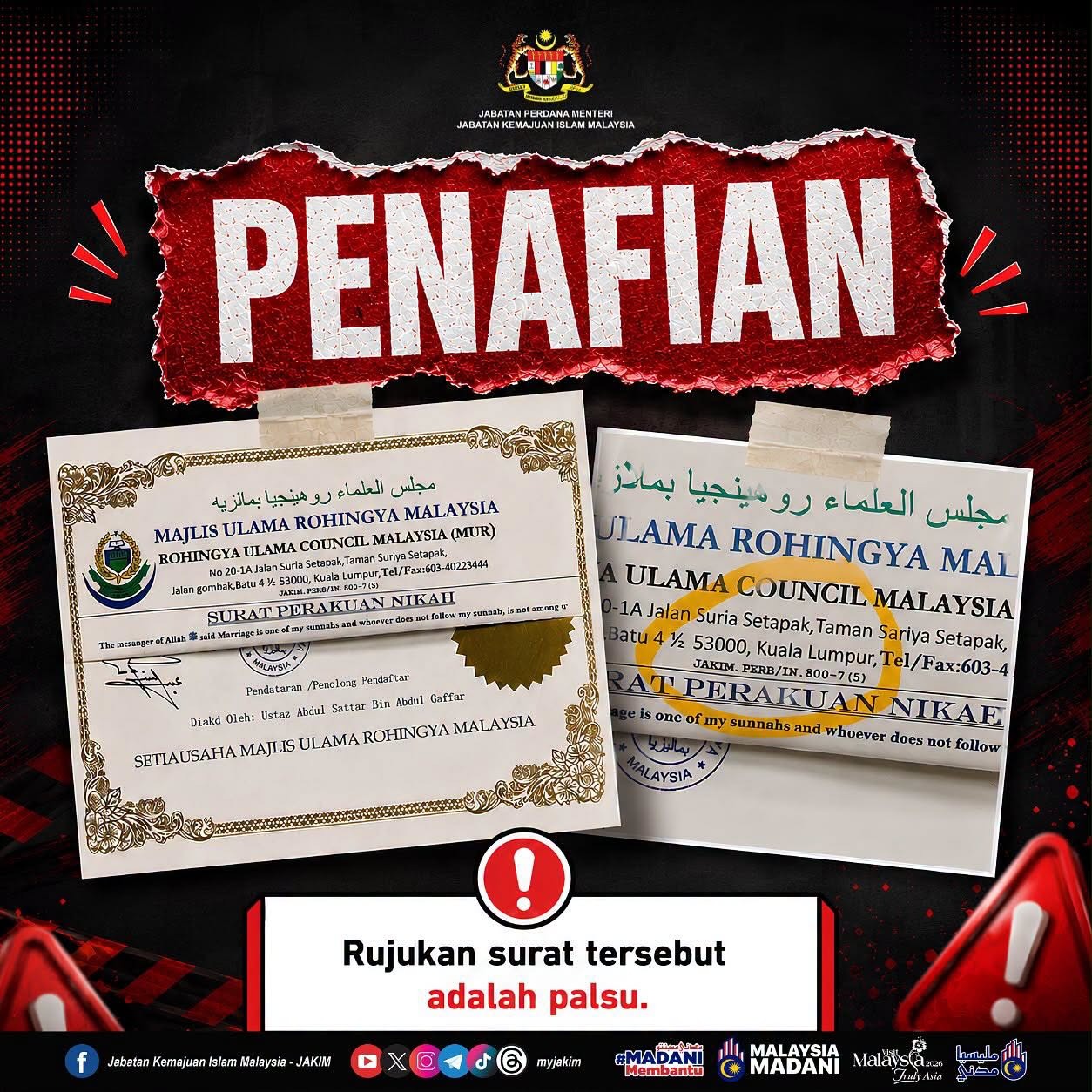
Malaysia's Department of Islamic Development (JAKIM) has moved to shut down a widening misinformation campaign centred on a forged letter purporting to grant an organisation official recognition to handle marriage matters. The department released a clarification on its official Facebook channel, confirming that the document circulating on social media does not originate from JAKIM or any other legitimate Islamic religious authority operating within the country. This intervention comes as the letter, which references the Malaysia Rohingya Ulama Council, has gained traction online and raised concerns about potential fraud affecting vulnerable communities.
The fraudulent document bore the reference number "JAKIM.PERH/LN.800-7(5)", which was deliberately crafted to appear authentic and lend credibility to the claims within. Upon investigation, JAKIM determined that this reference number does not correspond to any legitimate documentation issued by the department. The discovery underscores a troubling pattern in which bad actors fabricate official-looking correspondence to deceive members of the public into believing unauthorised organisations operate under government sanction. Such forgeries pose significant risks to individuals seeking legitimate religious services, particularly those from marginalised communities who may be less aware of proper verification procedures.
In its statement, JAKIM was explicit: neither the department itself nor any of Malaysia's state-level Islamic religious councils have ever engaged the mentioned organisation to manage, oversee, or certify marriage-related matters. This blanket denial reflects the seriousness with which authorities view the attempt to misrepresent an organisation's credentials and status. The implication is that anyone utilising this fraudulent letter as evidence of legitimacy would be relying on a completely fabricated foundation, exposing them to potential legal and social complications down the line. The department's firm stance signals to the public that it takes such misrepresentation seriously and will not tolerate unauthorised entities operating under its name.
The viral nature of the letter highlights a vulnerability in how religious and official documents circulate in the digital age. Social media platforms enable rapid dissemination of misinformation, and users often share content without verifying its authenticity. In this case, the professional appearance of the forged letter—complete with what appeared to be an official reference number—likely contributed to its initial credibility among those who encountered it. The episode demonstrates how even relatively simple forgeries can gain significant reach and potentially influence behaviour if not quickly counteracted by authoritative sources. For Malaysia's Islamic regulatory framework, which relies on clear hierarchies of authority and formal channels of communication, such deception represents both a challenge and an opportunity to educate the public about verification procedures.
Dr Zulkifli Hasan, the Minister in the Prime Minister's Department (Religious Affairs), acknowledged the matter and indicated that an investigation would proceed once comprehensive details became available. His involvement signals that the government is treating the incident with the appropriate level of institutional attention. The involvement of a ministerial-level official suggests recognition that document fraud affecting religious matters touches upon both public administration and social cohesion. The commitment to investigate implies that authorities will seek to identify the source of the forgery and determine whether additional fraudulent documents are in circulation. This proactive stance may help prevent similar incidents or reveal an organised pattern of deception requiring more comprehensive countermeasures.
JAKIM's advisory to members of the public represents an important step in combating such fraud. The department explicitly encouraged citizens to verify any questionable religious documentation directly with JAKIM or the appropriate state Islamic religious authority before treating such documents as genuine. This guidance effectively empowers individuals to serve as the first line of defence against misinformation by taking responsibility for confirming authenticity rather than passively accepting material at face value. In a religious context, where trust and legitimacy are paramount, such verification procedures are essential safeguards. The department's willingness to engage in direct communication with the public through accessible channels like Facebook indicates an understanding that transparency and accessibility are key components of combating fraudulent claims.
The targeting of the Malaysia Rohingya Ulama Council in this fraud case carries additional significance given the vulnerable status of Rohingya communities in the region. Members of this diaspora population may be particularly susceptible to fraudulent schemes, either because they face barriers to accessing accurate information or because their immigration and legal status creates dependency relationships with unofficial intermediaries. A forged letter purporting to legitimise an organisation serving their community could potentially be exploited to extract fees, gather personal information, or otherwise victimise individuals already facing considerable social and economic challenges. This dimension of the incident underscores why swift official clarification matters beyond mere administrative correction—it serves a protective function for populations at risk.
For Malaysian readers and regional observers, the incident illustrates broader challenges in managing information integrity across digital platforms. The ease with which official-looking documents can be fabricated, combined with the speed at which misinformation spreads online, creates persistent vulnerability. While JAKIM's response demonstrates institutional capacity to respond to such challenges, the underlying problem remains: the gap between the speed of fraudulent dissemination and the lag in official correction. As Southeast Asian nations grapple with similar issues across various sectors and jurisdictions, this case offers lessons in rapid response protocols and the importance of proactive public communication strategies.
Looking ahead, the incident may prompt JAKIM and other Malaysian government agencies to review their document security measures and public communication protocols. Enhanced security features on official documents, clearer public guidance on verification methods, and perhaps more frequent educational campaigns could reduce susceptibility to such fraud. Additionally, closer coordination with social media platforms might enable faster removal of flagrantly fraudulent content. The investigation into the source of the forged letter may also reveal whether this represents an isolated incident or part of a broader scheme targeting Malaysia's Islamic institutional framework. Regardless of the outcome, the department's swift and transparent response has already limited the immediate impact and reaffirmed the importance of institutional credibility in maintaining public trust.

