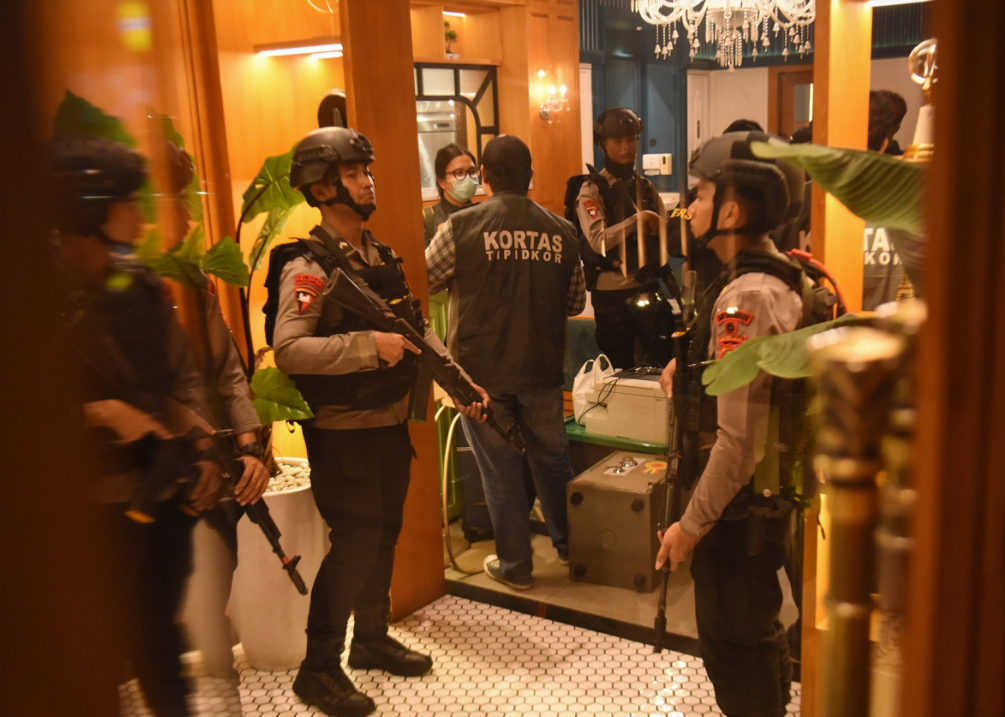
A dramatic series of raids across Jakarta and its surrounds has shaken Indonesia's law-enforcement establishment, with police uncovering extraordinary quantities of gold and foreign currency at properties allegedly linked to Febrie Adriansyah, who served as the nation's deputy attorney general for special crimes until his sudden resignation last weekend. The operation, which unfolded over an entire night and into the early hours of Thursday, culminated in the discovery of gold bars weighing 74 kilograms and millions of dollars in various currencies, revealing what investigators believe may be a sophisticated money-laundering and corruption operation at the heart of the country's judicial system.
The initial strike came at de'Clan Signature, an upmarket restaurant in Cipete, a low-rise neighbourhood in South Jakarta where armed personnel from the Jakarta police force and the National Police's specialised anti-corruption unit arrived in heavy tactical gear. Behind a cabinet inside the establishment, concealed in a safe roughly two metres high, officers found substantial quantities of cash in multiple currencies alongside important documents, all valued at millions of dollars. The operation did not stop there. Adjacent to the restaurant sat Koin Money Changer, where investigators breached another safe containing hundreds of thousands of additional dollars denominated in rupiah.
However, the most striking discovery came at a residential property in the affluent Sentul hills, situated approximately an hour's drive south of the capital. Within this high-end home, law enforcement teams located seven suitcases holding 74 kilograms of gold bars alongside cash in numerous currencies. The combined estimated value of assets seized across all locations reached US$26.3 million, making this among the largest single corruption hauls in recent Indonesian memory. The sheer volume of physical currency and precious metal, photographed and displayed by authorities, has become the dominant visual representation of an unfolding scandal that threatens to undermine public confidence in Indonesia's legal institutions.
Febrie Adriansyah, the individual at the centre of the investigation, had occupied his position as deputy attorney general for special crimes for more than four years before stepping down following the raids. Though investigators have named him as a suspect in both corruption and money-laundering cases, he has not been detained. In his response to the accusations, Febrie acknowledged ownership of the Sentul residence but disputed claims that the seized assets belonged to him, instead suggesting that their true origin and ownership would become clear through legal proceedings. This assertion has done little to quell mounting public and political scrutiny surrounding the case.
The scope of the operation extended well beyond the initial two raid sites. Police conducted searches at a minimum of ten additional locations across Jakarta and its vicinity, including an upmarket apartment at Pacific Place towers near the city's financial district and various commercial offices distributed throughout the metropolitan area. Investigators also targeted residential properties in the Gandaria area of South Jakarta, locations connected to Don Ritto, a lawyer who has similarly been identified as a suspect in the investigation. According to local media reports citing corporate documentation, Ritto maintains business interests in entities linked to both the raided restaurant and money-changing operation, suggesting the network may extend beyond Febrie himself.
Don Ritto, unlike Febrie, has been taken into police custody, indicating that investigators may view his role as more directly implicated in the alleged illicit activities. The decision to detain Ritto while releasing Febrie on his own recognisance has itself become a point of discussion among legal observers and anti-corruption advocates, who question whether the disparate treatment reflects investigative strategy or institutional consideration of Febrie's former senior position.
The discovery has triggered intense debate within Jakarta's political and legal circles regarding what these findings actually signify about Indonesia's anti-corruption infrastructure. Some commentators have characterised the successful identification and seizure of assets as evidence that institutional safeguards function effectively, demonstrating that even high-ranking officials remain subject to investigation and accountability. Others, however, view the case as yet another manifestation of a deeper structural corruption problem within the system, where individuals in positions of tremendous authority have been able to accumulate and conceal extraordinary wealth through illicit means.
Mahfud MD, a distinguished constitutional law expert who formerly served as chief justice of Indonesia's Constitutional Court and coordinating minister for political, legal and security affairs, has raised significant procedural concerns about the investigation's direction. In a public statement made through his YouTube channel, Mahfud questioned the legal foundation for transferring the case from police jurisdiction to the Attorney General's Office, arguing that such a transfer lacks explicit authorisation under Indonesia's criminal procedure code. He warned that this procedural irregularity could expose the entire case to pretrial legal challenge, potentially undermining any eventual prosecution. Mahfud has called upon the Corruption Eradication Commission, an independent state institution specifically mandated to investigate high-level corruption, to assume control of the investigation to ensure its integrity and legal soundness.
This institutional conflict reflects broader tensions within Indonesia's law-enforcement ecosystem, where multiple agencies possess overlapping jurisdictions and sometimes competing interests. The involvement of the Attorney General's Office becomes particularly significant given that Febrie himself served in that institutional structure, raising questions about whether the office possesses sufficient independence and impartiality to conduct an unbiased investigation of one of its own former senior leaders. The call for the Corruption Eradication Commission to take over represents an attempt to insulate the investigation from potential institutional bias and political manipulation.
As journalists and analysts in Jakarta scrutinised every new development through Monday afternoon, uncertainty remained about what additional properties or individuals might become subjects of investigation. The discovery of such substantial hidden assets connected to a figure responsible for prosecuting financial crimes has profound implications for public trust in Indonesia's legal system. It raises uncomfortable questions about how thoroughly institutions actually monitor the wealth accumulation of their own officials and whether existing anti-corruption mechanisms possess sufficient teeth to deter high-level malfeasance. For Malaysia and other Southeast Asian neighbours, the Jakarta scandal serves as a cautionary reminder of the persistent vulnerability of even robust institutional frameworks to penetration by corruption at the highest levels.

