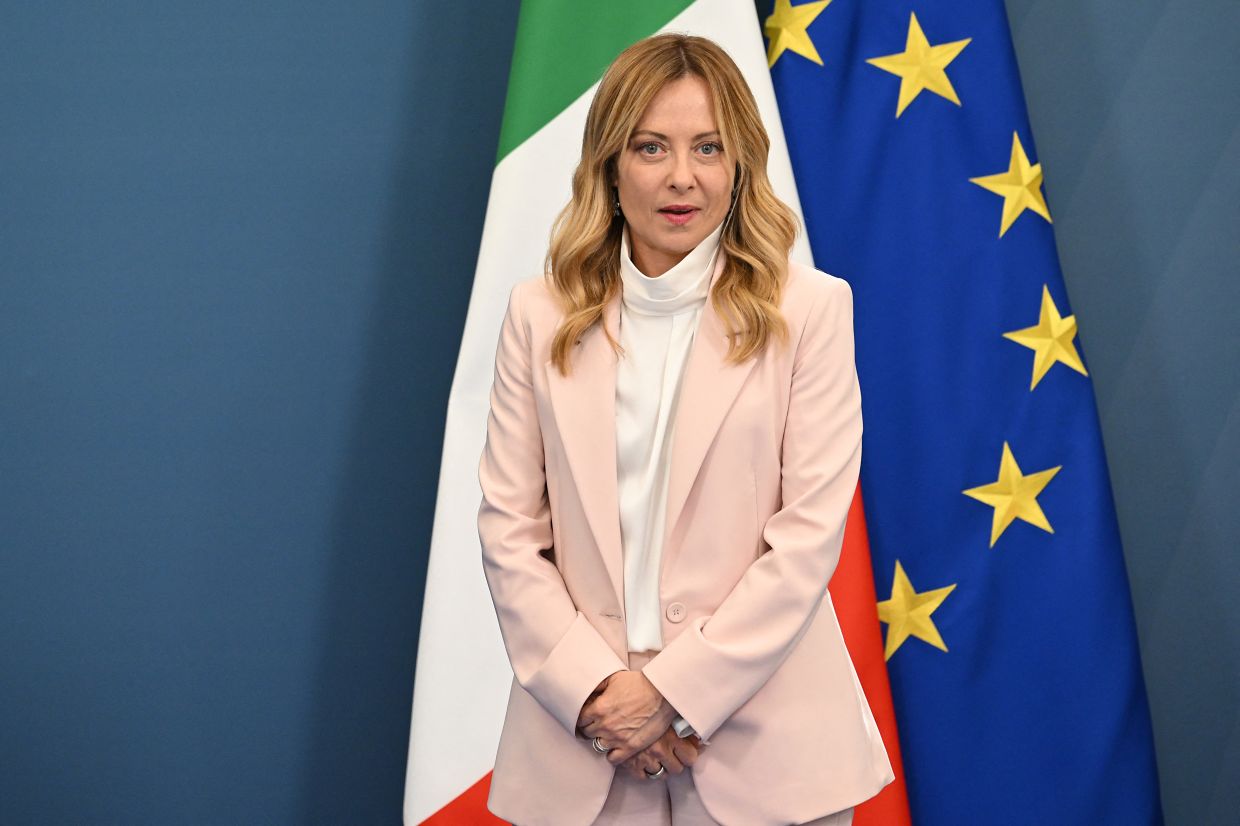
Italian Prime Minister Giorgia Meloni has undergone a remarkable transformation since ascending to power in October 2022, and perhaps nowhere is this metamorphosis more visible than in her carefully curated wardrobe. What the leader chooses to wear tells a compelling story about her political recalibration—from the dark, austere aesthetic of her outsider days to the softer, more welcoming silhouettes she now favours on the international stage. Fashion experts and political analysts increasingly recognise that Meloni's sartorial choices function as a sophisticated form of non-verbal communication, signalling her evolution toward pragmatism without explicitly abandoning the conservative credentials that swept her party to power.
When Meloni first entered the premier's office in October 2022, her appearance unmistakably reflected her political positioning. Heavy black boots paired with dark suits created an imposing, confrontational visual identity that aligned perfectly with the expectations many held of a leader emerging from Italy's post-fascist political fringe. These garments were not incidental fashion choices but deliberate symbols of her outsider status and ideological commitment to a particular segment of the electorate. However, as her tenure has progressed and she approaches the possibility of becoming Italy's longest-serving postwar leader, her public presentation has undergone a calculated softening. Today, pastel-coloured suits with generous, wide-legged trousers characterise her typical appearance, with high heels deliberately obscured beneath the fabric—a stark departure from her earlier sartorial statements.
This wardrobe evolution reflects a deeper political recalibration that has surprised many observers. Contrary to expectations when she took office, Meloni has governed considerably less radically than critics anticipated. While maintaining conservative domestic policies, particularly regarding migration, she has adopted a distinctly pragmatic approach toward the European Union and emerged as one of Ukraine's most steadfast supporters during its conflict with Russia. She has even demonstrated a willingness to publicly disagree with United States President Donald Trump, earning respect from European counterparts who questioned whether a leader with post-fascist roots could be a reliable partner. These political shifts—from ideological purity to establishment responsibility—required corresponding changes in her public image, and her clothing became an essential tool in communicating this transformation.
Fashion experts who study the intersection of sartorial choices and political messaging recognise the sophisticated calculus at work. Antonio Mancinelli, who teaches at Rome's Costume and Fashion Academy, notes that Meloni clearly understands how integral clothing is to non-verbal political communication. The shift from harsh blacks to softer pastels conveys authority while eliminating the confrontational edge that characterised her earlier image. These lighter hues carry psychological associations with openness, approachability, and trustworthiness—qualities essential for a leader seeking to govern a major European democracy rather than agitate from opposition. The tailored cuts of her contemporary suits project professionalism without the aggression of her former aesthetic choices.
The significance of Meloni's fashion diplomacy carries particular weight given Italy's outsized cultural and economic position in the fashion world. For a female leader representing a nation where fashion constitutes a pillar of the economy and national identity, wardrobe choices transcend personal preference to become a statement about the country itself. As Italian-Haitian fashion designer Stella Jean observes, the stakes are considerably higher when a woman leading a globally respected fashion powerhouse makes deliberate sartorial statements. Meloni's evolution toward elegant, accessible styling sends a message not only about her own political maturation but about Italy's place on the world stage—sophisticated, stable, and fully embedded in European institutional life.
Meloni's early political career presented a starkly different image. In 1996, when she was just nineteen, a French television crew documented the young activist dressed almost entirely in black as she organised members of a right-wing youth movement. During that filmed interview, she openly defended Benito Mussolini—comments that have repeatedly resurfaced to complicate her political narrative. For more than two decades, she worked to distance herself from these extremist associations, a process that accelerated dramatically once she moved into formal political office. Her appointment as youth minister under Prime Minister Silvio Berlusconi in 2008 marked an important pivot point, when she began presenting herself in more serious, conventional attire—dark suits paired with white shirts that signalled professionalism and responsibility rather than ideological militancy.
The 2022 election campaign itself demonstrated how consciously Meloni was managing her image by that point. Her memorable speech describing herself as "a woman, a mother, a Christian" helped broaden her appeal beyond her traditional base and resonated powerfully with conservative centrists. This rhetorical softening accompanied corresponding changes in her public presentation. Even before winning the election, she had substantially reduced her appearances in all-black ensembles, recognising that such styling carried unwelcome historical associations in the Italian context. Black, while undoubtedly fashionable and worn by mourners and stylish individuals worldwide, remains deeply connected to fascism in Italian cultural memory—a connection that a pragmatic political operator could not afford to invite.
Since assuming office, Meloni has maintained remarkable consistency in her evolved wardrobe strategy. Tailored suits in muted, neutral palettes now constitute her standard public appearance, with trousers cut wide enough to conceal her heels entirely. This specific sartorial choice merits particular attention, as it represents a calculated decision to avoid the sharp, potentially aggressive visual statement that high heels visible beneath narrow trousers might communicate. Instead, the wider cut suggests stability, groundedness, and a deliberate de-emphasising of elements that might distract from her authority and competence. Fashion educator Michela Bonafoni, who teaches at Unicollege in Florence, notes that lighter colours psychologically communicate loyalty, tenderness, and gentleness, creating a welcoming impression essential for a leader seeking to project inclusive governance.
Political analysts understand these wardrobe choices within the broader context of Meloni's repositioning as she navigates her final year as premier. According to Riccardo Alcaro of Italy's Institute for International Affairs, her transformation from leading a small right-wing party with a narrow electorate to leading a major European Union country required a fundamental recalibration of her public image. Where she once needed to appeal to committed ideological supporters, she now must present herself as a credible, debate-worthy leader capable of managing a complex modern democracy. Her wardrobe serves this essential function, communicating gravitas, approachability, and belonging within established institutional frameworks.
The contrast between Meloni's current styling and her earlier presentation illuminates how thoroughly she has repositioned herself within Italy's political landscape. Those who watched her evolve from the 1996 television interview to her contemporary appearances witness not merely fashion evolution but a complete recasting of political identity. She faces mounting challenges from rivals on the right who question her ideological commitment, and no amount of tailoring can entirely overcome those political tensions. Yet her fashion choices have demonstrably contributed to her ability to govern effectively across ideological lines and maintain standing as a consequential European leader. Whether intentional or organic, her wardrobe has become an instrument of political communication as significant as her rhetoric, helping her navigate the delicate balance between her ideological origins and her institutional responsibilities.
Meloni's office has declined to comment on her wardrobe decisions or confirm whether she receives formal fashion advice. This silence itself communicates a strategy—suggesting that her clothing choices emerge organically from her evolving political identity rather than result from calculated manipulation. Yet the consistency and sophistication of her sartorial evolution suggest at minimum a clear understanding of how appearance functions in modern politics. As other world leaders—from Volodymyr Zelenskyy in military dress to Claudia Sheinbaum in Indigenous-embroidered garments—demonstrate, clothing remains a powerful vehicle for political messaging. Meloni's particular achievement lies in using fashion to reconcile her origins with her present responsibilities, allowing her to govern as an establishment figure while maintaining credibility with her original constituency.

