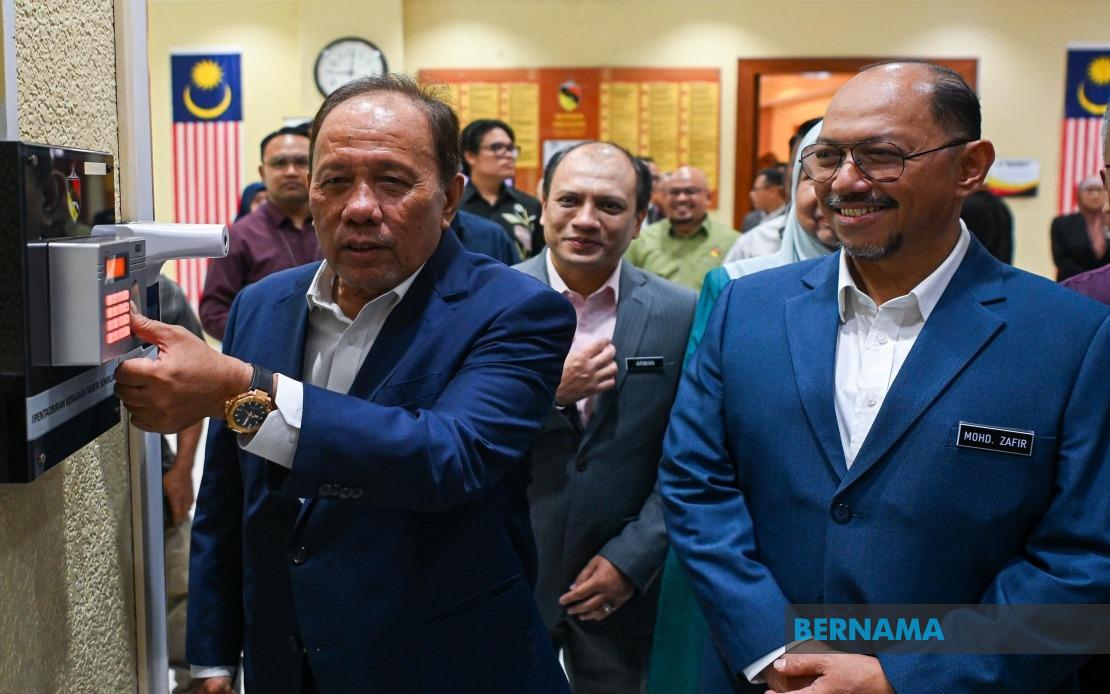
Datuk Ismail Lasim moved swiftly to defend the integrity of his recent appointment as Negeri Sembilan Menteri Besar, insisting that his elevation to the state's top executive position adhered strictly to established constitutional protocols. Speaking to journalists shortly after formally commencing his duties at Wisma Negeri in Seremban, Ismail expressed confidence that every step in the appointment mechanism had been executed with appropriate regard for proper governance standards and regulatory frameworks.
The newly minted Menteri Besar's public remarks came in direct response to assertions raised by Wawasan chairman Tan Sri Rais Yatim, who had voiced concerns regarding the legitimacy of the selection process. Rais Yatim's criticisms extended beyond procedural matters, with the influential figure alleging that external forces had improperly involved themselves in decisions touching upon Negeri Sembilan's constitutional arrangements and customary practices—suggestions that struck at the heart of state sovereignty and institutional independence.
Ismail's assumption of office followed a formal swearing-in ceremony conducted before Yang Dipertuan Besar of Negeri Sembilan Tuanku Muhriz Tuanku Munawir at Istana Besar Seri Menanti the preceding Sunday, lending his position the ceremonial weight and constitutional legitimacy that such rituals are designed to confer. The timing and solemnity of the investiture were intended to underscore the propriety of the appointment and to ground his mandate firmly within the state's traditional institutional framework.
The political backdrop to Ismail's appointment reflects shifting coalitional dynamics within Negeri Sembilan's legislature following the state elections. Barisan Nasional secured 18 seats from the 36-seat assembly, while Perikatan Nasional claimed seven, a distribution that granted both blocs commanding supermajorities individually. This fractured outcome meant that either coalition possessed sufficient numbers to govern unilaterally, creating uncertainty about which political force would ultimately assume the helm. Ismail's emergence as Menteri Besar was therefore not a foregone conclusion but rather the product of complex negotiations and decision-making processes involving various stakeholders within the ruling coalition structures.
For Malaysian readers accustomed to competitive politics, the appointment controversy highlights the persistent tensions between formal constitutional procedures and the informal political maneuvering that often accompanies leadership selection in state governments. The appointment of a Menteri Besar technically rests with the Yang Dipertuan Besar, who exercises discretion in choosing from among eligible candidates following consultations with relevant parties. However, the reality of coalition politics frequently creates scenarios where multiple contenders possess legitimate claims to the position, necessitating behind-the-scenes deliberations that can generate suspicion when not transparently communicated.
Rais Yatim's invocation of external interference represents a particularly sensitive accusation in Malaysia's federal structure. Concerns about federal government overreach into state affairs periodically surface in regional political discourse, touching upon fundamental questions about federalism and the autonomy that state governments should possess. Such allegations, whether substantiated or not, resonate with observers who view state-level governance as a critical counterbalance to federal power concentration. The specific mention of interference in matters relating to state customs and constitutional provisions amplified the gravity of the criticism, as these areas are traditionally conceived as lying within each state's domain of governance.
Ismail Lasim's record as the Juasseh state assemblyman provided him with legislative credentials, though he represented one seat among many within the larger Negeri Sembilan assembly. His selection over other potential candidates from within Barisan Nasional's cohort would have required deliberation among party leadership and state actors regarding experience, acceptability, and strategic considerations. The fact that he emerged as the choice speaks to calculations made by kingmakers within the coalition, though the nature of those deliberations remained largely opaque to public scrutiny.
The controversy surrounding Ismail's appointment also reflects broader anxieties within Malaysia's political ecosystem regarding institutional integrity and procedural adherence. In an era marked by shifting coalitions, defections, and frequent recalibrations of political alignments, public confidence in the legitimacy of appointments to high office depends substantially upon transparent adherence to constitutional norms. When questions arise about whether established procedures have been properly observed, they can undermine the perceived legitimacy of officeholders even when formal requirements have technically been satisfied.
For observers in other Southeast Asian jurisdictions, Negeri Sembilan's appointment process illustrates the peculiar institutional arrangements that characterize Malaysian federalism, wherein ceremonial rulers exercise real constitutional powers in relation to executive leadership selection. This feature distinguishes Malaysia's system from purely Westminster-model parliaments and creates additional layers of complexity in succession processes. The involvement of the Yang Dipertuan Besar as more than a merely ceremonial actor means that state-level executive transitions involve institutional players beyond the elected assembly itself, potentially creating friction between electoral outcomes and actual power distribution.
Ismail Lasim's defense of his appointment represents an effort to normalize the transition and to shift focus from procedural questions to substantive governance priorities. By asserting the regularity of his appointment, he sought to foreclose further debate on the matter and to establish his legitimacy as a leader entitled to command the administrative machinery of Negeri Sembilan. However, the persistence of such criticisms from figures like Rais Yatim suggests that a significant segment of informed observers remained unconvinced, potentially complicating Ismail's authority during his tenure as Menteri Besar and creating potential vulnerabilities should his government encounter future difficulties.

