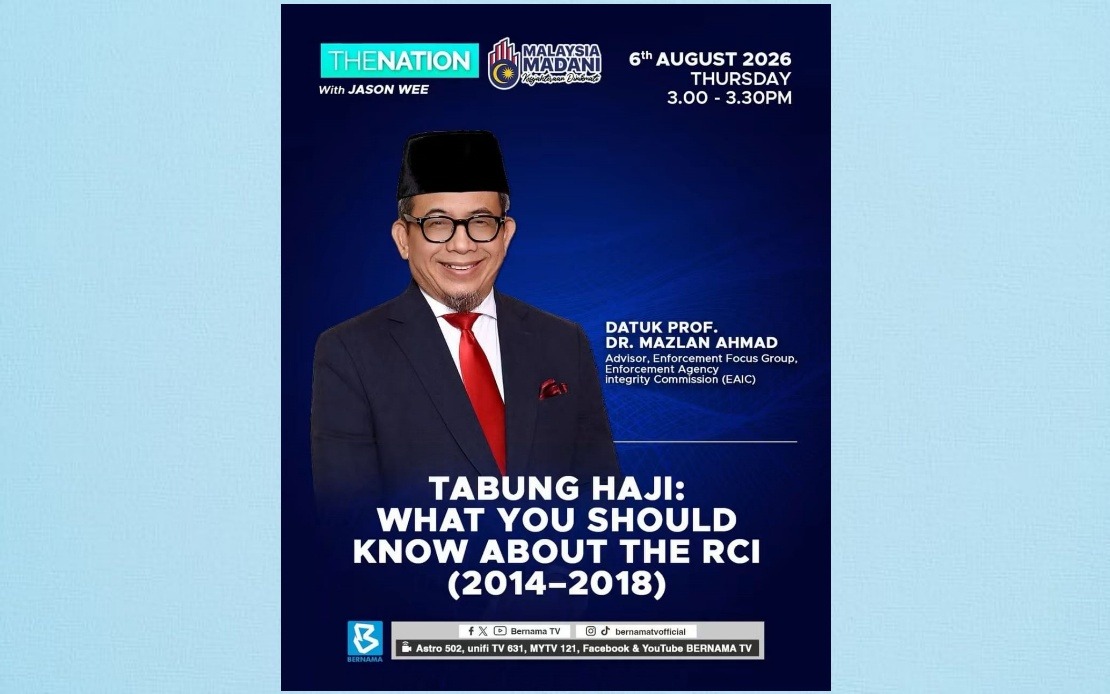
Following the release of a damning Royal Commission of Inquiry report on the Tabung Haji group, governance and enforcement specialists are now pushing for the Inland Revenue Board to launch a full-scale investigation into allegations of tax evasion spanning the 2014–2020 period. The call represents a significant escalation in scrutiny of the hajj savings institution, signalling that the official inquiry's conclusions may trigger wider criminal and financial investigations beyond the scope of the original RCI mandate.
Prof Datuk Dr Mazlan Ahmad, an advisor to the Enforcement Focus Group at the Enforcement Agency Integrity Commission, has articulated a comprehensive framework for how such an investigation should proceed. Speaking during a televised interview, Mazlan expressed conviction that both the main Tabung Haji entity and its subsidiary operations engaged in tax evasion, making IRB intervention not merely advisable but essential. His comments carry particular weight given his dual credentials as a chartered accountant and council member of the Malaysian Institute of Accountants, positioning him as both a technical expert and a voice within Malaysia's professional accounting community.
Critically, Mazlan has emphasised that any credible investigation must transcend conventional approaches and incorporate sophisticated forensic accounting methodologies. Such techniques would enable investigators to reconstruct the complete financial architecture of suspicious transactions, tracing capital flows from their original sources through intermediate destinations to final beneficiaries. This forensic dimension is crucial for establishing the intentionality and scale of any alleged wrongdoing, distinguishing between isolated irregularities and systemic patterns of misconduct that might implicate multiple decision-makers across the organisation.
Beyond tax evasion alone, Mazlan has raised the spectre of money laundering, suggesting that the suspicious transaction patterns identified by the RCI warrant examination through an anti-money laundering lens. Detecting money laundering involves identifying when funds move through financial channels in ways designed to obscure their illicit origins or criminal purpose. Were such activity present within Tabung Haji's operations, it would represent a far more serious violation than tax evasion alone, potentially invoking Malaysia's Anti-Money Laundering, Anti-Terrorism Financing and Proceeds of Unlawful Activities Act.
A particularly significant aspect of Mazlan's analysis concerns the scope of investigative focus. Rather than concentrating exclusively on senior management and board-level figures, he advocates for an ecosystem-wide examination encompassing all stakeholders, transaction counterparties, and institutional relationships surrounding Tabung Haji. This reflects a sophisticated understanding that large-scale financial misconduct rarely results from isolated bad actors but instead emerges from systemic vulnerabilities, weak controls, and institutional cultures that permit wrongdoing to flourish unchecked.
The governance failures identified in the RCI report constitute the foundation upon which these enforcement concerns rest. Mazlan has characterised the absence of adequate board-level oversight as a fundamental deficiency, one that represents a breach of the fiduciary duties inherent in directorship. In corporate law and governance theory, directors bear personal responsibility for ensuring that management operates within lawful boundaries and that adequate checks and balances exist to prevent misconduct. The RCI's findings of governance inadequacy thus suggest that senior institutional leaders may bear direct liability for financial irregularities occurring under their nominal watch.
The Royal Commission's July 29 publication of its final report regarding Tabung Haji's management and governance during 2014–2020 effectively constitutes an official roadmap for further investigation. Rather than representing the terminus of scrutiny, Mazlan contends that the RCI findings should serve as a launching point for deeper, more forensically rigorous examination by specialised enforcement agencies. This perspective reframes the inquiry as an initial assessment rather than a comprehensive resolution, implying that enforcement authorities now bear responsibility for translating the RCI's factual findings into determinations of criminal culpability and individual accountability.
Mazlan's characterisation of the situation as reflecting "systemic risk" rather than individual malfeasance carries profound implications for how investigations should proceed and how accountability should be assigned. Systemic risk suggests that multiple institutional actors, across various hierarchical levels, contributed to an environment enabling wrongdoing. This understanding militates against focusing exclusively on scapegoating individual executives while leaving underlying institutional vulnerabilities unaddressed—a pattern that has unfortunately characterised some previous Malaysian corporate governance scandals.
The timing of these calls for investigation is significant, as Parliament's special sitting scheduled for August 11 is set to debate the RCI report. This parliamentary discussion will likely amplify public and political pressure on enforcement agencies to demonstrate concrete follow-through on the inquiry's recommendations. For Malaysian citizens with funds invested through Tabung Haji, the prospect of serious financial crimes occurring within the institution raises urgent questions about asset protection, investor compensation, and the credibility of financial regulatory oversight in Malaysia's Islamic financial sector.
The intersection of tax evasion, money laundering, and governance failures within a large institutional framework like Tabung Haji also carries broader ramifications for Malaysia's regulatory ecosystem. The case may catalyse reforms in how oversight bodies coordinate investigation efforts, how forensic accounting expertise is deployed within enforcement agencies, and how corporate governance standards are enforced across large financial institutions entrusted with public funds.
Moreover, given Tabung Haji's particular significance as the primary channel through which Malaysian Muslims save for and undertake the hajj pilgrimage, the institutional trust violations alleged carry profound dimensions beyond mere financial crime. They strike at confidence in institutions specifically designed to serve religious and community purposes, potentially affecting millions of Malaysian families who depend on Tabung Haji for one of Islam's five pillars.

