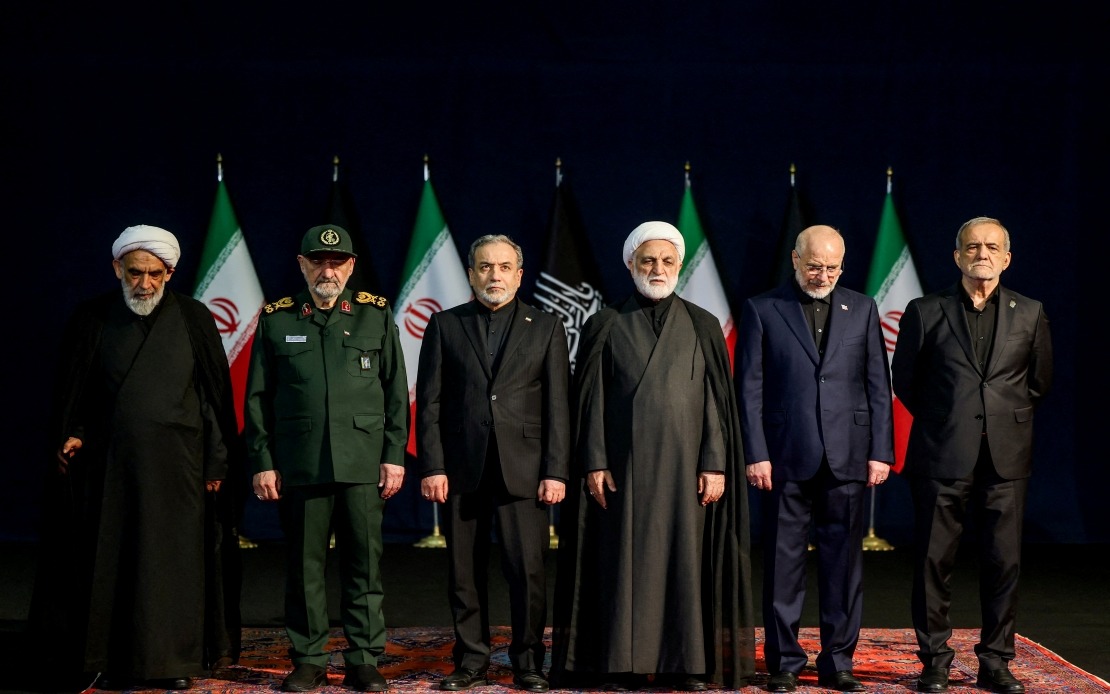
High-ranking dignitaries from across the globe converged on Tehran on Friday to participate in a formal tribute ceremony honouring Iran's late Supreme Leader Ayatollah Ali Khamenei, underscoring the international dimensions of Iran's political transition and the diplomatic implications of his successor's appointment. The ceremony, held at Imam Khomeini's Mosalla prayer hall in central Tehran, drew an impressive roster of foreign heads of state alongside Iran's top political and religious establishment, demonstrating the geopolitical significance Iran seeks to project during this critical moment of institutional succession.
The gathering reflected Iran's efforts to present a unified front and signal continuity in leadership during a period of heightened regional tensions. The domestic political establishment turned out in force, with Iranian President Masoud Pezeshkian, Parliament Speaker Mohammad Baqer Qalibaf, Judiciary Chief Gholamhossein Mohseni-Ejei, and Chairman of the Expediency Discernment Council Sadeq Amoli Larijani all in attendance. This collective show of institutional solidarity among Iran's powerful bodies suggests that despite the sudden nature of Khamenei's death, the mechanisms of state succession have functioned without apparent internal disruption or challenge to the established power hierarchy.
The international attendance at the tribute ceremony carried particular weight given the tense geopolitical context surrounding Khamenei's death. The gathering of foreign dignitaries—including heads of state from Pakistan, Armenia, Georgia, Iraq, and Tajikistan—provided Iran with an opportunity to demonstrate regional support and refute any suggestion that the nation faced internal instability or international isolation. Pakistan's representation by both Prime Minister Shehbaz Sharif and Chief of Army Staff Field Marshal Syed Asim Munir signalled the particular importance Islamabad assigns to maintaining stability in its neighbour and ally, while the attendance of Iraqi and Kurdish leaders underscored the continuing centrality of Iran's role in regional Middle Eastern affairs despite the loss of its paramount leader.
Among the attendees were also senior delegations from China and Russia, two powers with whom Iran has cultivated strategic partnerships in recent years. Their participation carried symbolic weight, suggesting that despite Western pressure on Iran and international tensions surrounding its nuclear programme, these major powers maintained diplomatic engagement and formal respect for Iran's succession process. The presence of these global players alongside smaller regional states reflected Iran's successful positioning within a multipolar international system where it maintains relationships across geopolitical divides.
The ceremony brought together not only political figures but also religious scholars, tribal leaders, and other traditional sources of authority within Iranian society. This inclusive approach to the tribute extended recognition to the diverse constituencies that constitute Iran's political and social fabric, from the formal state apparatus to tribal and religious communities. Such breadth of representation served both symbolic and practical functions—acknowledging the Supreme Leader's position as a figure transcending ordinary politics while securing buy-in from traditional power bases that remain influential in Iran's governance structure.
Khamenei's death resulted from what Iran attributes to a coordinated United States and Israeli military strike on Tehran on February 28, an event that sharply intensified regional tensions and raised questions about Iran's vulnerability to external attack. The succession process, which moved with unusual speed, saw Mojtaba Khamenei, the late Supreme Leader's son, selected as his replacement in March. This dynastic transition raises significant questions about institutional continuity and the long-term direction of Iran's governance model, particularly whether the consolidation of power within a single family indicates a shift toward more personalised leadership or reflects established patterns of succession within Iran's theocratic system.
The extended funeral ceremonies scheduled through July 9 will include major processions across Iran's three principal cities—Tehran, Qom, and Mashhad—as well as commemorative rites conducted in Iraq. The scale and geographic scope of these events underscore the symbolic importance the Iranian state assigns to the transition period. The announcement of public closures and airspace restrictions in Tehran and Mashhad, combined with the designation of Thursday as a national day of mourning, demonstrates the formal mobilisation of state apparatus to mark this historical moment and manage its domestic political implications.
For regional observers including Malaysia and Southeast Asia, the succession and the international response it generated carry implications for understanding how power transitions within major Middle Eastern states can affect broader stability. The demonstration of continuity through institutional participation and foreign state recognition suggests that despite the shock of Khamenei's assassination, Iran's governing structures have absorbed the succession without apparent fracture. The new Supreme Leader assumes office with his legitimacy already endorsed by both domestic power holders and significant international figures, a consolidated position that differs markedly from uncertain transition scenarios that might otherwise have emerged.
The ceremony's attendees and their roles signal how Iran will seek to position itself internationally under its new leadership. The emphasis on welcoming diverse foreign delegations while maintaining institutional coherence at home suggests a leadership determined to project both stability and influence during what might have become a vulnerable transitional period. For Malaysia and other Southeast Asian nations monitoring developments in the Middle East, the succession's apparent smoothness and the international validation it received offer evidence that despite regional tensions and external military strikes, Iran's institutional capacity for managing internal political transitions remains intact.

