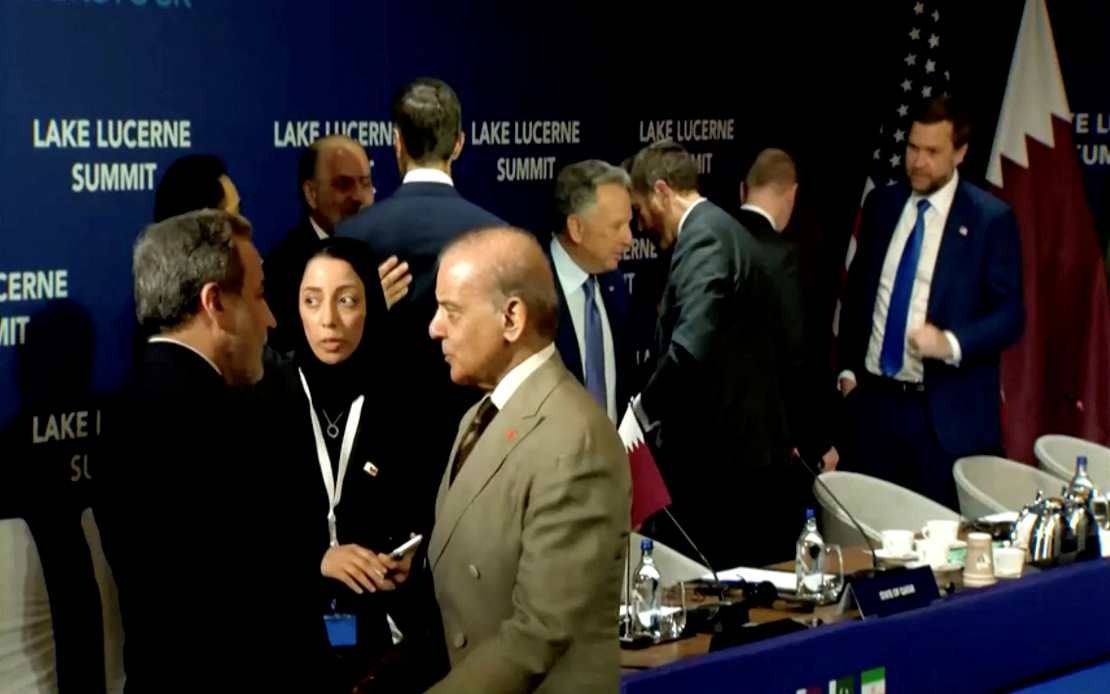
A senior member of Iran's delegation to ongoing peace negotiations revealed on Sunday that representatives from Tehran and Washington have successfully concluded a draft accord addressing the temporary suspension of sanctions targeting Iranian petroleum sales. The development emerges from intensive talks held at the Burgenstock resort in Switzerland, marking a significant advancement in efforts to achieve broader reconciliation between the two nations and their respective allies in the region.
Hossein Ghorbanzadeh indicated that the memorandum of understanding negotiated between Iran and the United States contains multiple provisions that remain conditional on reaching a comprehensive settlement to halt the protracted conflict in Lebanon. This conditionality reflects the interconnected nature of regional security concerns, with negotiators treating the Lebanon conflict as integral to achieving lasting diplomatic resolution rather than addressing each dispute in isolation.
The Swiss negotiations proceeded through parallel channels, with Ghorbanzadeh explaining that technical working groups convened separately to address complex implementation details beyond the scope of main discussions. These specialized sessions ultimately yielded the finalized draft on temporary sanctions relief, demonstrating a structured approach to resolving decades of bilateral tension through compartmentalized problem-solving.
Beyond oil sanctions, Iran's delegation seized the opportunity to broach the sensitive matter of frozen Iranian assets during consultations with the Qatari delegation, reflecting Doha's continued role as a critical intermediary. The release of these assets represents a longstanding Iranian priority, with billions in government and private funds locked in international accounts, hindering economic recovery and reconstruction efforts domestically.
The current negotiation framework stems from the Islamabad Memorandum of Understanding, a 14-point accord announced on June 14 that Pakistan helped broker through patient diplomacy. This agreement fundamentally shifts the tenor of US-Iran relations by explicitly committing both parties to end hostilities and resolve disputes through dialogue rather than escalation. The memorandum's scope extends beyond bilateral matters to encompass regional stability, positioning it as an ambitious attempt to reorder Middle Eastern geopolitics.
The accord formally entered force on June 18 following electronic signatures from Iranian President Masoud Pezeshkian and US President Donald Trump, lending it immediate legal weight and signaling both governments' commitment to implementation. This rapid activation contrasts sharply with past failed negotiations and suggests political momentum behind achieving substantive progress.
The memorandum's enumerated provisions constitute a comprehensive agenda for regional de-escalation. Ending hostilities across all theaters of conflict, including Lebanon where proxy forces have clashed intermittently, addresses one of the region's most destabilizing dynamics. Simultaneously, provisions regarding the Strait of Hormuz and the US naval blockade touch critical economic concerns, as the waterway remains vital to global oil flows and Iranian commerce relies heavily on unrestricted maritime access.
For Malaysian policymakers and business interests, these developments carry substantial implications. Malaysia's economy depends significantly on Middle Eastern stability and energy security, particularly regarding petroleum supplies and regional trade routes. A sustained reduction in US-Iran tensions could diminish risks to shipping lanes and energy prices, while simultaneously presenting opportunities for Malaysian companies to participate in Iranian reconstruction once comprehensive sanctions are lifted.
The temporary nature of the oil sanctions relief underscores negotiators' pragmatism; full normalization remains contingent on resolving broader conflicts rather than premature lifting of leverage. This graduated approach allows both parties to demonstrate good faith compliance before committing to irreversible measures, though skeptics question whether temporary measures will prove durable or devolve into renewed confrontation.
Regional observers note that success hinges critically on all parties honoring commitments across multiple theaters simultaneously. Lebanon's intricate sectarian composition and entrenched interests complicate efforts to establish a genuine ceasefire there, potentially jeopardizing the broader bargain if violence resurges. Similarly, maritime security in the Strait of Hormuz requires sustained coordination between numerous state and non-state actors whose interests may diverge from Tehran and Washington's positions.
The Swiss venue itself carries symbolic weight, Switzerland having served as a neutral space for US-Iran diplomacy repeatedly since the 1979 revolution. The Burgenstock resort, nestled in Switzerland's mountains, removed negotiations from the glare of hostile media environments in either country, allowing delegates to explore creative solutions with reduced domestic political constraints.
Momentum from these preliminary successes must translate into concrete implementation mechanisms and verification protocols to sustain progress. Oil sanctions relief, while economically significant for Iran, represents only one component of a much larger reconfiguration of Middle Eastern alignments. How Chinese, European, and Gulf state interests intersect with the emerging framework remains unclear, suggesting that truly durable peace depends on coordinating expectations across an expanding circle of stakeholders rather than simply achieving bilateral accord between Washington and Tehran.

