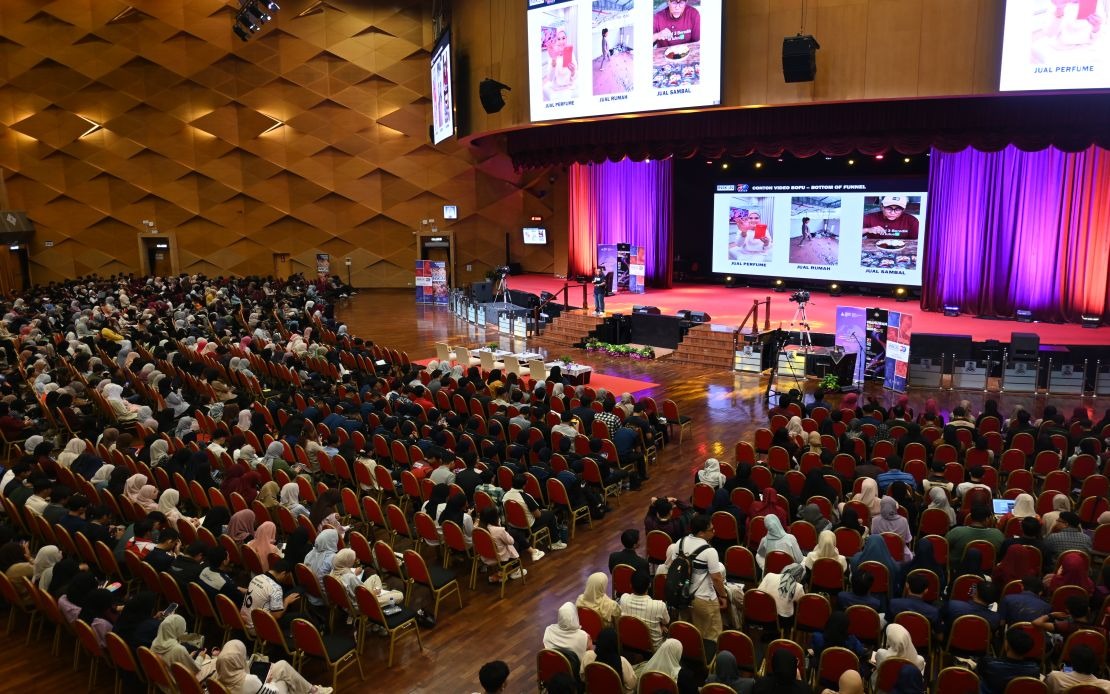
The National Entrepreneurship Institute (INSKEN) and Universiti Teknologi MARA (UiTM) have achieved a significant milestone in Malaysia's entrepreneurship education landscape, drawing 6,877 participants to the Usahawan MADANI Mega (SUM MEGA) 2026 seminar held at the Dewan Agung Tuanku Canselor in Shah Alam. The event, which accommodated both in-person and online attendees, has secured recognition from the Malaysia Book of Records as the nation's largest student-led entrepreneurship seminar, marking a watershed moment in efforts to cultivate business-minded graduates.
The seminar represented a collaborative venture between INSKEN, the Malaysian Academy of SME and Entrepreneurship Development (MASMED), and UiTM, bringing together undergraduates and soon-to-be graduates from universities nationwide. The scale of participation underscores a fundamental shift in how Malaysian tertiary institutions are engaging with entrepreneurship as a discipline, moving beyond classroom theory toward immersive, hands-on knowledge exchange and networking opportunities designed to translate academic learning into real-world business acumen.
The government's backing for the initiative was evident through the attendance of Datuk Mohamad Alamin, Deputy Minister of Entrepreneur and Cooperatives Development, who framed the record-breaking turnout as a validation of entrepreneurship's growing appeal among young Malaysians. His remarks highlighted an important paradox in modern economies: while traditional employment remains stable, younger cohorts increasingly view business ownership and innovation as credible pathways to economic security and personal fulfilment. This generational shift has profound implications for Malaysia's labour market and economic dynamism over the coming decade.
Mohamad Alamin positioned entrepreneurship not merely as an occupational choice but as a structural necessity for national economic resilience. In an environment marked by global supply chain volatility, technological disruption, and competitive pressures from neighbouring economies, locally-rooted entrepreneurs assume outsized importance in driving productivity gains, job creation, and innovation. The Ministry of Entrepreneur and Cooperatives Development (KUSKOP), operating under the MADANI government agenda, has therefore escalated its focus on ecosystem enablers—access to capital, business development support, digital infrastructure, and market connectivity—that convert entrepreneurial ambition into sustainable enterprises.
The breadth of KUSKOP's portfolio reveals the complexity of nurturing viable entrepreneurs. Beyond financing, which remains a critical bottleneck for nascent ventures, the ministry's emphasis on capacity building, supply chain integration, and digitalisation acknowledges that success hinges on multifaceted support. For Malaysian entrepreneurs seeking to compete regionally and globally, these enabling functions are non-negotiable, particularly in sectors where digital-first competitors have already captured significant market share.
USHER systems at the seminar were anchored on the MOFA framework—an acronym representing marketing, operations, finance, and business administration. This pedagogical structure reflects practitioner-driven insights into entrepreneurial resilience, focusing on domains where inexperienced founders frequently falter. By drilling into marketing strategy, operational efficiency, financial discipline, and administrative robustness during the seminar, organisers equipped participants with diagnostic tools to stress-test their own business ideas and identify capability gaps early, before resource-intensive launches.
Insken Board of Trustees chairman Datuk Mustaffa Kamil Ayub expanded the conceptual frame, arguing that entrepreneurship must transcend career categorisation to become a cultural orientation embedded across society. This framing resonates with international evidence suggesting that entrepreneurial economies correlate with institutional cultures that normalise risk-taking, celebrate experimentation, and treat failure as informative rather than terminal. Malaysia's historical reliance on large multinational employers and government jobs has created inertia against such cultural reorientation, making events like SUM MEGA 2026 potentially transformative in signalling to young people that entrepreneurship is a legitimate and respectable identity.
The seminar's architecture also advanced inter-institutional collaboration, bringing together government agencies, higher education providers, financial institutions, and industry bodies on a shared platform. This ecosystem perspective acknowledges that no single stakeholder can unilaterally solve the constraints facing emerging entrepreneurs. Banks and fintech lenders must supply appropriate capital products; universities must equip graduates with relevant competencies; government must create enabling policy and infrastructure; and established businesses must create contracting or partnership opportunities for smaller entrants. SUM MEGA 2026 functioned as a coordination mechanism where these actors could align priorities and identify complementary roles.
Insken's broader portfolio of entrepreneurship initiatives extends beyond the mega seminar. Programmes including the INSKEN Masterclass, BANGKIT, and PROTÉGÉ represent a tiered approach to entrepreneur development, catering to cohorts at different maturity stages—from nascent ideation through scaling and professionalisation. This maturation pathway is crucial because early-stage support that fails to transition entrepreneurs toward sustainable business models risks squandering human capital and creating a narrative of disappointment around venture creation.
The seminar was explicitly positioned as a vehicle for advancing the National Entrepreneurship Policy 2030, the government's strategic blueprint for building an entrepreneurial economy. This policy articulates specific targets around the number of entrepreneurs to be developed, their contribution to GDP, and their capacity to generate employment. SUM MEGA 2026, by exposing nearly 7,000 students to entrepreneurial thinking and networks, functions as both recruitment mechanism and validation vehicle for the policy's aspirations, converting vision into tangible pipeline.
For Malaysia's regional standing, the record-breaking seminar signals serious institutional commitment to entrepreneurship education, potentially strengthening the country's attractiveness to international venture capital, technology transfer partnerships, and skilled migrants seeking entrepreneurial ecosystems. Southeast Asia's entrepreneurial intensity is rising markedly, with countries like Indonesia and Vietnam producing increasingly visible startup clusters. Malaysia's deliberate amplification of university-based entrepreneurship programming positions the country competitively within the region's innovation hierarchy.
The practical downstream challenge remains conversion: translating seminar exposure into venture formation, sustainable business operation, and economic impact. Not all 6,877 participants will launch enterprises, and those who do will face significant obstacles in accessing capital, retaining talent, and navigating regulatory frameworks. Whether government and institutional support systems can scale sufficiently to serve the cohort advanced through SUM MEGA 2026 will ultimately determine whether the record-breaking seminar represents catalytic inflection point or symbolic milestone.

