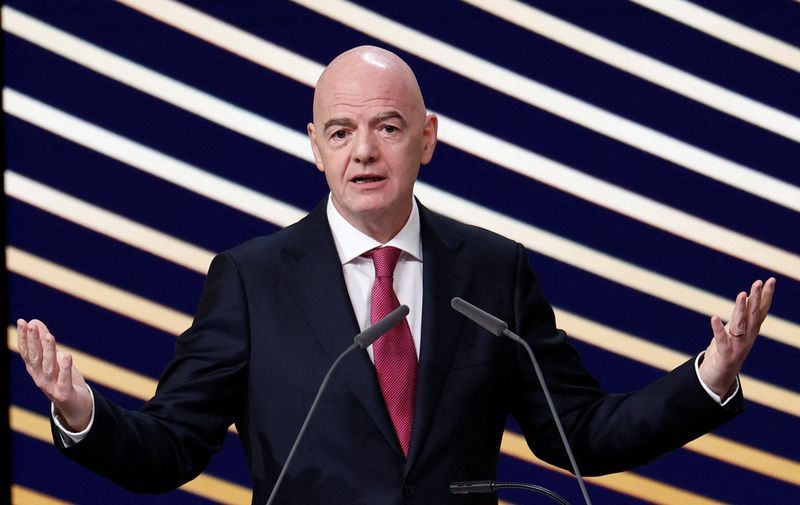
FIFA president Gianni Infantino found himself in unprecedented political peril after a private equity scheme designed to inject fresh investment into global football spiralled into organisational crisis within days. The plan, which would have created a commercial entity to operate the World Cup and other tournaments with 20% ownership sold to external investors, faced such overwhelming resistance from football's power brokers that Infantino was forced to formally abandon it on Friday, marking a stunning reversal for a leader who had previously weathered multiple controversies with relative ease.
The proposal's collapse came after three tumultuous days during which UEFA, European football's governing body and the sport's most financially influential regional confederation, declared it would boycott all FIFA events until the scheme was shelved entirely. This coordinated opposition from continental bodies exposed the depth of anger within football's establishment over what many viewed as a unilateral grab for commercial authority without proper consultation or consensus-building. The speed and severity of the backlash caught Infantino's supporters off guard, suggesting that even his loyal constituencies felt betrayed by the lack of transparency surrounding the initiative.
The fallout extended to Infantino's inner circle, with cracks appearing in his previously loyal support network. Carlos Cordeiro, a senior adviser with deep influence over FIFA's strategic direction, resigned on principle and publicly characterised the arrangement as "a bad deal for football," providing external critics with credibility and institutional legitimacy for their opposition. More damaging still was the statement from FIFA's Chief Operating Officer Kevin Lamour, who alleged that staff members had been deliberately misled by Infantino and characterised the entire initiative as "a project of one person," indicating that internal governance structures had been circumvented in favour of executive unilateralism.
The Asian Football Confederation registered its own formal protest, labelling the process "totally unacceptable" and demanding institutional reform at FIFA. This intervention from Asia signals that discontent with Infantino's governance extends far beyond Europe's traditional power base, suggesting a potentially broader coalition ready to challenge his leadership authority. With 47 member nations under its aegis, the AFC's positioning carries significant weight within FIFA's electoral mathematics, where continental confederations wield substantial influence over voting coalitions.
Infantino's handling of the private equity outreach itself revealed troubling governance failures that undermined his political position. Key stakeholders, including the national federations whose competitions would be affected, learned of the proposal only after details leaked to international media on Tuesday, forcing FIFA into a hasty public announcement rather than allowing for orderly stakeholder engagement. The decision to partner with Thrive Capital, a firm founded by Joshua Kushner and possessing notable family connections to U.S. President Donald Trump, introduced an additional layer of political controversy that distracted from the commercial merits of the underlying proposal.
Infantino's relationship with Trump had already become a subject of scrutiny within football circles following FIFA's award of its inaugural Peace Prize to the former and current U.S. President in December. During the recent World Cup, Trump publicly claimed he had contacted Infantino requesting that American player Folarin Balogun's match suspension be overturned, and Balogun was subsequently cleared to play following a FIFA disciplinary ruling. While the disciplinary body officially operates with independence, the optics of Trump's intervention followed by a favourable outcome fuelled perceptions of improper political interference in football matters through Infantino's channel.
Former FIFA vice-president Jim Boyce, who worked alongside Infantino during his prior tenure at UEFA, suggested on the BBC that the Swiss administrator's judgment had been compromised by his proximity to Trump's political sphere. Boyce's assessment carried weight given his direct knowledge of Infantino's character and professional trajectory, and his willingness to publicly criticise a former colleague signalled that even footballing insiders with historical connections to Infantino felt obliged to distance themselves. Sports marketing analyst Bob Dorfman reinforced this critique, noting that the involvement of a Trump family member in the commercial proposal only amplified existing concerns about inappropriate political influence shaping FIFA's commercial strategy.
Yet Infantino's political standing, while severely damaged, remains potentially recoverable in the context of FIFA's presidential election scheduled for March in Morocco. His previous four-year tenure coincided with unprecedented commercial success for the World Cup, generating record broadcast revenues and sponsorship income that funded expanded distributions to national football federations. Many of FIFA's 211 member federations, particularly those from developing footballing nations, have benefited substantially from Infantino's largesse, creating a transactional political base that could reassert itself if rival candidates prove uninspiring or if Infantino positions his capitulation as responsive leadership rather than weakness.
Prior to this week's crisis, Infantino's re-election for a fourth consecutive term had appeared virtually assured, with no credible rival candidates having declared their intent to challenge him. The private equity debacle has now altered that calculus fundamentally, with rivals almost certain to emerge before the March vote. However, the fundamental arithmetic of FIFA's electoral system may still favour Infantino if he successfully reframes his decision to abandon the proposal as evidence of his willingness to listen to confederation concerns. The requirement for either a two-thirds majority in the opening ballot or a simple majority in subsequent rounds means that Infantino need not win universal support, merely demonstrate sufficient contrition and organisational competence to retain the backing of federations most dependent on FIFA funding.
Infantino's trajectory from presumed heir apparent to a leadership position under genuine threat reflects broader tensions within FIFA regarding governance transparency, stakeholder consultation, and the appropriate balance between commercial innovation and football's traditional structures. His independent leadership style, which had previously allowed him to recover from setbacks including his defence of Qatar as the controversial 2022 World Cup host, collided this week with a fundamental requirement for institutional legitimacy that transcends technical competence or commercial success. Whether his political rehabilitation proves possible depends substantially on whether continental confederations view his reversal as a genuine recalibration of his decision-making approach or merely a tactical retreat necessitated by immediate circumstances.

