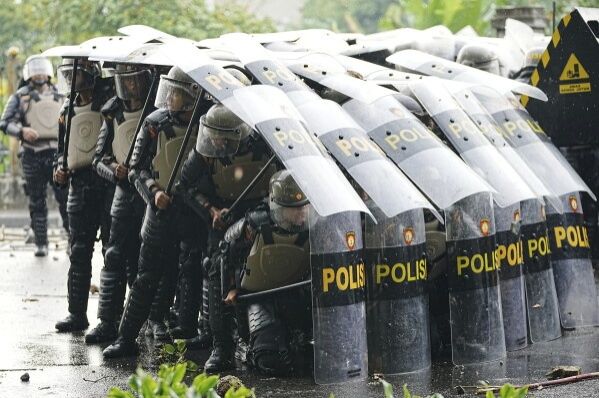
Indonesia's institutional stability faces fresh scrutiny as police investigations into multiple corruption cases have drawn public attention to apparent disagreements between the country's security apparatus, particularly following a series of raids in Jakarta that culminated in military personnel being deployed to protect a high-ranking official accused of nothing but whose home was searched by law enforcement.
The police operations this week recovered assets valued in the tens of millions of dollars across several locations in the capital region. Officers reported uncovering gold bullion, domestic and international currencies, and other valuables during searches they connected to at least three separate graft inquiries. These investigations span alleged irregularities in coal shipments to power stations, potential misconduct related to state insurance companies Asabri and Jiwasraya, and matters involving debt settlements tied to Krakatau Steel operations.
The most conspicuous discovery came at a South Jakarta residence belonging to Febrie Adriansyah, the Deputy Attorney General overseeing special crimes. Investigators located 74 kilograms of gold bars alongside substantial quantities of cash and foreign exchange reserves—totalling approximately 26.3 million US dollars—stored within seven locked suitcases inside a residence safe. The dramatic nature of the discovery, combined with the official's prominent position prosecuting high-profile corruption cases involving Timah, Pertamina, Garuda Indonesia, and even initiatives linked to President Prabowo Subianto, generated considerable public and media attention.
What followed complicated the narrative further. Armed military personnel subsequently arrived at Febrie's Jakarta address, a deployment that the military attributed to requests from the Attorney General's Office and cited longstanding protocols concerning official protection. This manoeuvre immediately raised alarm bells among observers of Indonesian governance, as it appeared to blur traditional boundaries between civilian law enforcement and military functions. The juxtaposition of police conducting searches while military units established presence at the same location created visual and operational ambiguity that sparked speculation about institutional coordination or conflict.
Febrie responded to the situation on Friday by acknowledging ownership of the residence but categorically denying any connection to the discovered assets. He characterised the seized materials as unrelated to his personal conduct and insisted that the Attorney General's Office maintains respect for investigative procedures while awaiting police conclusions. His statement emphasised the importance of presuming innocence and cautioned against premature judgements based on social media commentary or preliminary reporting. This defensive posture, while legally appropriate, underscored the seriousness with which officials viewed the public perception of institutional integrity.
Military leadership moved swiftly to contain the narrative fallout. A spokesman stated that security arrangements did not interfere with law enforcement operations and rejected any suggestion of institutional conflict. The military further asserted full support for all police and prosecutorial activities, framing the deployment as routine protection rather than political manoeuvre. This messaging strategy aimed to prevent public interpretation of the troop presence as obstruction or interference in investigative work.
President Prabowo Subianto injected presidential authority into the discourse without directly addressing the specific case. During a dam inauguration ceremony on Lombok island, he delivered remarks emphasising accountability and public service, reminding officials, military personnel, and police that their authority derives from the citizenry they serve. He explicitly extended these observations to the Attorney General's Office, suggesting a presidential perspective that institutional integrity matters across all security and prosecutorial bodies. His indirect commentary conveyed disapproval of institutional dysfunction without personalising criticism.
The incident reflects deeper vulnerabilities in Indonesia's institutional architecture. Febrie oversees investigations into some of the nation's most sensitive cases, including matters touching on presidential initiatives and state enterprises fundamental to national economic strategy. His sudden prominence in a seizure narrative, regardless of factual outcome, creates potential reputational damage to prosecutorial independence at a moment when corruption cases demand public confidence.
International observers have signalled alarm about implications for democratic governance. Amnesty International Indonesia warned that military deployment to civilian law enforcement scenes threatens civilian supremacy and institutional credibility, calling for guarantees that investigators face no intimidation or obstruction. This assessment reflects broader international concern about Southeast Asian democracies experiencing gradual militarisation of civilian functions.
Nicky Fahrizal, researcher at the Jakarta-based Center for Strategic and International Studies, characterised the situation as reflecting institutional breakdown with dangerous trajectories. He argued that allowing such tensions to escalate risks eroding Indonesia's rule-of-law foundations and triggering broader loss of investor and public confidence. His analysis highlights how specific incidents of inter-agency friction can signal systemic fragility, particularly concerning for markets and foreign stakeholders assessing Indonesia's investment climate.
The timing adds complexity given Indonesia's regional economic significance. Investor perception of prosecutorial independence and institutional stability directly influences capital flow decisions and business confidence. Corruption investigations, while essential to governance, require careful institutional choreography to maintain public confidence that investigations serve justice rather than factional interests. The visible tensions between police and military units, despite official denials, suggest operational coordination challenges that undermine this perception.
Indonesia's security establishment faces pressure to demonstrate that multiple institutions can pursue corruption investigations simultaneously without institutional rivalry compromising outcomes. The investigation's trajectory will likely reveal whether the seized assets genuinely connect to criminal conduct or represent misunderstandings about asset ownership and procedural adherence. Regardless of factual findings, however, the incident has already exposed institutional friction that correcting requires not merely official denials but demonstrable operational integration and transparent institutional accountability mechanisms.

