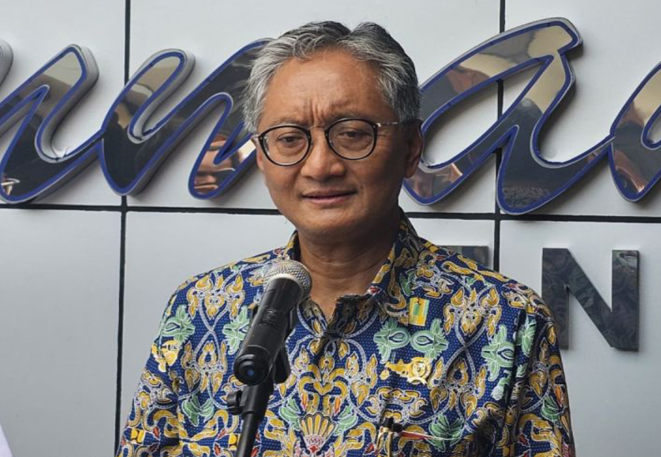
A confidential travel document that became public in early July has triggered fresh institutional turbulence within Indonesia's Public Works Ministry, with allegations of retaliatory personnel transfers now shadowing the tenure of Minister Dody Hanggodo. The controversy centres on an official memo signed by ministry secretary-general Apri Artoto on June 29, which outlined an eight-person delegation scheduled to travel to New York from July 13 to 19 to participate in a United Nations-organised conference. The composition of this delegation—which included not only ministry officials but also Hanggodo's wife Irma Hermawati and daughter Aurellia Tsabitha Meidirama—triggered significant public backlash once the document circulated widely across social media platforms.
The inclusion of the minister's family members in what was ostensibly an official government mission immediately prompted criticism and sparked allegations that state resources were being diverted for personal benefit. The reputational damage proved sufficient to prompt a cancellation of the entire trip, yet the fallout extended well beyond the abandoned journey itself. Within days of the document going viral, social media networks filled with claims that Hanggodo had initiated a wave of personnel transfers targeting officials suspected of leaking the sensitive paperwork, with many of the reassigned staff being relocated to regional postings outside Java.
When confronted about these transfers during a Wednesday media appearance, Hanggodo neither denied the moves nor attempted to distance himself from the decision-making process. Instead, he responded with a dismissive rhetorical question that revealed his confidence in ministerial prerogative. "I have 38,600 employees, why shouldn't I be allowed to reassign them?" he told reporters, according to Kompas.com. The comment underscored a fundamental tension within Indonesian bureaucracy: while ministers possess formal authority to reorganise their departments, the manner and timing of such restructures can raise eyebrows, particularly when they follow controversies or perceived slights to leadership.
Secretary-general Apri offered a different rationale for the family members' inclusion during a July 7 press briefing. He characterised their presence as a bureaucratic necessity, claiming that including Hanggodo's relatives in the delegation paperwork was required to streamline visa application procedures through the Foreign Ministry. Apri further sought to address financial concerns by asserting that state funding would not actually cover any costs associated with their participation. These explanations, however, did little to quell public scepticism or defuse the underlying controversy. Apri simultaneously pledged to investigate the source of the leak and threatened to pursue legal action against any official found responsible for disclosing the document, signalling that the ministry regarded the breach as a serious breach of internal discipline.
Since assuming office in October 2024, the 60-year-old Hanggodo—who brings engineering credentials and prior business connections to Democratic Party politics—has initiated an aggressive programme of departmental reorganisation. His background includes ties to South Kalimantan entrepreneur Andi "Haji Isam" Syamsuddin Arsyad, and his tenure has been marked by continuous personnel churn. Social media posts compiled evidence suggesting that more than 100 ministry employees underwent reassignment during his relatively brief time in charge, spanning positions from director-general level down to junior civil service ranks. The most recent reshuffle in May saw seven high-ranking officials appointed to new positions, with Apri elevated to secretary-general—a role that had previously changed hands in another July 2025 reorganisation when Wida Nurfaida departed after less than a year in the position.
The frequency and scope of these institutional reshuffles have not gone unnoticed by lawmakers tasked with legislative oversight. During a House of Representatives Commission V meeting in June—the body responsible for infrastructure matters—concerns about workplace morale and programme continuity came to the fore. Yasto Soepredjo Mokoagow, representing the Indonesian Democratic Party of Struggle (PDI-P), pointed specifically to the demotion of directors to non-structural positions as generating widespread anxiety. "Civil servants at the ministry are now afraid to carry out programs," Mokoagow stated during the June 11 session, capturing a sentiment that extends beyond typical bureaucratic caution to suggest outright paralysis of departmental functions.
Hanggodo has justified his reorganisation strategy through a distinctive ideological lens, contending that a "deep state" operates covertly within his ministry, undermining its legitimacy and effectiveness. He has compared this alleged shadow structure to termites silently consuming institutional foundations, using the metaphor to explain why systematic purges and restructures represent necessary corrective measures rather than arbitrary exercises of authority. This framing reflects broader Indonesian political discourse around state capture and informal power networks, yet critics contend that it provides convenient cover for potentially destabilising personnel management.
The institutional turbulence occurring at the Public Works Ministry has compounded following revelations of corruption investigations targeting senior departmental officials. The Jakarta High Prosecutor's Office named multiple suspects in June connected to irregularities in water resources projects, including former water resources director general Dwi Purwantoro and former acting irrigation and swamp director Yosiandi Radi Wicaksono. Hanggodo responded by pledging full cooperation with law enforcement authorities and explicitly disavowing any intent to shield subordinates from accountability, attempting to position himself as supportive of anti-corruption efforts rather than protective of institutional interests.
Yet questions about Hanggodo's personal management style surfaced when social media users circulated video footage of his interactions with subordinate staff. One particularly notable clip captured him reprimanding an employee at a school construction site inspection in East Java during April, where he was observed pointing fingers while describing the official's explanations as "dumb excuses." Such unfiltered displays of frustration and reproach, when amplified through digital circulation, can intensify perceptions of an authoritarian or hostile workplace environment—precisely the kind of atmosphere that lawmakers had flagged as impeding normal operational functions. The incident illustrated how ministerial conduct at operational sites reverberates through organisational culture and affects employee confidence in departmental leadership.

