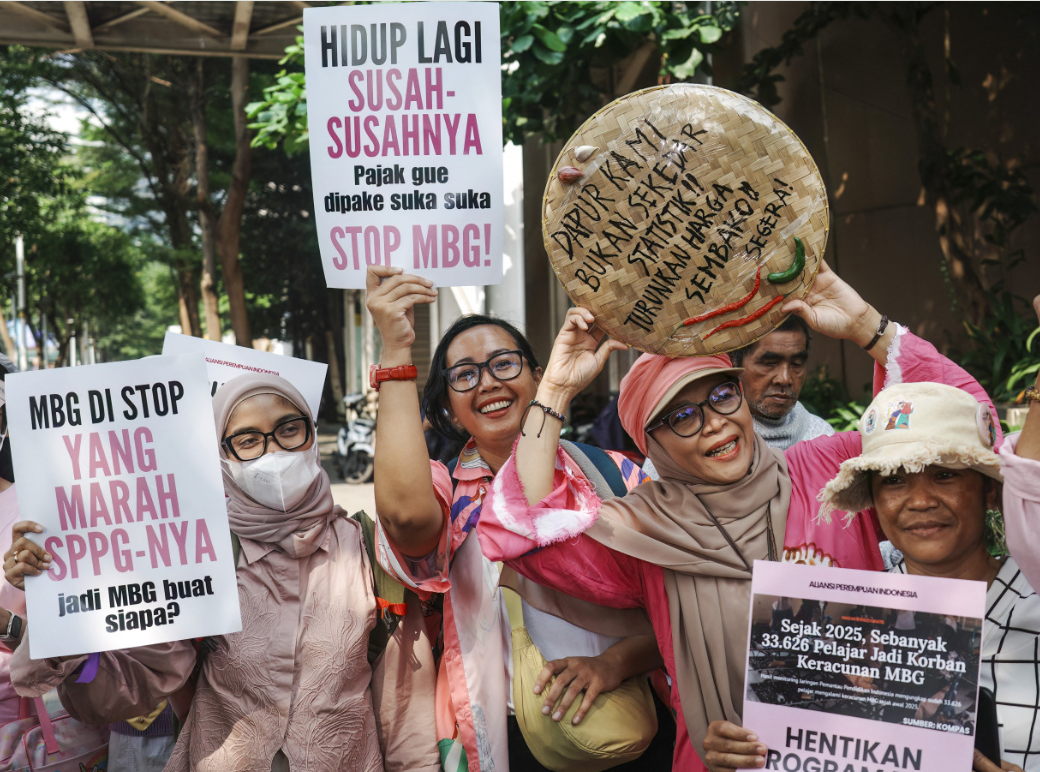
President Prabowo Subianto's ambitious free nutritious meal scheme, designed to tackle childhood stunting across Indonesia, is encountering a groundswell of public discontent that threatens to undermine its credibility and effectiveness. Rather than expressing gratitude for government support, many programme recipients are now vocally questioning whether the assistance meets basic nutritional and quality standards, with some explicitly stating they would prefer the initiative be suspended for comprehensive reform rather than continue in its current form.
The deteriorating reputation of the programme crystallised in June when Nesti Nagari, a mother from Kediri in East Java, posted images on social media showing the meal provided for her eight-month-old baby—described as an unidentifiable clumped white paste. Her decision to feed the contents to her chickens rather than her child generated widespread online engagement, accumulating more than 11,000 likes and symbolising growing public frustration with the scheme's implementation. Nagari subsequently declined further meals, declaring she possessed sufficient resources to nourish her child independently and would support temporary programme suspension to enable meaningful evaluation and potential reallocation of the substantial budget towards education and healthcare infrastructure.
Quality grievances extend well beyond isolated incidents. Diah Farika, a nursing mother in Semarang, Central Java, enrolled in the programme since May, documented persistent problems including nutritionally unbalanced portions, unripe fruit, inadequate meal sizes, and dismissive responses from nutrition fulfillment service units (SPPG) responsible for meal preparation. Her experience highlights a systemic issue where the decentralised kitchen network, though theoretically designed for local responsiveness, appears to lack consistent quality oversight. Farika's willingness to embrace programme suspension reflects a crucial insight: beneficiaries prioritise nutritional integrity over free assistance, viewing substandard meals as potentially harmful rather than helpful.
Activist organisations have amplified these concerns. On Thursday, the Indonesian Women's Alliance staged a demonstration in Central Jakarta featuring dozens of women and rights activists demanding governmental halting and comprehensive review of the programme. This grassroots mobilisation represents a critical juncture where social movements have transitioned from advocating programme expansion to calling for structural reforms, indicating that political support from beneficiary communities—essential for any large-scale social initiative—has become fragile.
Paradoxically, while beneficiaries demand improvements, the programme faces destabilisation from business stakeholders. SPPG operators and investors have grown anxious following recent corruption revelations involving former National Nutrition Agency (BGN) leadership, which prompted the agency's new management to suspend further SPPG network expansion. Reportedly, investors claiming to have invested hundreds of billions of rupiah in kitchen infrastructure visited BGN offices seeking assurances regarding investment returns should facilities close. This tension between social demands for quality and business concerns about continuity creates a complex policy environment where purely technical solutions may prove insufficient.
Operational disruptions have compounded credibility problems. Several SPPGs reported temporary closures in early June due to funding delays, though some subsequently resumed operations. These service interruptions damage public confidence and suggest administrative challenges in managing a network currently comprising approximately 27,000 kitchens nationwide. The scale of this infrastructure, while impressive, may exceed current management capacity given apparent quality control deficiencies.
Independent scrutiny has raised fundamental questions about programme targeting and resource allocation. MBG Watch, an oversight platform established by civil society groups, noted that mounting problems have substantially eroded public confidence. Isnawati Hidayah from the Centre of Economic and Law Studies, one of MBG Watch's initiators, posed a pointed question: whether the multi-billion-dollar budget genuinely serves intended beneficiaries or whether resources leak toward less deserving recipients and operational inefficiencies. A CELIOS study estimated that approximately 34 percent of current beneficiaries—roughly 61 million children and pregnant women—may not represent the most vulnerable populations, instead including economically secure households with adequate nutritional access.
This targeting imprecision carries serious implications for Southeast Asia's broader social policy context. As regional governments increasingly pursue large-scale nutritional and social protection initiatives, Indonesia's experience demonstrates that programme scale alone does not guarantee effectiveness or equity. Countries including Malaysia, Thailand, and Philippines monitoring Indonesia's implementation may reconsider their own approaches, recognising that rigorous beneficiary selection and quality assurance require upfront investment rather than post-hoc adjustment.
In response to mounting criticism, BGN has initiated refocusing measures. The agency has dropped 76 schools across Java from the programme, affecting more than 39,000 beneficiaries, with plans to narrow the beneficiary pool toward those genuinely requiring government nutritional assistance. BGN deputy head Agustina Arumsari framed this contraction as reallocation toward citizens with authentic need for government intervention, acknowledging implicitly that the original scope exceeded capacity for quality delivery. Simultaneously, the agency is implementing austerity measures including elimination of daily kitchen incentives during non-operational periods and evaluation of underperforming facilities.
The 2026 budget allocation illustrates how controversy has constrained programme ambitions. Initially set at Rp 335 trillion (approximately US$18.74 billion), the allocation was trimmed to Rp 268 trillion following public scrutiny regarding the programme's substantial cost relative to competing budget priorities, particularly education. This reduction, despite the programme's foundational importance for child development, signals that political sustainability depends on demonstrating value and preventing resource misallocation.
The broader lesson for Malaysian policymakers involves the critical distinction between programme intention and implementation quality. While nutritional support for vulnerable children represents a legitimate public priority, beneficiaries' willingness to forgo assistance rather than accept substandard provision suggests that government cannot assume gratitude will overcome dissatisfaction with service quality. This dynamic has profound implications for how Southeast Asian governments should approach large-scale social initiatives: adequate resourcing for quality assurance, transparent accountability mechanisms, and genuine beneficiary consultation should precede programme expansion rather than follow it.
Moving forward, Indonesia's BGN faces pressure to demonstrate that retrenchment enables genuine quality improvement rather than merely reducing public scrutiny through programme contraction. The agency's success will depend on whether it can rebuild beneficiary trust through consistent meal quality, transparent operations, and responsiveness to user feedback. For the broader region, Indonesia's experience illustrates that social policy ambition requires equal commitment to implementation excellence, quality verification, and beneficiary satisfaction.

