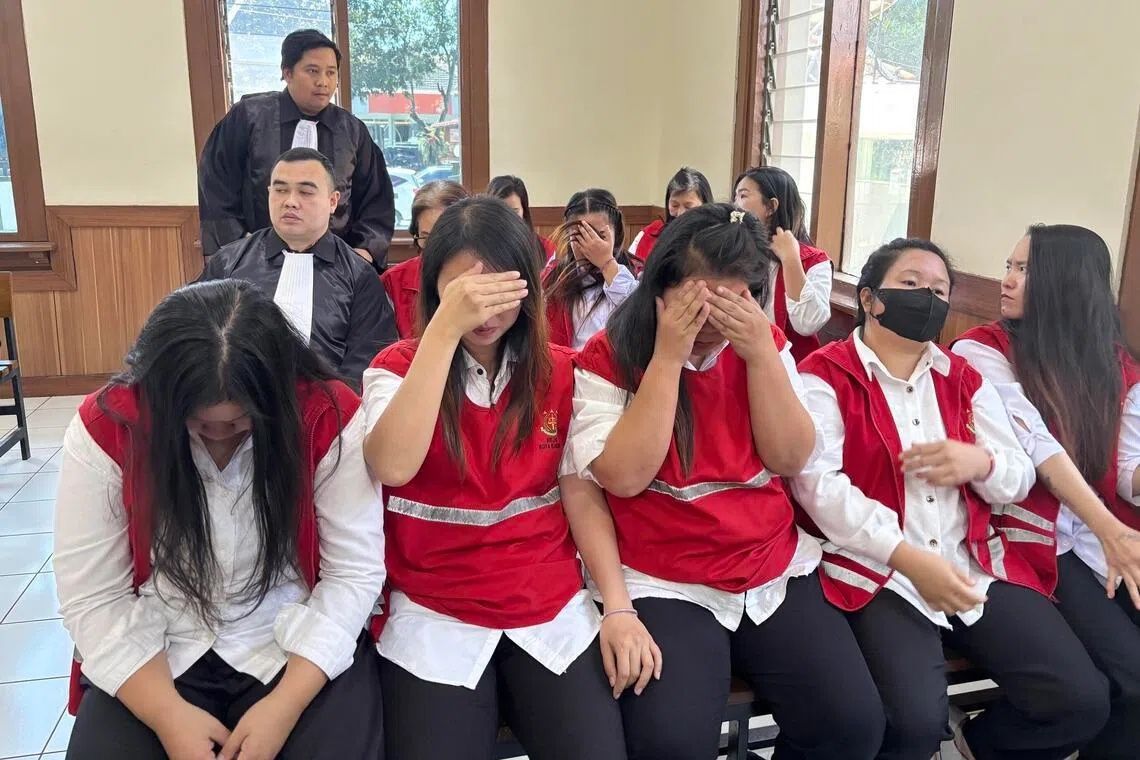
An Indonesian court heard closing arguments on Tuesday from prosecutors seeking up to 10 years' imprisonment for members of an alleged baby trafficking network that authorities say sold at least 34 infants, including numerous cases involving buyers in Singapore. The case, which prosecutors described as among Indonesia's most significant cross-border human trafficking investigations in recent years, has seen 19 defendants—18 women and one man—tried since April on charges of systematically trafficking children between 2023 and 2025. The Bandung District Court proceedings mark a critical juncture in an investigation that exposed a sophisticated criminal operation with international dimensions, raising serious questions about adoption fraud and child exploitation networks operating across Southeast Asia.
According to court records presented by Prosecutor Cucu Gantina, at least twelve of the trafficked infants were transferred to Singapore, with babies commanding prices between 200 and 250 million rupiah, equivalent to approximately S$18,110 each. The alleged operation depended on coordinated criminal activity spanning recruitment, documentation, transportation, and placement—the hallmarks of an organized trafficking enterprise. The monetary value attached to each child in what prosecutors characterized as a commercial transaction distinguishes this case from isolated adoption irregularities, suggesting instead a calculated business model designed to exploit vulnerable infants and desperate adoptive families.
Central to the prosecution's case is 70-year-old Lie Siu Luan, identified as Lily or Popo by investigators, whom authorities have branded as the ring's orchestrator. The evidence presented indicates she managed multiple aspects of the criminal operation, including identifying and acquiring babies, preparing falsified documentation necessary for placement, and coordinating international delivery arrangements. Prosecutors have argued that her coordinating role and control over the network's activities place her at the apex of a hierarchical criminal structure. The targeting of a septuagenarian as the primary architect reveals how sophisticated trafficking networks frequently employ older individuals to manage operations while maintaining some distance from direct contact with victims.
Prosecutors targeted specific defendants with enhanced sentences reflecting their alleged roles in the hierarchy. Astri Fitrinika, identified as a principal recruiter responsible for identifying and acquiring children, received a 10-year recommendation identical to that sought for Lie. Fellow recruiters Djaka Hamdani and Elin similarly faced 10-year terms, as did Lai Su Hua, accused of forging state documents to satisfy adoption requirements and create the documentary veneer of legitimacy. The remaining fourteen defendants, characterized as caretakers who maintained the infants pending placement, faced prosecutors' recommendations of five-year sentences. This sentencing structure reflects differentiation based on culpability and proximity to decision-making authority within the organization.
The courtroom scene reflected the emotional weight of the allegations. Upon hearing the prosecutors' sentencing demands, both Lie and Astri wept, a moment that underscored the gravity of potential imprisonment outcomes. However, the emotional reaction contrasted sharply with the composed legal strategy adopted by their defence counsel. Lie's attorney, Sendi Sanjaya, indicated that while the defence acknowledged and respected the prosecution's formal demands, it would challenge the evidence on substantive grounds. Sanjaya argued that prosecutors had failed to establish the critical element of exploitation, asserting instead that trial testimony demonstrated the adopted children remained in good health with known whereabouts, thus negating the prosecution's foundational claim regarding harmful intent or outcome.
Astri's defence counsel, Hendri Samuel Tampubolon, adopted a differentiation strategy, arguing that the identical 10-year recommendation for his client and for the alleged mastermind failed to account for significant distinctions in culpability and decision-making authority. Tampubolon positioned Astri as operating under Lie's control rather than exercising independent criminal agency, and emphasized that his client had cooperated with police and prosecution investigations—a factor potentially relevant to sentencing considerations. This argument echoes common defence strategies in organized crime cases where subordinate defendants attempt to establish meaningful distance from hierarchical superiors and emphasize their cooperation with authorities.
The investigation's origins illuminate how trafficking operations become exposed. The case emerged in July 2025 when West Java authorities detained approximately a dozen suspects following a report filed by a local resident, Dani Hidayat. Hidayat's involvement as an information source began innocuously when, seeking to adopt during his wife's pregnancy, he joined a Facebook adoption group where Astri subsequently contacted him offering 8 million rupiah for his unborn child. The casual nature of the initial contact—conducted through a mainstream social media platform under the guise of legitimate adoption assistance—demonstrates how trafficking networks exploit the genuine vulnerabilities and hopes of prospective parents. The fact that the operation was discovered through individual initiative rather than systematic enforcement efforts suggests potential gaps in regulatory oversight of online adoption intermediation.
The investigation has acquired diplomatic dimensions following acknowledgment by both Singapore and Indonesian governments in January that they are collaborating on the case. During trial proceedings, Lie identified four Singaporeans allegedly functioning as adoption placement agents within the network, designating them only by first names or nicknames: "Petter," "John," "Mr Tan," and "Mr Chew." The involvement of Singapore-based intermediaries indicates the trafficking operation extended beyond passive reception of trafficked children into active recruitment and placement roles, suggesting complicity by individuals in the destination jurisdiction. This bilateral dimension complicates prosecution and suggests that complete accountability may require coordinated legal action across borders, though Southeast Asian countries have historically faced challenges in prosecuting transnational trafficking cases.
The case reflects broader patterns of infant trafficking in Southeast Asia, where combinations of poverty, corrupt officials, inadequate adoption regulation, and cross-border demand create conditions enabling exploitation. Indonesia's robust prosecution efforts in this instance, resulting in charges against nineteen individuals across hierarchical roles within a trafficking organization, contrast with historical underenforcement in certain jurisdictions. However, the reliance on individual whistleblowers rather than proactive investigative detection raises questions about the scale of undetected trafficking operations, suggesting that prosecution numbers may represent only a fraction of actual criminal activity. The trial's demonstration that trafficking networks adapt quickly to exploit legitimate institutional processes—in this case, adoption frameworks designed to protect children—underscores the need for enhanced verification protocols and international regulatory coordination.
The trial's next hearing, scheduled for the following week, will see defendants present their defence arguments, potentially challenging the prosecution's evidence construction and sentencing recommendations. The judges' eventual decision will establish important precedent regarding sentencing standards for trafficking offences involving infants and cross-border placement dimensions. Beyond the immediate legal outcome, however, the case raises systemic questions about adoption oversight, social media exploitation risks, document verification procedures, and international enforcement cooperation that extend far beyond this specific network. For Malaysian and other Southeast Asian policymakers monitoring the proceedings, the trial's progress and the judicial reasoning in the eventual verdict will likely inform discussions about strengthening adoption safeguards and international trafficking prevention mechanisms within the region.

