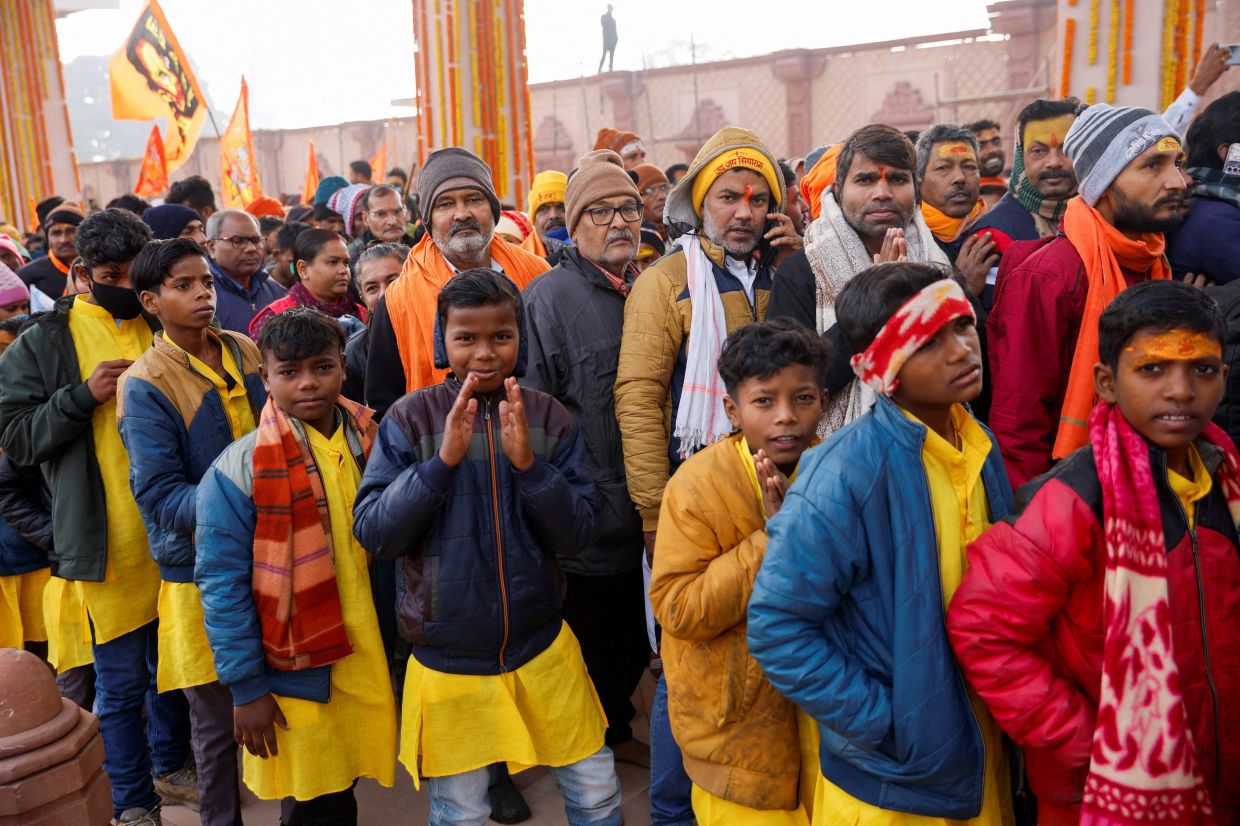
The discovery of alleged embezzlement at India's newly inaugurated Ram temple in Ayodhya has brought uncomfortable questions about how major religious institutions safeguard the financial trust placed in them by millions of devotees. When police launched their investigation in June and arrested eight people involved in handling donations at the shrine, it exposed vulnerabilities in systems that process extraordinary volumes of cash, gold, and precious offerings daily. While authorities have remained silent on exact figures, media investigations suggest the stolen amount could reach 30 million rupees, roughly equivalent to US$314,000—a sum that represents years of accumulated donations from ordinary worshippers across India.
The significance of this breach extends far beyond the numerical loss. For devotees like Ashok Prasad Kushwaha, an auto-rickshaw driver from Delhi who has made three pilgrimages to the temple in two years, the theft strikes at the spiritual foundation of charitable giving. When someone donates at a temple, the transaction carries an implicit covenant between donor and institution—an understanding that their contribution, often representing genuine sacrifice from limited means, will support religious and community purposes. The revelation that such money can disappear through internal theft rather than reaching its intended purpose creates a profound rupture in that trust, transforming what devotees regard as acts of spiritual devotion into potentially misplaced generosity.
This incident forms part of a troubling pattern affecting India's largest and most prominent religious institutions. The Tirumala Tirupati Devasthanams, regarded as one of the world's wealthiest temple trusts with assets estimated at US$31 billion, has previously faced similar scandals. The Badrinath shrine has experienced comparable controversies. These are not isolated incidents involving marginal religious sites but rather episodes affecting institutions that operate at a scale and complexity rivalling major multinational corporations. Yet unlike those corporations, which face rigorous regulatory oversight, auditing requirements, and transparent financial reporting standards, many of India's major temples operate under frameworks designed decades ago for smaller, simpler religious organisations.
The systemic nature of the problem becomes apparent when examining how the Ram temple's theft occurred. Investigators uncovered that accused staff members exploited weak counting procedures and surveillance gaps—vulnerabilities that suggest the institution's financial operations had not evolved to match its dramatically increased scale and significance. The temple, inaugurated by Prime Minister Narendra Modi in 2024, has become one of India's paramount religious sites, attracting approximately 90,000 visitors daily. Each day brings streams of devotees making cash offerings, presenting gold ornaments, or leaving behind silver articles. This continuous flow of high-value donations, managed through manual processes with inadequate oversight, created an environment where misappropriation became feasible.
The Ram temple's sensitive position adds another dimension to this controversy. The shrine stands on ground that was the flashpoint for one of India's longest and most contentious religious disputes. The 1992 demolition of the Babri Mosque by Hindu mobs, followed by communal violence claiming over 2,000 lives, transformed this location into India's most fraught religious site. After the Supreme Court's 2019 decision awarding the land for temple construction, a nationwide fundraising campaign collected approximately US$341 million to build the structure. That the new temple—representing Hindu aspirations realised through decades of struggle and massive collective sacrifice—should now face allegations of internal financial corruption represents a particularly stinging betrayal for its supporters.
The underlying challenge confronting Indian religious institutions reflects their transformation from traditional houses of worship into massive financial and social enterprises. India's religious and spiritual market was valued at US$70.14 billion in 2025 and is projected to expand to US$135.41 billion by 2034, according to consultancy firm IMARC. This growth reflects not merely inflation but rather the expanding reach and operational complexity of religious institutions. Major temples now operate educational facilities, healthcare services, publishing operations, hospitality networks, and agricultural projects. They manage pension schemes, charitable programmes, and community development initiatives. Yet the legal and regulatory structures governing their finances often remain rooted in frameworks designed when temples were primarily ritual spaces managed by hereditary priests with modest cash holdings.
Legal experts point to the absence of unified national standards as a critical vulnerability. According to Sonam Chandwani, managing partner at KS Legal & Associates, India's religious institutions operate under multiple overlapping legal regimes and inconsistent tax systems, creating a patchwork where oversight standards vary dramatically between regions and religious communities. Unlike corporate entities, which must comply with standardised financial reporting requirements and independent audits, temples can adopt widely divergent accounting practices and transparency standards. This fragmentation creates opportunities for misconduct while simultaneously obscuring how prevalent such problems might be across India's broader religious landscape.
Religious activist Rahul Easwar, grandson of a former chief priest at Kerala's Sabarimala temple, has articulated the specific institutional reforms needed to restore public confidence. Large religious organisations require mandatory digitised accounting systems replacing cash-based record-keeping. They need mandatory receipts for all donations, enabling donor verification and creating an audit trail. Surveillance systems should monitor all areas where donations are counted and stored. Independent external audits, conducted by professional firms rather than internal committees, should verify financial accounts regularly. These recommendations reflect practices standard in any major financial institution but largely absent from even India's largest temples.
The practical challenges of implementation become apparent when considering India's largest religious gatherings. The Kumbh Mela pilgrimage, which occurs periodically and draws millions of devotees, generates donations on an almost incomprehensible scale—the equivalent of dozens of major temples operating simultaneously. Managing, counting, verifying, and safeguarding such volumes of cash and valuables exceeds the capacity of traditional temple management structures. Political analyst Anurag Naidu has suggested that religious institutions handling such vast sums require financial control systems comparable to those governing large public sector organisations. This argument rests on a straightforward principle: the scale of an institution should determine the sophistication of its internal controls, regardless of whether it operates as a corporation, government agency, or religious trust.
For Southeast Asian readers, the Ram temple case carries particular resonance given the regional prevalence of similar issues. Temples across Malaysia, Singapore, Thailand, and other Southeast Asian nations frequently handle substantial donations and manage valuable assets, often with comparable governance challenges. The region's religious institutions operate in contexts where traditional management structures coexist with modern financial complexity. Devotees across Southeast Asia may find themselves asking whether their own local temples possess adequate safeguards against the kinds of theft that occurred in Ayodhya. The case thus functions as an uncomfortable mirror, prompting questions about institutional accountability that extend far beyond India's borders.
The broader implications suggest that restoring public confidence in religious institutions requires fundamental structural changes. Temples cannot simply adopt corporate governance frameworks wholesale, as religious authority and spiritual legitimacy operate according to different principles than shareholder accountability. Yet the absence of any financial controls—of any system distinguishing charitable allocation from misappropriation—damages both the institution and the community it purports to serve. The Ram temple case demonstrates that scale and visibility intensify rather than diminish the need for transparency. As India's religious institutions grow wealthier and more influential, the stakes involved in getting institutional governance right have never been higher.

