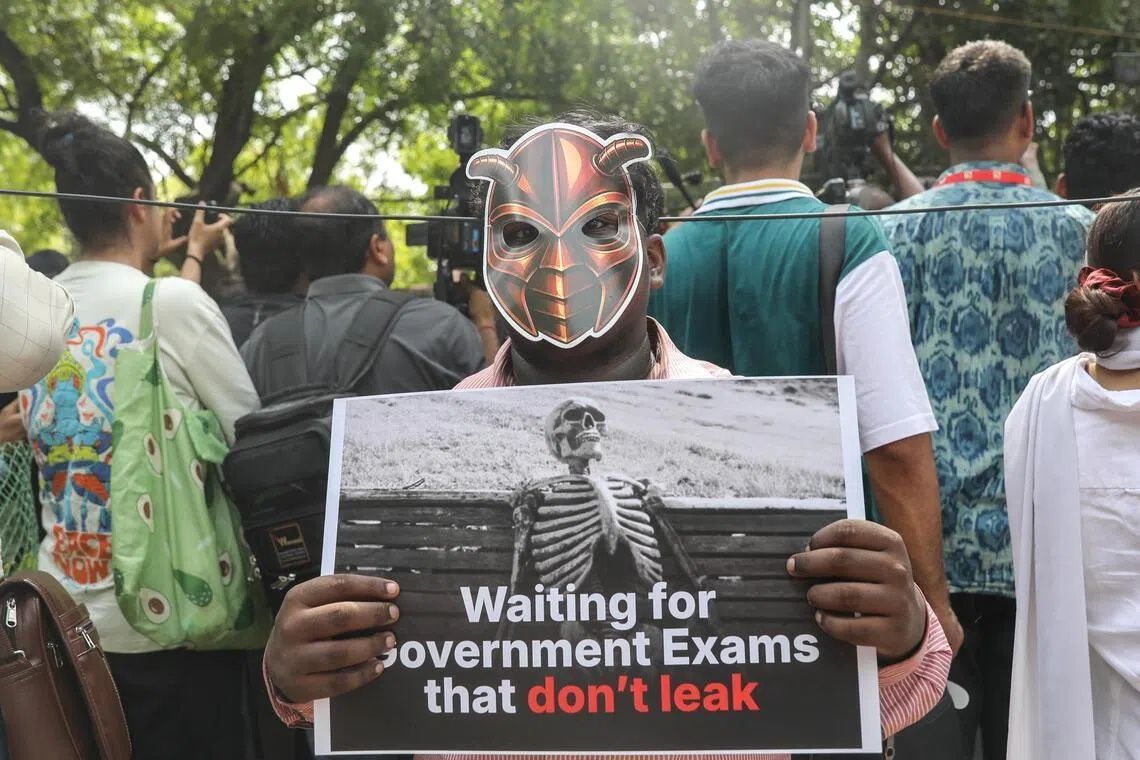
India's educational system faces a moment of reckoning as 2.2 million aspiring medical students prepare to sit a crucial re-examination on Sunday, June 21, under one of the most heavily monitored testing environments the country has ever implemented. The decision to completely void the earlier test and conduct a fresh nationwide exam reflects the severity of the paper leak scandal that has shaken public confidence in the examination process and triggered intense scrutiny of government institutions responsible for administering the world's largest entrance test system.
The original test, scheduled for May, collapsed following systematic leaks of question papers through underground networks, exposing vulnerabilities in a testing infrastructure that processes millions of candidates annually. The incident set off a chain reaction of public anger, with students and parents expressing deep frustration over a system that many felt had become compromised by organised criminal elements. Reports emerged of distraught teenagers taking their own lives following the examination fiasco, adding a tragic dimension to the administrative failure and intensifying demands for accountability from senior officials.
The National Testing Agency, the government body responsible for conducting the National Eligibility cum Entrance Test, has responded with a comprehensive overhaul of security protocols. Over 200,000 officials, including armed police personnel, have been mobilised across the country to monitor test centres and prevent any possibility of repeat breaches. The sheer scale of this deployment underscores how seriously authorities are treating the crisis and their determination to restore institutional credibility. Beyond physical security, the agency has implemented sophisticated technological safeguards including biometric identification systems to verify candidates' identities, artificial intelligence-powered surveillance cameras positioned throughout examination halls, and satellite-based tracking systems to monitor the movement of question papers from storage facilities to test centres.
The controversy has extended beyond this single examination failure. Simultaneously, India's education ministry grapples with a separate scandal involving the online marking system used for high school examinations taken by nearly two million students. Widespread allegations emerged that the automated grading platform malfunctioned, resulting in incorrect marks being assigned to wrong candidates and causing additional anguish among families already dealing with the medical exam debacle. This compound crisis has created a perfect storm of public dissatisfaction with India's examination governance, suggesting systemic problems rather than isolated incidents.
The intensity of youth anger has manifested in unexpected ways, including the emergence of a satirical political movement called the Cockroach People's Party, which has rapidly accumulated millions of online followers since its launch in May. Though presented with humour, this phenomenon reflects genuine frustration among young Indians who feel betrayed by institutions meant to govern merit-based advancement. The movement has explicitly called for the resignation of Education Minister Dharmendra Pradhan, placing considerable political pressure on the government to demonstrate tangible reform rather than merely managing the immediate crisis.
Central to the leak scandal is the arrest of an alleged orchestrator identified as a chemistry lecturer, according to India's Central Bureau of Investigation. This revelation demonstrates how educational insiders have been co-opted into examination fraud networks, exploiting their access to sensitive materials for personal gain. The involvement of someone holding a teaching position raises uncomfortable questions about institutional oversight and the vetting procedures used when appointing individuals with access to examination infrastructure.
Investigations have revealed that cheating networks exploited instant messaging applications, particularly Telegram, to rapidly distribute leaked question papers among paying candidates who sought unfair advantages. The Telegram breach prompted Indian authorities to impose a week-long ban on the platform within the country, a move that Telegram's chief Pavel Durov publicly criticised as ineffective. Durov argued that restricting communication apps represents treating symptoms rather than causes, noting that leaked materials would simply migrate to alternative platforms. His position highlights a fundamental tension in addressing examination fraud: technological restrictions alone cannot eliminate systemic vulnerabilities created by human corruption and insufficient institutional accountability.
The National Eligibility cum Entrance Test occupies a unique position within India's educational ecosystem. Roughly 2.2 million candidates compete annually for approximately 100,000 undergraduate medical seats across the country's colleges, creating an intensely competitive environment where securing a place determines individuals' professional trajectories. This extreme scarcity of seats relative to candidate numbers has spawned an enormous coaching industry estimated at billions of rupees, creating both legitimate preparation services and opportunities for fraudulent operators offering shortcut solutions to aspirants.
For Malaysia and other Southeast Asian nations monitoring Indian higher education developments, this crisis carries important lessons regarding examination security infrastructure. As countries increasingly digitise assessment systems and expand access to higher education, the Indian experience demonstrates that technological sophistication alone cannot prevent fraud without simultaneous investment in institutional cultures emphasising integrity. The scandal also illustrates how public trust in educational systems can rapidly erode when governance failures suggest that advancement mechanisms have become compromised by corruption rather than merit.
The retest scheduled for mid-afternoon on Sunday will begin with heightened scrutiny from Indian media and international observers watching to assess whether the security apparatus successfully prevents any recurrence of the leaking problems. Success would partially restore confidence in India's examination administration, though the underlying institutional questions about preventing insider corruption and maintaining examination integrity are likely to persist for months ahead. The decisions made regarding examination reform in the coming weeks will set precedents for how India's educational authorities approach similar challenges and whether structural improvements sufficiently address root causes rather than simply adding security layers.

