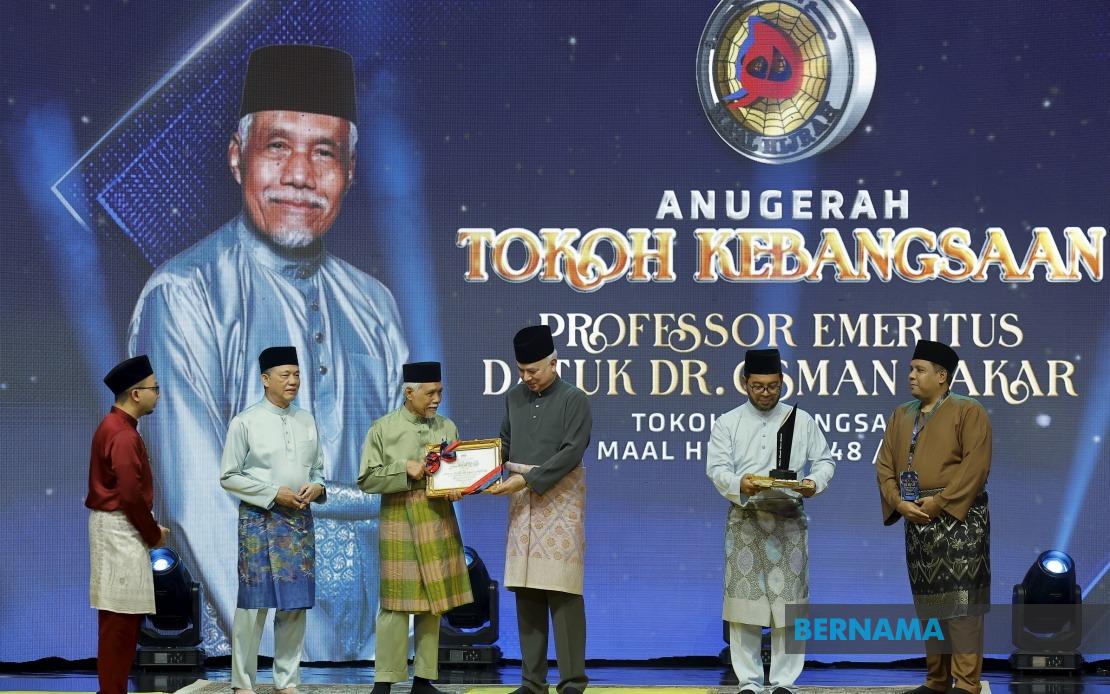
International Islamic University Malaysia (IIUM) Rector Prof Emeritus Datuk Dr Osman Bakar has received the prestigious National Tokoh Maal Hijrah award at a ceremony held at Putra Mosque in Putrajaya. The recognition marks a significant honour for the educational leader, who has been instrumental in shaping Islamic higher education in Malaysia. The award ceremony, held as part of the national-level Maal Hijrah 1448H/2026 celebration, underscored the importance of recognising distinguished figures who have made lasting contributions to Islamic scholarship and community development in the country.
The presentation of awards took place under the auspices of Sultan Nazrin Shah, the Sultan of Perak, who conferred the honours on the recipients. The ceremony reflected the significance placed by Malaysia's leadership on celebrating figures whose work embodies Islamic values and intellectual rigour. Beyond the prestige associated with the award, recipients were presented with tangible recognition in the form of cash prizes, trophies and official certificates of appreciation, marking the formal acknowledgement of their contributions to Islamic thought and practice in Malaysia.
Dr Osman Bakar's selection as National Tokoh Maal Hijrah reflects his extensive career in Islamic education and scholarship. As rector of IIUM, one of the region's leading Islamic universities, he has guided the institution in its mission to develop Muslim intellectuals grounded in both Islamic sciences and contemporary knowledge. His academic work has spanned philosophy, Islamic thought and interfaith dialogue, positioning him as a bridge-builder between traditional Islamic learning and modern academic enquiry. The honour recognises not merely his administrative role but his deeper contribution to advancing Islamic intellectual discourse within Malaysia and the broader Muslim world.
Paralleling the national award, the ceremony also recognised international Islamic scholarship by honouring Dr Ahmad Al-Raysuni from Morocco with the International Tokoh Maal Hijrah designation. This dual recognition—one national, one international—reflects Malaysia's positioning as a hub for Islamic learning and its engagement with the global Muslim intellectual community. Dr Al-Raysuni's selection as the international recipient demonstrates Malaysia's appreciation for scholarly excellence across borders and its commitment to fostering connections among Muslim thinkers worldwide. The inclusion of both national and international honourees elevates the Maal Hijrah celebration beyond domestic recognition into a platform for affirming Islam's universal intellectual heritage.
The theme for this year's Maal Hijrah celebration, "MADANI Dihayati, Ummah Diberkati," carries particular significance in Malaysia's current social and political context. The MADANI framework—which prioritises pragmatism, accountability, transparency and inclusivity—represents the government's broader vision for national development. By anchoring the Maal Hijrah celebration to these principles, the occasion connects Islamic spiritual renewal with contemporary governance ideals. The emphasis on community well-being and strengthening bonds of compassion and unity speaks to how religious observance is being framed not as separate from civic responsibility but as integral to it.
The ceremony's attendance by high-ranking government officials underscored the state's investment in recognising Islamic intellectual leadership. Deputy Prime Minister Datuk Seri Fadillah Yusof and his wife Datin Ruziah Mohd Tahir, alongside Minister in the Prime Minister's Department (Religious Affairs) Dr Zulkifli Hasan, brought ministerial-level representation to the event. This level of official presence signals that the government views the recognition of Islamic scholars and educators as a matter of national importance. The gathering of these leaders at Putra Mosque, Malaysia's national mosque, provided a symbolic setting that merged spiritual significance with governmental authority.
For Malaysia's educational sector, the honouring of an Islamic university rector carries implications for how the nation positions itself in global knowledge hierarchies. IIUM has established itself as an institution capable of producing rigorous Islamic scholarship that engages with international academic standards. Dr Osman Bakar's recognition validates this institutional mission and encourages further development of Islamic intellectual capacity within Malaysian universities. As Southeast Asia increasingly engages with questions about how Islamic societies can modernise whilst maintaining religious authenticity, the work of figures like Dr Bakar becomes particularly relevant to regional debates about education, governance and social development.
The Maal Hijrah celebration itself, marking the Islamic calendar year 1448H, provides an annual opportunity for Malaysia to reflect on its identity as a Muslim-majority nation navigating a complex global landscape. The festival has evolved from a purely religious observance into a state-sponsored occasion where Islamic scholarship, governance philosophy and national values intersect. By honouring distinguished educators and scholars, Malaysia frames Islamic renewal not merely as spiritual practice but as intellectual and social endeavour. This framing has implications for how younger generations of Muslims in Malaysia understand their faith—as compatible with rigorous academic enquiry and aligned with principles of good governance.
The recognition accorded to Dr Osman Bakar and Dr Ahmad Al-Raysuni also reflects changing conversations about Islamic leadership in the contemporary world. Rather than emphasising only religious authority based on traditional credentials, Malaysia's award scheme recognises academic achievement and intellectual contribution. This signals a shift in how Muslim-majority societies are identifying and honouring their thought leaders. For Malaysian readers, this suggests that pathways to recognised Islamic leadership increasingly involve formal education, scholarly publication and institutional responsibility alongside or even ahead of purely religious roles. This recalibration of what constitutes respected Islamic authority carries implications for professional aspirations within Malaysian Muslim communities.
Looking forward, the honour bestowed on Dr Bakar may also be understood as encouragement for other Islamic educational institutions and scholars to pursue excellence in their respective fields. By recognising rector-level contributions, the ceremony validates university leadership as a significant form of Islamic service. This could inspire greater investment in Islamic higher education across Malaysia and the region, particularly as governments seek to develop local intellectual capacity in response to global challenges ranging from climate change to technological disruption. The integration of Islamic values with contemporary knowledge production, exemplified by Dr Bakar's work at IIUM, becomes increasingly vital as Muslim societies navigate rapid social change.