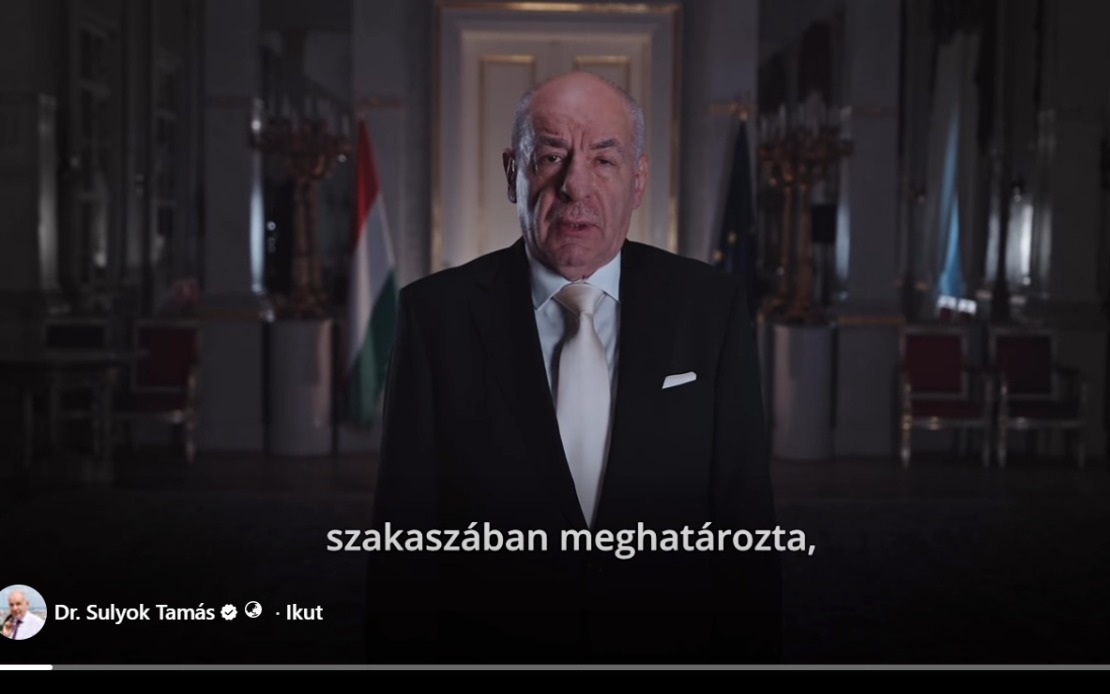
Hungarian President Tamás Sulyok has capitulated to constitutional pressure, agreeing to countersign amendments that will effectively end his presidency by Monday. The decision came after prolonged deliberation, with Sulyok ultimately deciding against legal resistance despite his conviction that parliament's removal process violates the constitution. His departure marks a watershed moment in Hungarian politics, clearing the way for Prime Minister Péter Magyar to implement far-reaching democratic changes after taking office in April following Viktor Orbán's electoral defeat.
Sulyok's predicament arose when parliament approved a constitutional amendment specifically designed to remove him from the presidential post. Prime Minister Magyar, exercising newly consolidated political authority, had issued a five-day ultimatum: countersign the changes or face formal impeachment proceedings. Rather than pursue a futile legal battle he believed he could not win, Sulyok chose to acknowledge parliamentary sovereignty, even while maintaining that the procedure itself contradicted Hungary's constitutional framework. This distinction between philosophical opposition and practical submission underscores the limited institutional protections available to Hungary's ceremonial head of state when confronting a determined legislative majority.
The constitutional court, which traditionally serves as guardian of fundamental law in Central European democracies, proved unable to offer meaningful protection. Legal experts noted that Hungary's apex judicial body could theoretically challenge the parliamentary decision only on narrow procedural grounds, without authority to overturn substantive policy choices made by elected legislators. This institutional constraint reflects a broader pattern across post-communist Europe where constitutional courts, despite theoretical independence, hesitate to directly confront elected governments on matters perceived as fundamental to state reorganisation. Sulyok's legal advisers apparently concluded that appealing to this court would amount to symbolic protest rather than practical recourse.
Until parliament elects a replacement within thirty days, Agnes Forsthoffer, the parliamentary speaker, will assume presidential functions and ceremonial responsibilities. In Hungary's parliamentary system, the head of state is selected by the legislature rather than popular vote, meaning Sulyok's successor will reflect the current parliamentary balance rather than direct citizen preference. This arrangement concentrates institutional influence among Magyar's political allies during a critical transition period when fundamental constitutional amendments are entering force. The mechanism, while constitutionally permissible, demonstrates how electoral victories in parliamentary democracies can yield sweeping powers extending well beyond traditional executive domains.
Prime Minister Magyar framed Sulyok's removal as liberation from authoritarian constraints imposed during the Orbán years. On Facebook, Magyar declared that the constitutional changes would restore to Hungarian citizens fundamental democratic protections, asserting that the Orbán regime had systematically eroded limitations on executive power and compromised independent state institutions. Magyar's rhetoric emphasises restoration rather than revolution, positioning his government as recovering constitutional normalcy rather than imposing radical transformation. This narrative matters significantly for European Union observers concerned about democratic backsliding; it presents reform as rectification of past abuses rather than potential concentration of power under new management.
Sulyok's video statement highlighted structural vulnerabilities in the Hungarian presidency that these constitutional changes apparently fail to address. He complained that the ceremonial head of state now operates entirely at the discretion of the executive and legislative majority, lacking meaningful oversight capacity or institutional independence. This critique suggests that even with Orbán's departure, constitutional architecture remains fundamentally imbalanced, with presidential functions reduced to formal procedures devoid of substantive power or checks. Sulyok's concern reflects broader European anxieties about parliamentary democracies where concentrated legislative majorities face minimal institutional restraint.
The constitutional amendments now entering force represent the centrepiece of Magyar's political agenda, framed as reversing institutional decay accumulated under fifteen years of Orbán governance. Though specific reforms remain partially obscured in international reporting, Magyar has emphasised reclamation of public property, restoration of state capacity to serve citizens rather than partisan interests, and re-establishment of meaningful boundaries on governmental power. These represent familiar democratic reform goals across Eastern Europe, yet implementation details will determine whether Magyar's coalition actually disperses power or merely redirects it toward alternative beneficiaries.
Sulyok's predicament offers cautionary perspective for other post-communist democracies grappling with institutional design questions. His removal demonstrates that formal constitutional provisions protecting presidential independence prove illusory when parliament commands overwhelming majorities and public opinion demands change. Conversely, his capitulation prevented institutional crisis that forcible removal might have precipitated. The sequence of events—ultimatum, deadline, countersignature—maintained procedural legitimacy while achieving Magyar's political objectives through apparent cooperation rather than confrontation.
For Malaysian observers, the Hungarian episode illustrates tensions inherent in parliamentary democracies between majoritarian governance and protection of institutional minorities. Malaysia's own constitutional framework vests significant powers in the Yang di-Pertuan Agong while granting parliament substantial legislative authority. Should Malaysian electoral competition intensify and produce polarisation comparable to Orbán's tenure, questions about presidential independence and parliamentary constraint might acquire fresh relevance. The Hungarian experience suggests that ceremonial heads of state possess limited practical leverage against determined legislative majorities, particularly when public sentiment supports institutional change.
The broader implications extend throughout Southeast Asia and beyond, where newly-elected governments may contemplate constitutional revision to consolidate power or reverse predecessors' policies. Hungary's episode demonstrates that such ambitions can advance through formally democratic procedures, with opposition figures accepting outcomes they deem constitutionally questionable rather than risk appearing obstructionist. This creates space for institutional transformation that, while procedurally legitimate, potentially reshapes fundamental political relationships. Magyar's success in removing a political rival through constitutional amendment, rather than electoral defeat or legal proceedings, suggests that in modern parliamentary democracies, control of legislative majorities grants extraordinary discretion to reshape institutions themselves.

