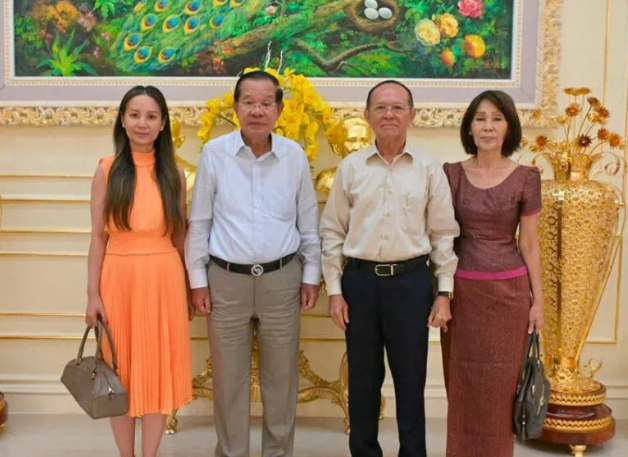
Cambodian Senate president Hun Sen received former opposition leader Kem Sokha at his private residence for an extensive three-hour meeting on Sunday morning, underscoring what appears to be a significant shift in the relationship between two figures who for years anchored opposing poles of the kingdom's political spectrum. The encounter, which lasted from 9am until noon and included Sokha's wife and daughter, represents another milestone in the gradual rehabilitation of Sokha's public standing following his May release from years of legal confinement.
Hun Sen's decision to publicly characterise the discussions and specifically praise Sokha's daughter Kem Monovithya as an "excellent human resource for the nation" carries particular weight given the fraught history between these camps. The Senate president did not elaborate on the substantive matters discussed during their meeting, leaving observers to speculate whether political considerations featured in their conversation. However, the very fact that Hun Sen felt compelled to highlight Monovithya's capabilities suggests deliberate messaging about the family's potential role in Cambodia's future.
The context surrounding these meetings illuminates how dramatically Sokha's circumstances have shifted in recent months. Imprisoned since 2014 on treason-related charges of allegedly conspiring with foreign powers to overthrow the government, Sokha had languished under severe restrictions even after his formal 27-year sentence was handed down in 2023. The Phnom Penh Appeal Court upheld this conviction on April 30, 2026, maintaining both the prison term and imposing a five-year international travel prohibition that effectively rendered him immobilised.
Yet within weeks, the trajectory reversed sharply. On May 25, King Norodom Sihamoni granted a royal pardon that immediately terminated Sokha's remaining incarceration and house arrest, though authorities stopped short of lifting his prohibition on political engagement. Subsequently, on July 24, a royal decree eliminated his overseas travel restrictions, signalling further easing of the constraints that had defined his existence since his 2014 arrest. These successive interventions suggest a deliberate calibration of restrictions rather than abrupt reversal, raising questions about whether they foreshadow additional normalisation.
Sokha has begun testing the boundaries of his newfound mobility. Days after the travel ban was lifted, he journeyed to Banteay Meanchey province to visit Cambodian families displaced by ongoing Cambodia-Thailand border tensions. During that trip, he carefully characterised himself as a private citizen offering humanitarian concern rather than a political representative, a framing that allowed him to maintain technical compliance with his prohibition on political activity while demonstrating his sustained relevance and capacity to mobilise around national issues.
Hun Sen's Sunday reception of Sokha at his home represents at least the second such private meeting in recent weeks, with the Senate president noting that Sokha had previously visited several weeks earlier before departing for the northern border region. The frequency and duration of these encounters suggest something more than ceremonial reconciliation—they indicate substantive engagement between two men whose rivalry once defined Cambodian politics. Hun Sen's extended discussion specifically with Monovithya, rather than limiting their exchange to pleasantries with Sokha himself, suggests targeted interest in the next generation of the opposition family.
The historical context makes these developments particularly significant for understanding Cambodia's political trajectory. The Cambodian National Rescue Party, which Sokha co-founded and led, emerged during the 2013 national election as a genuine electoral challenger to Hun Sen's Cambodian People's Party, capturing 55 seats and catalysing genuinely competitive politics. The CNRP's 2017 commune election gains further demonstrated its grassroots appeal across Cambodia. Yet the party was dissolved by the Supreme Court in November 2017 following Sokha's arrest, effectively terminating organised opposition.
That institutional obliteration, combined with Sokha's incarceration, created a vacuum in opposition politics that Hun Sen's government filled completely. Restoration of Sokha as a political actor, whether direct or through his daughter Monovithya, would represent a significant shift toward reconstituted political plurality. Hun Sen's conspicuous praise of Monovithya, who maintained prominence within CNRP circles before the party's dissolution, may signal receptivity to such reconstitution under carefully managed terms.
For regional observers monitoring democratic trajectories across Southeast Asia, these developments carry implications beyond Cambodia itself. The pattern reflects a broader phenomenon wherein authoritarian consolidation is occasionally mitigated through carefully controlled liberalisation that restores limited opposition activity while maintaining ultimate governmental supremacy. This calibrated approach contrasts with either rigid authoritarianism or genuine democratic opening, instead constructing managed pluralism that provides safety valves for political expression without permitting genuine threat to incumbent power.
Neither Hun Sen nor Sokha's representatives have publicly characterised their meetings as precursors to formal political reconciliation or power-sharing arrangements. Hun Sen's lavish praise of Monovithya deliberately avoided specifying whether it anticipated any particular public role for her, maintaining strategic ambiguity about the meetings' ultimate purpose. This opacity serves multiple functions—it allows the regime to signal flexibility without committing to specific arrangements, while giving Sokha's family grounds for cautious hope about potential reintegration.
The timing of these developments warrants attention as well. Cambodia approaches electoral cycles where the legitimacy benefits of demonstrable opposition activity could strengthen international perceptions of competitiveness. Restoring a calibrated opposition presence through Sokha or his daughter could serve Hun Sen's government's diplomatic interests without genuinely threatening its overwhelming parliamentary dominance. The royal pardon that initiated Sokha's liberation emerged from palace channels rather than governmental initiative, suggesting potential institutional calculations within Cambodia's leadership about optimised approaches to managing the opposition.
As Cambodia's political landscape evolves, the trajectory of Sokha's reintegration and Monovithya's potential ascendance will reveal whether these meetings represent genuine reconciliation between rivals or merely the carefully choreographed restoration of controlled opposition that preserves ultimate governmental authority. Hun Sen's strategic deployment of praise for Monovithya suggests the latter, though subsequent months will clarify whether political restrictions yield to accommodate substantive opposition participation or whether they remain largely ornamental constraints on what remains fundamentally circumscribed political space.

