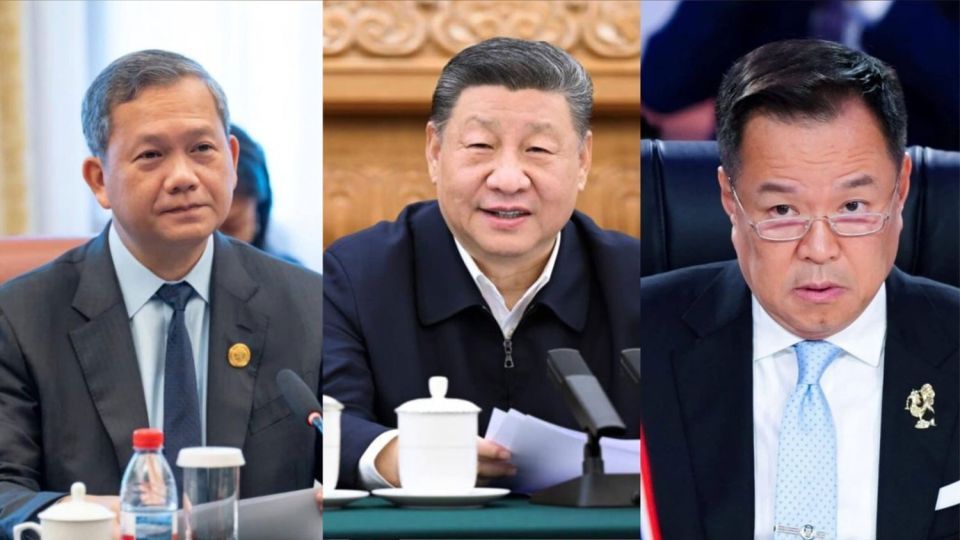
Prime Ministers Hun Manet of Cambodia and Anutin Chanvirakul of Thailand are set to converge on Shanghai this month for the World AI Conference 2026, where they will meet with Chinese President Xi Jinping and Premier Li Qiang on July 17. The invitation from Xi himself underscores China's diplomatic priority in maintaining close ties with both Southeast Asian nations, particularly as regional geopolitical complexities intensify. For Hun Manet, the July 15-17 journey represents an opportunity to reinforce Cambodia's strategic alignment with Beijing, whilst Thailand's participation signals similar intent despite the Thai government's more complicated relationship with Chinese influence.
Hun Manet will bring a substantial delegation reflecting the importance Cambodia places on the engagement. Foreign Minister Prak Sokhonn, Defence Minister Tea Seiha, and Sun Chanthol, first vice-chairman of the Council for the Development of Cambodia, will accompany the premier. Thailand's contingent will include Foreign Minister Sihasak Phuangketkeow, though the full composition remains less publicised. The composition of these delegations is telling: Cambodia has included its defence minister, suggesting potential military-to-military discussions with Beijing, whilst Thailand's delegation remains comparatively focused on diplomatic channels.
Cambodia's official framing of the visit emphasises deepening ties with China across multiple dimensions. The foreign ministry released a statement highlighting the relationship as foundational to advancing the Comprehensive Strategic Partnership of Cooperation, enhancing what Bangkok and Phnom Penh separately refer to as their "Diamond Cooperation Framework," and building what Cambodia describes as an "all-weather Cambodia-China Community with a Shared Future in the new era." The language reflects how thoroughly enmeshed these bilateral relationships have become with China's broader strategic vision for Southeast Asia. Thailand similarly characterised its participation as an opportunity to strengthen the "Thailand-China Comprehensive Strategic Cooperative Partnership," indicating parallel but distinct frameworks through which Beijing manages its relationships across the region.
Yet beneath the diplomatic polish lurks an unresolved question that analysts and observers cannot ignore: will China leverage its economic and political influence to push Cambodia and Thailand toward resolving their protracted border dispute? The two countries have not engaged in substantive negotiations since December, when the December 2025 Fuxian Consensus—itself a Chinese-brokered agreement—was supposed to set the framework for peaceful resolution. When Hun Manet and Anutin crossed paths at the third ASEAN Future Forum in Hanoi in early June, they exchanged handshakes for photographers but initiated no meaningful discussions addressing the territorial tensions between them.
The border dispute has festered for years, with several regions of Cambodia remaining under Thai military occupation and approximately 20,000 Cambodian civilians denied the possibility of returning to their homes. This humanitarian dimension adds weight to the dispute beyond mere cartographic disagreement. Cambodian scholars and analysts have grown increasingly vocal about the necessity for Chinese intervention, viewing Beijing as potentially the only actor with sufficient leverage over both governments to compel movement toward resolution. Kin Phea, director of the International Relations Institute at Cambodia's Royal Academy, has emerged as a prominent voice articulating this perspective, suggesting that China possess both the incentive and capability to act as an arbitrator.
Phea has identified a critical asymmetry in implementation that complicates diplomatic progress. Whilst Cambodia points to agreements reached by Thai civilian leadership, the Thai military establishment has demonstrated reluctance to abide by these commitments, continuing to conduct operations that encroach on Cambodian territory. This distinction between civilian and military authority in Thailand reflects structural tensions within Thailand's governance architecture that external pressure alone may struggle to resolve. Phea has argued forcefully that China should utilise its position as a major trading partner to pressure both nations toward dialogue grounded in international law, suggesting that Beijing adopt a more assertive mediatory role beyond simply facilitating meetings.
The analyst has specifically called upon Thailand to honour the December 2025 Fuxian Consensus by withdrawing troops from occupied territories, returning to the negotiating table, and engaging constructively with the Joint Boundary Commission without further delay. This represents an escalation from passive hope to active demands that China cannot ignore if it genuinely commits to regional stability. For Malaysian and Southeast Asian observers, the Cambodia-Thailand dispute carries broader implications for regional order. Should China successfully orchestrate a resolution, it would demonstrate Beijing's capacity to solve thorny disputes among ASEAN members, potentially positioning China as indispensable to regional peace-making architecture. Conversely, if the Shanghai conference yields no substantive movement, it would suggest limits to Chinese influence or willingness to press its neighbours on sensitive sovereignty matters.
The Shanghai gathering therefore represents more than a showcase for artificial intelligence technologies and innovation. It constitutes a critical diplomatic moment in which the trajectory of Cambodia-Thailand relations, the credibility of Chinese mediation efforts, and broader questions about regional conflict resolution mechanisms converge. The presence of senior defence and foreign ministry officials alongside the prime ministers indicates that substantive discussions may occur beyond the formal conference agenda. For Cambodia, securing explicit Chinese pressure on Thailand to implement the Fuxian Consensus would constitute a diplomatic victory of considerable significance. For Thailand, attending the conference whilst maintaining its military position creates an awkward balancing act between honouring diplomatic relationships and preserving what Bangkok views as legitimate security interests.
The international community and ASEAN member states will scrutinise what emerges from the bilateral meetings scheduled to occur on the sidelines of the AI conference. Whether China's economic weight translates into diplomatic momentum remains an open question that will resonate throughout Southeast Asia, affecting perceptions of how regional disputes may be settled in an increasingly multipolar Asia.

