Malaysia's Home Ministry (KDN) will intensify its investment in Johor's security apparatus and administrative infrastructure, Home Minister Datuk Seri Saifuddin Nasution Ismail announced, signalling a broader commitment to strengthen operations across the strategically important southern state. The announcement, made as the state heads toward a general election, reflects the federal government's prioritisation of Johor as both a security stronghold and critical gateway for international movement and commerce.
Saifuddin Nasution underscored Johor's geographical and strategic importance, positioning it as a cornerstone of Malaysia's security framework and public service delivery. As a state that borders Singapore and hosts major ports and border crossing points, Johor functions as a crucial node in the nation's security architecture. The ministry's development focus on this state signals recognition that infrastructure investment here carries implications beyond state boundaries, affecting how efficiently the country manages immigration, law enforcement and maritime security across the entire southern corridor.
The scope of the planned work is substantial, involving coordination across six distinct agencies under the Home Ministry's purview. The Royal Malaysia Police (PDRM) will see the most visible expansion, with new district headquarters under construction in Segamat and planned expansion of facilities in Pengerang. Additionally, the ministry will fund maintenance and upgrades to police living quarters and lift systems at existing stations, addressing what often goes unnoticed but significantly affects officer morale and operational readiness in a region experiencing rapid urbanisation.
Border and immigration facilities will receive particular attention, with upgrades at the Sultan Iskandar Building and Sultan Abu Bakar Complex representing the ministry's commitment to streamlining entry and exit procedures. These facilities process hundreds of thousands of travellers monthly, and improving their infrastructure directly affects Malaysia's reputation for efficient border management. Better-organised, modern facilities enhance both security screening capacity and the visitor experience, matters increasingly relevant as regional tourism and trade activity recover post-pandemic.
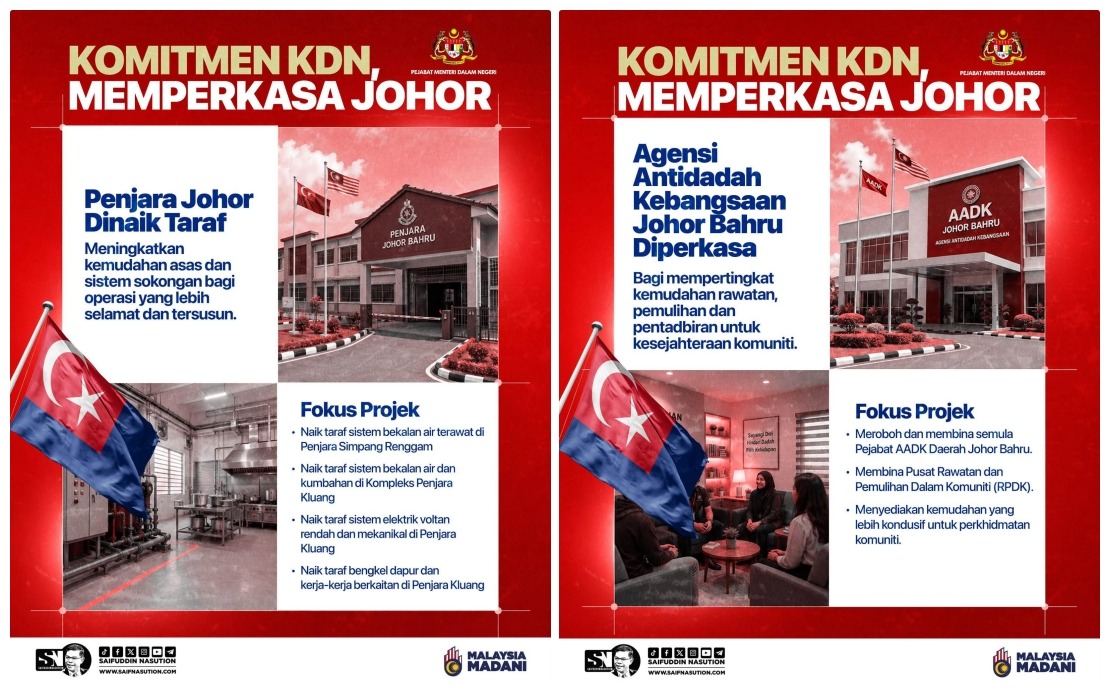
The National Registration Department (JPN) will gain a new district office in Batu Pahat, reflecting administrative capacity-building in Johor's hinterland. The Prisons Department's modernisation agenda targets basic system upgrades at both Kluang and Simpang Renggam facilities, improvements that directly affect the living conditions of both inmates and correction officers managing an increasingly complex prisoner population. The National Anti-Drugs Agency (AADK) will see offices and treatment centres redeveloped across the state, tackling infrastructure that supports counter-narcotics operations and rehabilitation services in a region historically significant in Malaysia's drug enforcement efforts.
The Malaysian Maritime Enforcement Agency (MMEA) receives attention through upgrades to the Abu Bakar Maritime Base's jetty and building infrastructure. This facility operates within the Straits of Malacca and surrounding waters, one of the world's busiest shipping corridors where Malaysia maintains crucial enforcement responsibilities. Enhancing these facilities supports MMEA's capacity to conduct surveillance, intercept illegal activities, and respond to maritime emergencies in an area where piracy, smuggling and environmental incidents periodically occur.
Saifuddin Nasution framed these projects not merely as infrastructure expansion but as investments in personnel welfare and public service quality. This messaging reflects evolving approaches to security sector development, acknowledging that modern law enforcement and border management depend on well-maintained facilities, properly resourced staff, and contemporary operational systems. Staff working in prison facilities, immigration checkpoints or maritime bases function more effectively in environments that support their professional standards and personal wellbeing.
The ministry's commitment underscores a broader principle that security infrastructure forms the backbone of state stability and economic function. Johor's role as a commercial hub, its proximity to Singapore, and its responsibility as an entry and exit point for millions annually mean that delays or inefficiencies at police headquarters, prison facilities or immigration desks generate cascading effects throughout regional commerce and mobility. Investment at this infrastructure level thus carries economic implications beyond traditional security calculations.
The timing of this announcement, preceding Johor's state election, reflects the federal government's interest in demonstrating developmental commitment to the state's electorate. However, the projects themselves represent longstanding ministry priorities that transcend electoral cycles. Infrastructure of this nature typically requires multi-year implementation and funding commitments, suggesting these initiatives will continue regardless of electoral outcomes. For Johor residents, the promised improvements to operational efficiency and service delivery represent tangible changes in how they interact with security agencies and administrative bodies.
The multi-agency coordination required to execute these projects also suggests evolving inter-agency collaboration within the federal security establishment. Simultaneous upgrades across police, immigration, prisons and maritime enforcement require coordinated planning, shared budget prioritisation and possibly consolidated project management. Such coordination, when effective, can identify efficiencies and reduce redundancies across the security sector.
For Malaysia's broader regional standing, investment in Johor's border and maritime infrastructure signals commitment to maintaining professional, efficient security operations in Southeast Asia. As ASEAN countries grapple with irregular migration, transnational crime and maritime security challenges, Malaysia's capacity to manage its borders and territorial waters significantly affects regional stability and burden-sharing. Johor's infrastructure improvements contribute to that capacity.
The Home Ministry's developmental agenda for Johor thus operates on multiple levels simultaneously: addressing immediate infrastructure deficiencies, supporting personnel welfare, enhancing service delivery to Johor residents, and maintaining Malaysia's capacity to fulfil its regional security responsibilities. Whether all projects meet their implementation timelines remains an open question, as government infrastructure projects frequently encounter delays. Nevertheless, the scale and specificity of the ministry's announcement indicates serious resource allocation toward Johor's security and administrative apparatus during a period when the federal government navigates multiple competing development priorities across Malaysia's thirteen states.

