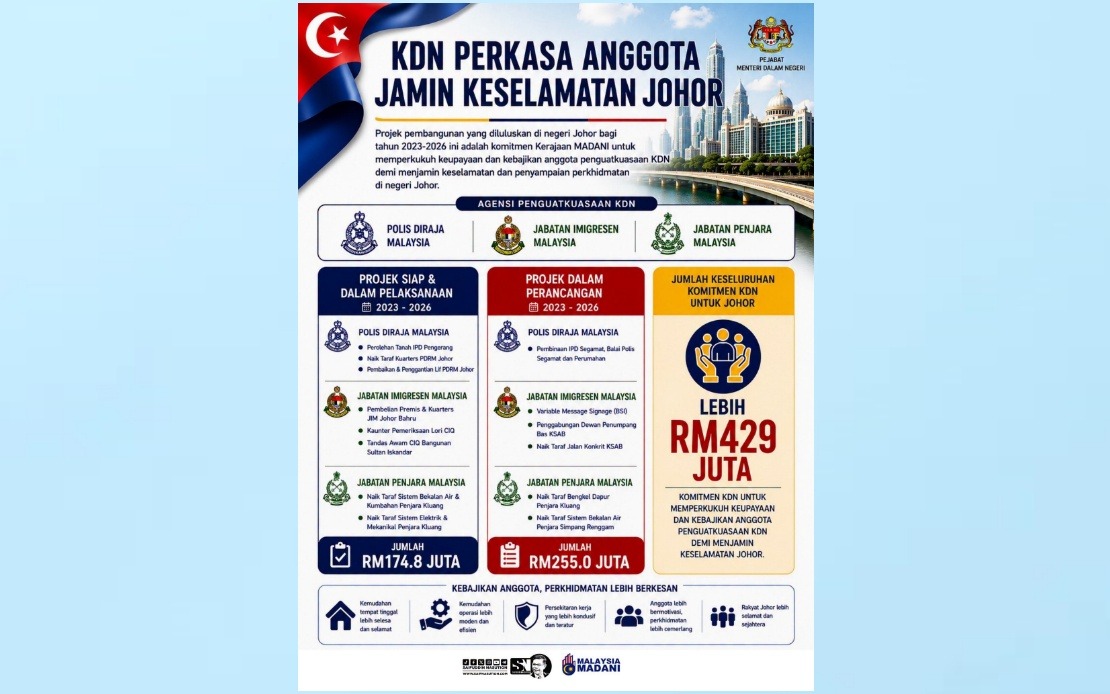
The Malaysian Home Ministry is channelling more than RM429 million into Johor's enforcement sector, targeting a comprehensive upgrade of both human resources and operational infrastructure across the Royal Malaysia Police, Malaysian Immigration Department, and Prisons Department. According to Home Minister Datuk Seri Saifuddin Nasution Ismail, this investment represents a strategic shift in how the government approaches law enforcement—one that recognises personnel wellbeing as foundational to public safety rather than incidental to it.
The scale of the commitment underscores the government's recognition that Johor, as Malaysia's second-largest state by population and a crucial economic corridor, requires proportional security infrastructure. The allocation divides into two tranches: RM174.8 million already committed to projects either completed or actively under construction, and RM255 million earmarked for initiatives still in planning phases. This phased approach allows the ministry to balance immediate operational needs with longer-term strategic development.
Saifuddin Nasution framed the investment beyond simple asset accumulation, positioning it as enabling enforcement personnel to execute their mandates with greater efficiency and safety. The logic is straightforward but consequential: officers working in modern facilities with adequate quarters and contemporary equipment can concentrate on their core responsibilities rather than struggling with deteriorating workspaces or inadequate accommodation. For Johor residents, this translates to more responsive policing, streamlined immigration processing, and better-managed correctional facilities.
Current implementation projects offer a snapshot of immediate priorities. The Pengerang District Police Headquarters project involves land acquisition for a new facility that will serve the district's growing population and industrial zones. Similarly, the Johor Bahru Immigration Department is securing permanent office and residential premises, addressing what appears to be longstanding space constraints in one of Malaysia's busiest immigration hubs. At Kluang Prison, basic facility upgrades aim to improve conditions for both inmates and staff operating within overcrowded facilities.
The pipeline of planned projects reveals longer-term structural ambitions across the state. Segamat District will receive a purpose-built police headquarters complete with residential quarters—a significant development for a district that has experienced infrastructure gaps. The consolidation of bus passenger services at the Sultan Abu Bakar Complex represents ancillary security infrastructure, recognising that transport terminals require coordinated law enforcement attention. Kitchen and water supply upgrades at Kluang and Simpang Renggam prisons address fundamental operational and humane concerns within the correctional system.
The timing of this announcement carries political significance. Home Minister Saifuddin Nasution referenced Prime Minister Datuk Seri Anwar Ibrahim's recent parliamentary clarification that Johor's total development and management allocation has risen substantially to RM14.6 billion from the previous RM10.2 billion. This broader budgetary context matters for Malaysian readers tracking how the MADANI Government distributes resources across states. The enforcement sector investment represents one component of a significantly expanded Johor budget, suggesting a deliberate effort to rebuild confidence in state-level development after previous governance periods.
For Malaysian readers concerned with security outcomes, the investment strategy reflects a particular philosophy about enforcement effectiveness. Rather than purely tactical spending on surveillance technology or operational deployments, the Home Ministry is prioritising the foundational conditions under which enforcement personnel operate. This approach acknowledges that retention, morale, and workplace conditions directly influence service quality—a recognition that many Southeast Asian security agencies are still developing.
The allocation also addresses regional competitiveness within Malaysia's enforcement sector. Johor's rapid economic growth and strategic position bordering Singapore mean immigration and customs operations here operate at unusually high volumes and complexity. The infrastructure investment aims to ensure these facilities can handle contemporary demand without the bottlenecks that sometimes characterise regional border operations.
Personnel welfare improvements carry particular weight in enforcement sectors historically characterised by long hours, hazardous conditions, and modest compensation. Better housing for police officers and prison staff, modern facilities for immigration officers processing thousands of daily crossings, and upgraded prison infrastructure all contribute to workforce stability. For the agencies themselves, reduced turnover and improved retention mean institutional knowledge remains embedded, training investments pay dividends over longer periods, and operational consistency improves.
The announcement also reflects contemporary thinking about security infrastructure as economic infrastructure. Well-functioning enforcement agencies reduce business transaction costs by providing reliable border processing, effective criminal investigation, and correctional system predictability. For Johor's manufacturing, logistics, and tourism sectors, faster immigration clearance and lower crime correlate with competitive advantage. The Home Ministry's investment thus serves economic as well as security objectives.
Critics might note that RM429 million, while substantial in absolute terms, represents a relatively modest outlay when distributed across three major agencies and multiple districts over seven years. Whether the allocation suffices to address all identified gaps across Johor remains an open question. Nonetheless, the transparent accounting of projects and their stages—distinguishing completed work, ongoing projects, and future plans—provides a framework for monitoring implementation.
The announcement also signals confidence in Johor's development trajectory. The specific projects identified suggest the Home Ministry has conducted needs assessments and prioritised based on demographic trends, traffic volumes, and operational assessments. The inclusion of facilities like the Pengerang headquarters indicates planning based on industrial zone development, while Johor Bahru immigration facilities reflect the state capital's continuing role as a major population centre and cross-border hub.
Looking forward, Malaysian observers should track whether these allocations translate into visible service improvements—shorter processing times at Johor Bahru immigration, more responsive policing in developing areas, and better-managed correctional facilities. The test of such government investments ultimately lies not in announcements but in operational outcomes that citizens experience directly. For a state as economically important and strategically positioned as Johor, getting enforcement infrastructure right carries implications extending beyond state boundaries.

