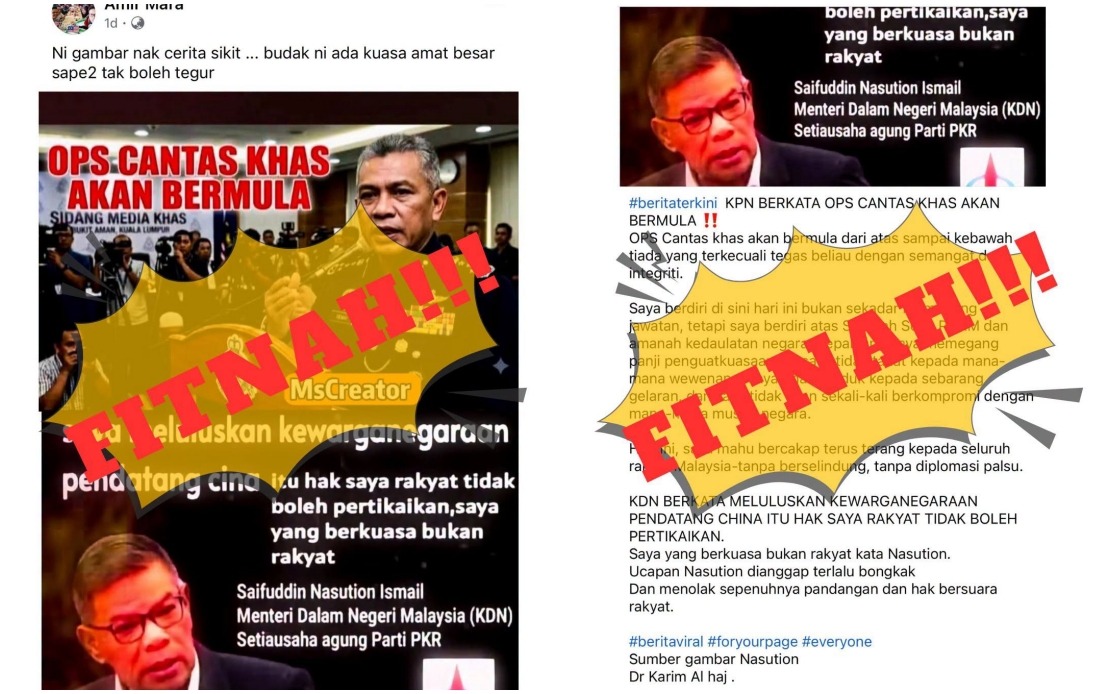
Home Minister Datuk Seri Saifuddin Nasution Ismail has emphatically rejected longstanding allegations that the Home Ministry granted citizenship to large numbers of foreign nationals, dismissing claims that 1.2 million Chinese nationals remained in Malaysia without proper documentation. Speaking from Putrajaya on August 19, the minister expressed frustration at what he characterized as a deliberate campaign to resurrect debunked narratives through social media and digital platforms, despite his repeated public denials backed by official statistics.
The minister acknowledged that various posters and viral content alleging improper citizenship grants have circulated extensively across social media platforms, but contended that such material represents recycled misinformation rather than factual reporting. Saifuddin Nasution emphasized that he has addressed these allegations on numerous occasions through official channels, each time providing documentary evidence and data to counter the claims. He appeared frustrated by the persistence of the narrative, suggesting that deliberate actors are choosing to ignore previous corrections and continue propagating the same unsubstantiated allegations for various strategic purposes.
Beyond simply denying the specific citizenship claims, Saifuddin Nasution raised broader concerns about the consequences of allowing such misinformation to flourish unchecked. He warned that the dissemination of false claims about government institutions damages public trust in state machinery and creates conditions for social instability. The minister highlighted the particular danger that such narratives pose to community harmony, noting that the allegations often carry ethnic undertones designed to inflame tensions between different Malaysian communities and foster interracial resentment.
The Home Minister explicitly connected the spread of misinformation to threats against national security and public order. By suggesting that false claims about citizenship policies could destabilize the country, Saifuddin Nasution framed the issue not merely as a factual dispute but as a matter affecting Malaysia's fundamental stability. This elevation of the concern reflects growing government anxiety about the weaponization of social media narratives in political discourse and the difficulty authorities face in controlling the narrative around sensitive policy areas.
Saifuddin Nasution called upon all stakeholders to cease propagating the citizenship allegations and resist the temptation to exploit contentious issues for political advantage or social media engagement. The appeal appeared directed both at political opponents who might benefit from fomenting public anxiety and at ordinary citizens who unknowingly amplify such content. The minister suggested that much of the problem stems from poor information hygiene rather than deliberate malice, though he acknowledged that some actors deliberately recycle debunked material with clear intent to mislead.
The minister urged the Malaysian public to adopt a more rigorous approach to information consumption, recommending that citizens verify claims against official sources before accepting or sharing content. This appeal reflects a broader challenge facing governments across Southeast Asia as they grapple with rapid information spread and declining trust in institutional authority. Saifuddin Nasution's emphasis on checking with official sources underscores the government's preferred solution: channeling public inquiry toward state institutions rather than allowing narratives to develop organically across social media.
Central to the minister's defense was his insistence that the government has already provided comprehensive explanations, citing documented facts and official data to support the Home Ministry's position. He referenced earlier statements and media reports that had supposedly resolved the controversy, suggesting that continued claims represent either ignorance of previous clarifications or willful disregard for factual correction. This argument, however, may not fully address why such claims continue to gain traction if official explanations have been sufficiently comprehensive and persuasive.
The persistent circulation of these citizenship allegations despite official denials points to deeper questions about government credibility and public confidence in institutional authority. Whether the resonance of these claims reflects genuine public skepticism about immigration and citizenship procedures, or whether it primarily represents the work of determined disinformation actors, remains an open question. The Home Ministry's approach of repeatedly issuing denials and appealing to the public to check official sources may prove insufficient if underlying trust deficits remain unaddressed.
For Malaysia, the controversy touches on historically sensitive issues surrounding citizenship rights, ethnic composition, and immigration policy. These matters have carried political weight since independence and remain capable of mobilizing voters along ethnic lines. The deliberate circulation of allegations about mass citizenship grants appears designed to activate these historical sensitivities and reinforce perceptions that one community's interests are being compromised by government policy, regardless of the factual accuracy of such claims.
Saifuddin Nasution's latest statement represents the government's continued effort to establish authoritative control over narratives concerning immigration and citizenship. As misinformation becomes increasingly difficult to contain through traditional correction mechanisms, Malaysian policymakers face the challenge of rebuilding public confidence in institutional communications. The minister's call for responsible social media use and verification of information against official sources reflects this broader strategic imperative to reestablish the government's role as a trusted arbiter of truth in public discourse.

