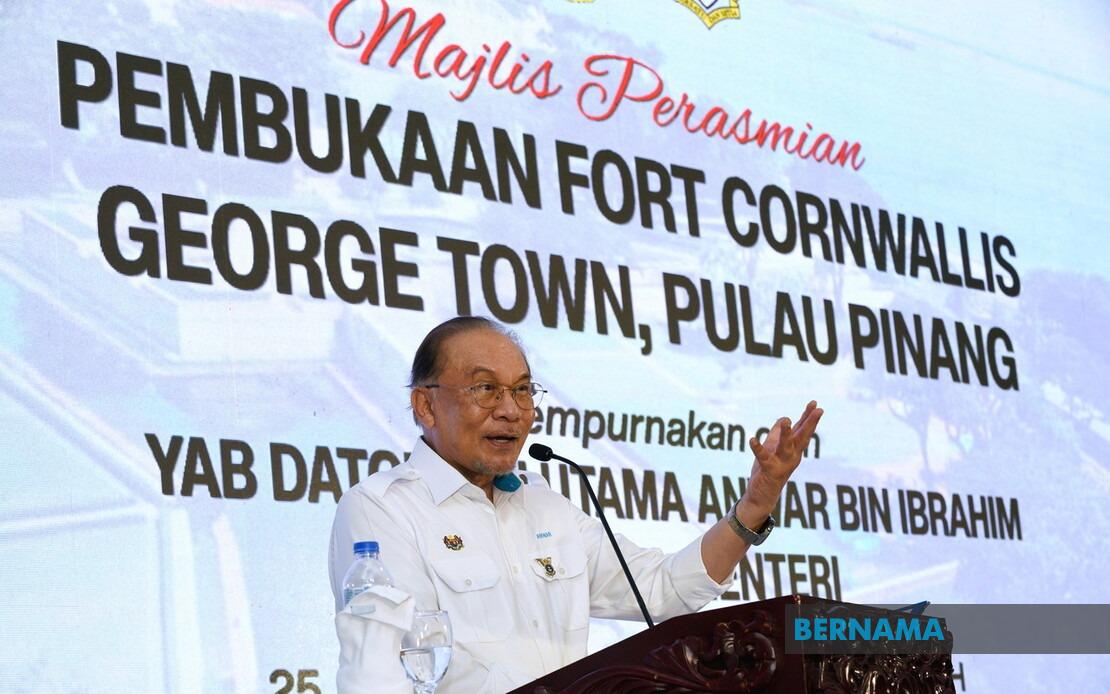
Prime Minister Datuk Seri Anwar Ibrahim has urged Malaysia to transform its historical sites into meaningful educational platforms, moving beyond their appeal as mere tourist destinations. Speaking at the opening ceremony of Fort Cornwallis in George Town on July 25, Anwar stressed that visits to heritage locations should equip young Malaysians with deeper understanding of national values, the cost of independence, and the hardships endured during colonial rule. The vision represents a significant shift in how the country approaches its relationship with historical memory, particularly in an era when heritage tourism drives considerable economic activity across the region.
The Prime Minister's remarks reflect growing recognition that physical preservation of historical sites holds limited value unless accompanied by robust educational frameworks. Anwar advocated for comprehensive interpretative programmes during youth visits to such locations, ensuring that experiences transcend aesthetic appreciation. Rather than allowing visitors to admire architectural features in isolation, he proposed embedding historical narratives that illuminate broader themes of national resilience and collective identity. This approach acknowledges that younger generations possess limited living connection to pre-independence experiences and require structured learning to grasp their significance.
Crucially, Anwar emphasised that Malaysia's historical narrative must be reclaimed from colonial perspectives that dominated earlier interpretations. For decades, many heritage sites were presented through the lens of colonial administrators, emphasising economic development, infrastructure achievement, and administrative order whilst downplaying displacement, exploitation, and resistance. By repositioning Fort Cornwallis and similar locations as spaces for Malaysian-centred historical understanding, the Prime Minister advocates for reclaiming narrative authority. This reframing enables communities to explore uncomfortable truths about their past whilst deriving lessons applicable to contemporary nation-building.
The distinction between preservation for tourism and preservation for education carries profound implications for Southeast Asia's broader historical consciousness. Tourism-oriented heritage conservation typically emphasises visual spectacle, comfort of international visitors, and economic return on investment. Educational models, conversely, prioritise critical thinking, contextual complexity, and local relevance. For Malaysia, where national cohesion depends partly on shared historical understanding across diverse communities, this pivot towards education-centred heritage becomes strategically important. Schools, universities, and informal learning groups could utilise such sites as living classrooms, reinforcing civic awareness during formative years.
Anwar's framing explicitly connects historical understanding to contemporary governance challenges. He highlighted how colonialism demonstrated the vulnerability of disunited nations to external domination, drawing parallels to current geopolitical pressures facing Southeast Asian states. By presenting colonial history not as distant academic subject but as foundational lesson for present-day unity and sovereignty, the Prime Minister positions heritage education within urgent national conversations. This linkage proves particularly resonant given ongoing regional tensions and internal pressures on social cohesion that periodically threaten Malaysian stability.
The conservation of Fort Cornwallis itself exemplifies the tension Anwar seeks to resolve. As a British military installation constructed during early colonial expansion, the fort could easily be misinterpreted as celebrating imperial achievement. However, Anwar explicitly rejected this reading, clarifying that preservation aims to facilitate critical examination rather than glorification. Such clarification proves essential in multicultural Malaysia, where historical interpretations can trigger community sensitivities. By establishing educational purpose as conservation's foundation, authorities signal intention to explore contested histories honestly rather than impose celebratory narratives.
Implementing this vision requires substantial investment in interpretative infrastructure, trained guides, curriculum development, and institutional coordination. Malaysian schools would need to integrate heritage site visits into history and civic education programmes, supported by pedagogical materials connecting site experiences to classroom learning. Government agencies responsible for heritage management must develop expertise in historical interpretation, moving beyond architectural preservation toward sophisticated historical scholarship. This transformation demands sustained funding and professional commitment, representing departure from heritage management models that prioritise maintenance over meaning-making.
The generational dimension of Anwar's appeal warrants particular attention. Youth disconnection from historical consciousness increasingly concerns political leaders across Asia, as rapid modernisation and digital distraction compete for attention. By embedding history within memorable experiential learning at heritage sites, Malaysia could strengthen intergenerational transmission of civic values. Young people encountering tangible reminders of independence struggles and colonial suffering develop emotional and intellectual engagement surpassing what textbooks alone provide. This embodied learning potentially cultivates deeper patriotic commitment grounded in understanding rather than abstract instruction.
Regionally, Malaysia's approach could influence how other Southeast Asian nations manage their colonial legacies. Vietnam, Indonesia, Thailand, and the Philippines similarly grapple with presenting complex historical narratives involving foreign domination and resistance movements. If Malaysia successfully demonstrates that heritage education strengthens rather than threatens social stability, neighbouring countries might adopt comparable frameworks. This could gradually shift regional historical consciousness from colonial-centred narratives toward Southeast Asian-centred understanding, fundamentally reshaping how younger generations across the region comprehend their societies' trajectories and international positions.
The Prime Minister's vision ultimately reflects conviction that history serves contemporary purposes beyond preserving information for its own sake. By deliberately deploying historical sites as educational instruments promoting unity, national pride, and informed citizenship, Malaysia acknowledges that how societies remember their pasts directly shapes their futures. This represents mature approach to heritage conservation, recognising that physical restoration without intellectual engagement squanders opportunities for collective learning. As Malaysian youth increasingly inherit responsibilities for regional stability and national development, grounding their understanding in carefully curated, honestly presented historical experience becomes strategic necessity rather than cultural luxury.

