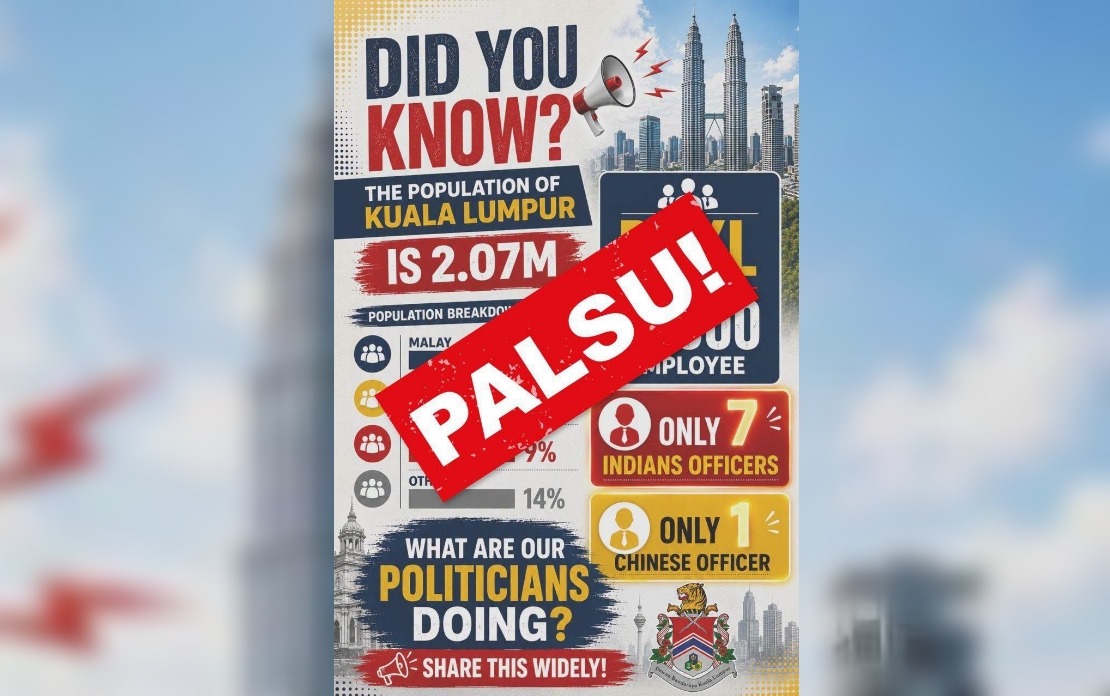
A misleading poster spreading across WhatsApp has prompted Malaysia's Minister in the Prime Minister's Department for Federal Territories to set the record straight regarding the ethnic composition of Kuala Lumpur City Hall's workforce. Hannah Yeoh moved quickly to counter the false narrative, which claimed that the municipal authority employed only seven Indian staff and a single Chinese employee, during a period when election campaigning has intensified misinformation about public institutions.
The actual figures paint a substantially different picture of DBKL's diversity profile. As of July 1, 2026, the city hall maintains a total workforce of 9,131 employees, among whom 490 are of Indian descent and 22 are Chinese nationals or Malaysian citizens of Chinese ethnicity. Within the more senior ranks—specifically the Management and Professional Group—the representation includes 10 Indian officers and two Chinese officers. These numbers, while still reflecting a predominantly Malay and Bumiputera workforce typical of federal entities in Malaysia, demonstrate a meaningful presence of minority communities that starkly contradicts the inflammatory claims circulating online.
Yeoh's public correction via Facebook serves multiple purposes in an election environment where demographic anxieties can be weaponised for political gain. By providing granular workforce data, she has attempted to replace rumour with verifiable information and restore public confidence in the institution's integrity. The minister's approach reflects growing concern among government figures about how unsubstantiated claims can rapidly corrode trust in public administration, particularly when such misinformation targets sensitive ethnic and religious sensibilities.
Acknowledging that while the current situation does not match the extreme claims being circulated, Yeoh has taken the measured stance that room for improvement exists across DBKL's employment landscape. Rather than dismissing concerns about representation entirely, she has framed the correction as an opportunity to examine systemic practices. This balance between defending the institution and recognising legitimate questions about inclusivity represents a pragmatic response to a politically charged moment.
To address potential gaps in workforce diversity, Yeoh has instructed DBKL to undertake a comprehensive review spanning multiple dimensions of human resource management. The examination will scrutinise recruitment protocols, the actual hiring practices applied during candidate selection, promotion criteria and pathways for advancement, and the channels through which job openings are advertised. By casting this audit across the entire employment pipeline, from initial recruitment through career progression, DBKL aims to identify whether any structural barriers might be limiting the participation of qualified candidates from minority communities.
The minister has explicitly emphasised that any reforms flowing from this review must prioritise transparency, fairness, and merit-based decision-making. These principles are critical reassurances both to potential applicants from underrepresented groups and to the broader public watching how public institutions handle questions of equal opportunity. In a Malaysian context where federal authorities have historically been dominated by particular ethnic groups, publicly committing to merit-based processes can help rebuild confidence that competence rather than patronage or hidden bias drives hiring decisions.
Yeoh's statement also represents a direct appeal to political actors and the public to resist weaponising employment statistics for divisive purposes. She called upon all stakeholders to refrain from exploiting workforce composition issues to deliberately foment racial tensions or discord among Malaysia's diverse communities. This caution reflects awareness that during election periods, false narratives about employment discrimination or ethnic favouritism can inflame intercommunal relations and undermine social cohesion.
Instead of exploiting such concerns, Yeoh encouraged a constructive approach centred on correcting misinformation and genuinely addressing any shortcomings that investigations might uncover. This framing attempts to shift political discourse away from blame and accusations toward solutions-oriented dialogue. For readers in Malaysia and Southeast Asia, the episode illustrates how easily falsehoods can propagate through social media platforms during campaign seasons, highlighting the importance of institutional transparency and rapid fact-checking by responsible officials.
The broader context for this correction involves the intensifying role of ethnic and religious identity politics in Malaysian elections. Public sector employment has long been a sensitive issue, with questions about the ethnic composition of civil service agencies intersecting with constitutional provisions regarding Bumiputera rights and meritocratic principles. When politicians or activists can introduce false claims into this contested terrain via social media, the potential for social disruption grows substantially.
DBKL, as Kuala Lumpur's municipal authority, occupies particular symbolic importance in Malaysia's political landscape. The capital city is a space where diverse communities interact daily, and perceptions about whether public institutions reflect and serve all residents fairly carry weight beyond mere employment statistics. That said, the specific numbers now provided suggest that while the bulk of DBKL's workforce remains drawn from the Malay-Muslim majority, as would be expected given constitutional arrangements, meaningful minority representation does exist and appears concentrated in professional and managerial positions.
The review Yeoh has initiated into DBKL's recruitment and promotion systems may yield findings that influence employment practices across other federal territories agencies and potentially model improvements for municipal authorities nationwide. Should the audit identify discriminatory patterns or unjustified barriers to minority applicants, corrective measures could establish precedents for how public institutions approach diversity and inclusion challenges. Conversely, if the review confirms that current processes are already functioning fairly, transparent publication of those findings could help inoculate DBKL against future false claims.
Moving forward, the immediate challenge facing DBKL involves completing its operational review efficiently and credibly while maintaining focus on delivering essential services to Kuala Lumpur residents. The institution must balance responsiveness to legitimate concerns about representation with resistance to pressure from those seeking to manipulate employment issues for political advantage. How DBKL handles this balance during the remainder of the election campaign may influence public perceptions of both the authority and the government more broadly.

