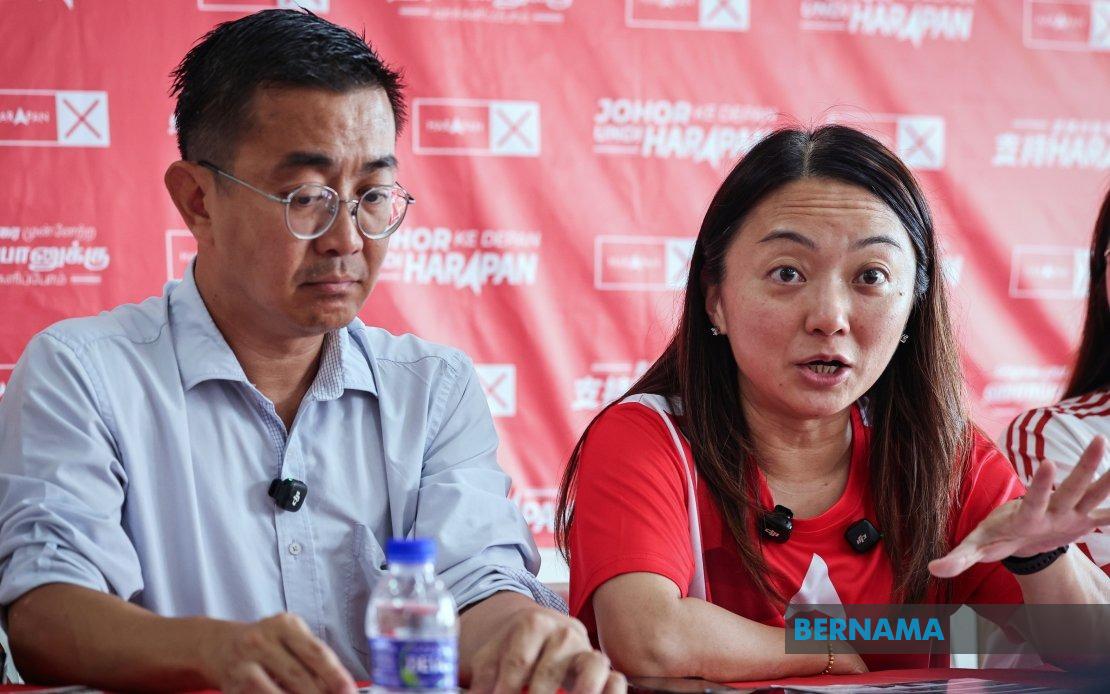
In a campaign push ahead of voting in the Pekan Nanas state constituency, DAP deputy secretary-general Hannah Yeoh has made an impassioned appeal to residents to grant Pakatan Harapan another opportunity to represent the area in the Johor State Legislative Assembly. Speaking at a press conference in Pontian on July 10, Yeoh underscored the importance of selecting an assemblyman capable of navigating government systems and securing resources for local development rather than merely attending to individual grievances.
Yeoh highlighted the multifaceted responsibilities shouldered by state representatives in Johor's legislative chamber. The role transcends conventional community service, she explained, extending to championing district-level concerns and spearheading infrastructure initiatives. Critically, assemblymen serve as connectors between constituents and higher bureaucratic structures, helping residents cut through red tape and access solutions from ministries and government agencies. This institutional knowledge and political leverage become especially valuable when communities face persistent problems requiring sustained intervention at state and federal levels.
The DAP leader expressed confidence in Yeo Tung Siong, the PH candidate contesting the Pekan Nanas seat. She portrayed him as someone with genuine understanding of administrative channels and the capacity to resolve constituent issues effectively. Yeoh promised that Yeo would serve the electorate equitably regardless of their political leanings—a signal attempting to appeal beyond traditional PH supporters in what remains a competitive battleground. Her confidence in the candidate reflected PH's broader campaign strategy of emphasizing competence and fairness over partisan identity.
However, Yeoh tempered expectations by cautioning that positive crowd responses at campaign events offer no reliable guide to electoral outcomes. The campaign trail enthusiasm that PH has experienced provides encouragement but remains fundamentally different from ballot-box reality. She stressed that the actual measure of support would emerge only when voters made the deliberate choice to cast their ballots on polling day. In competitive contests where margins matter, campaign energy cannot substitute for disciplined turnout organisation.
Recognising that victory remains far from assured, Yeoh issued a direct mobilisation call to PH supporters. She implored those committed to giving the coalition another chance to make concrete plans to vote and to encourage others to return home if they had relocated. The timing of her plea—made the day before voting—reflected the typically frenetic final phase of Malaysian electoral campaigns, when parties intensify efforts to shift undecided voters and ensure their base participates. Every percentage point of turnout carries weight in marginal constituencies.
Yeo Tung Siong himself reinforced the turnout theme, drawing on historical patterns to argue that PH's electoral fortunes depend heavily on voter participation rates. He pointed out that during the 2013 and 2018 general elections—both victories for the broader opposition movement—voter turnout exceeded 80 percent. By contrast, the 2022 Johor state election witnessed a notably lower turnout of approximately 60 percent. These statistics carry crucial implications: higher participation tends to favour PH's demographic support base and coalition machinery, while lower turnout can benefit other actors with different voter compositions or organisational structures.
Yeo's deployment of historical voting data served both analytical and motivational purposes. By documenting the correlation between high turnout and PH success, he provided a framework through which supporters could understand their individual voting decision as part of a collective outcome. The numbers also implicitly acknowledged that predicting results before seeing actual turnout figures would be premature and potentially misleading. In Malaysian electoral politics, where individual constituencies often defy broader state or national trends, such caution reflects genuine uncertainty rather than false modesty.
The Pekan Nanas contest pits Yeo against incumbent Tan Eng Meng of Barisan Nasional in a direct two-way battle. This straight fight configuration eliminates complications from three-cornered contests and focuses voter choice starkly. Barisan Nasional's incumbent status confers advantages—established constituency infrastructure, incumbent advantage, and potential dissatisfaction with alternative options—yet the fact that PH is contesting seriously suggests genuine competitive viability. The straight fight format means that whoever mobilises their base more effectively will likely prevail.
For Malaysian observers, the Pekan Nanas race illustrates broader dynamics in Johor's political evolution. The state remains a crucial electoral battleground where PH and BN compete intensely, and where every seat carries significance for both coalition building and political momentum. The emphasis on voter turnout reflects a deeper reality: Malaysian elections are often decided not by dramatic preference swings but by differential participation rates among existing supporters. Yeoh's campaign message thus transcends the particular contest, embodying a recognition that electoral victory in Malaysia's contemporary landscape depends on converting existing sympathies into actual votes.
The timing of this campaign phase, occurring in mid-2024 during a period of broader Malaysian political recalibration, adds additional weight to the Pekan Nanas vote. State-level contests increasingly serve as bellwethers for national political health and coalition sustainability. A PH victory would demonstrate the coalition's capacity to compete effectively in peninsula heartland constituencies against a BN still commanding significant resources and institutional backing. Conversely, a BN retention would affirm the incumbent coalition's continued resilience in traditional strongholds. Either outcome will reverberate through Malaysia's fractured political landscape.

