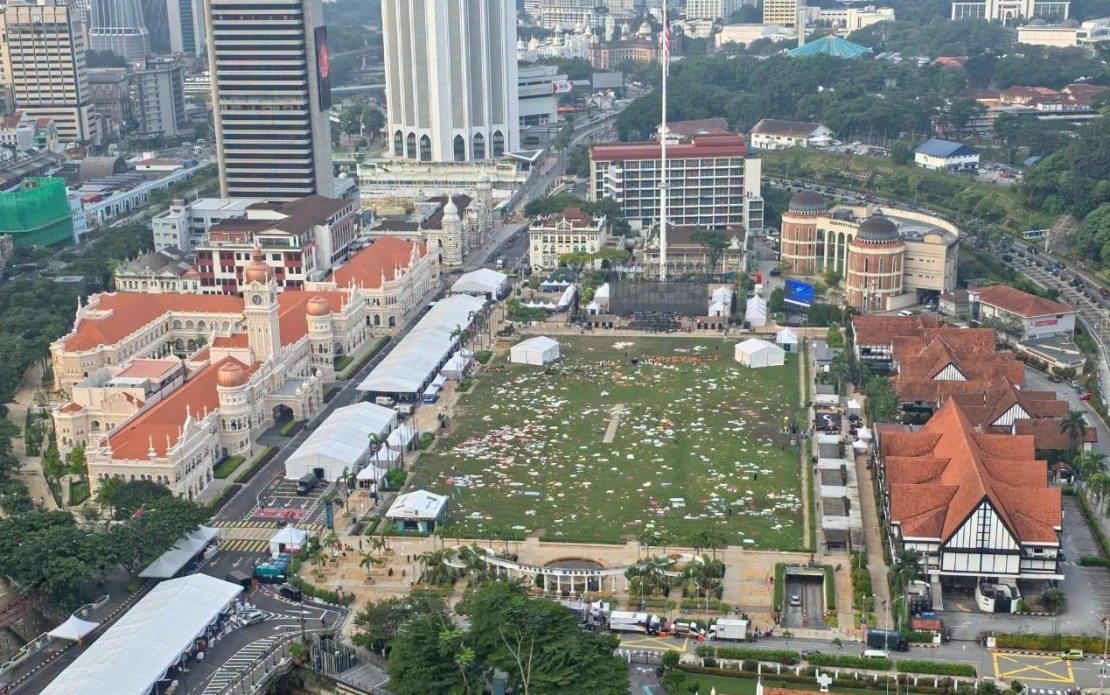
Hannah Yeoh, the Minister in the Prime Minister's Department overseeing Federal Territories, has commended the dedicated efforts of Kuala Lumpur City Hall workers who swiftly cleaned Dataran Merdeka after rubbish accumulated during a public screening of the 2026 FIFA World Cup final. While acknowledging DBKL's operational success, Yeoh seized the moment to underscore a broader civic principle: that maintaining the cleanliness of shared public spaces represents a collective responsibility rather than a burden to be shouldered by municipal workers alone.
The minister's intervention reflects growing frustration among government officials regarding public attitudes towards littering in high-traffic venues. Dataran Merdeka, as Malaysia's most symbolically significant open space and the historic heart of the nation's independence narrative, carries particular weight. The venue regularly hosts large gatherings, and its maintenance demands coordination between municipal services and public discipline. Yet the pattern of significant cleanup requirements following major events suggests a persistent gap between the volume of waste generated and public consciousness about disposal.
Yeoh's Facebook statement articulated a distinction that appears central to how the current administration views civic engagement. While taxpayers rightfully expect government agencies to maintain infrastructure and provide essential services, this expectation does not logically extend to absolving individuals of responsibility for their own rubbish. The minister framed bin usage as a foundational civic duty—neither aspirational nor negotiable—and pointedly noted that this basic practice should not require enforcement or incentivization.
The timing of Yeoh's remarks connects to broader themes within Malaysia MADANI, the government's development philosophy that emphasizes not only physical infrastructure and economic growth but also the cultivation of a responsible citizenry. Under this framework, national advancement depends equally on government delivery and citizen behavior. A gleaming capital city with deteriorating public spaces due to widespread littering would represent a failure of the latter component, regardless of how efficiently municipal services operated.
Dataran Merdeka itself carries historical and symbolic dimensions that elevate this discussion beyond routine waste management. As the location of Malaysia's declaration of independence and the site of numerous national commemorations, the space embodies collective memory and national identity. Allowing it to become marred by careless discarding of waste diminishes both its practical utility and its cultural significance. Yeoh's invocation of these symbolic dimensions served to reframe littering not merely as an inconvenience but as a form of disrespect toward shared national heritage.
The minister's statement also echoed sentiments previously expressed by Prime Minister Datuk Seri Anwar Ibrahim regarding how national progress should be measured. Rather than fixating exclusively on metrics of physical development—new buildings, expanded infrastructure, rising GDP—Anwar has argued that a nation's true character emerges through how its citizens conduct themselves in public spaces. This perspective suggests that a developed Malaysia is one where public decorum reflects cultivated values, not merely one where government resources are expansively deployed to clean up after carelessness.
The FIFA World Cup screening represented a celebratory national moment, with thousands of Malaysians gathering to support the national team and enjoy the spectacle. Yet the aftermath illustrated how large public celebrations can strain municipal resources if participants view shared spaces as temporary disposal grounds. This pattern is not unique to Malaysia; cities worldwide grapple with balancing public enjoyment of events against environmental and aesthetic consequences. However, the scale of cleanup required at Dataran Merdeka after this particular event suggests the problem has reached a point demanding public messaging and behavioral change.
Yeoh's rhetorical approach in addressing the issue deserves examination. Rather than adopting a tone of bureaucratic rebuke, the minister framed the situation as a home maintenance issue—"Kuala Lumpur is our home. Don't dirty our own home and expect someone else to clean it." This domestic metaphor aims to trigger psychological ownership and personal investment in how the capital appears and functions. It positions citizens as stakeholders rather than subjects, implying that their actions directly affect their own living environment.
The distinction between what government can and cannot deliver remains important for Malaysian policymaking. Municipal services can remove accumulated rubbish efficiently, but they cannot instill values or enforce behavioral norms at the individual level. That transformation requires shifts in how people view their relationship to shared public goods. Yeoh's intervention represents an attempt to catalyze such a shift through public recognition and moral suasion rather than regulatory enforcement.
For Kuala Lumpur specifically, this issue carries economic and tourism implications. A capital city renowned for cleanliness and orderliness projects an image of competence and respect for public goods—attributes that attract investment, talent, and visitors. Conversely, persistent littering problems, even if quickly remedied, signal underlying cultural attitudes that may worry potential investors or deter tourists. The cleanup is merely the visible remediation; the invisible challenge involves shifting social norms around public space stewardship.
The response to Yeoh's message will likely illuminate whether Malaysian society is receptive to this framing of civic responsibility. Social media reactions, follow-up news coverage, and observable changes in littering behavior at future large public gatherings will serve as metrics for assessing whether the intervention prompted meaningful reflection or remained confined to elite discourse. The government can create the conditions for cleanliness; citizens must ultimately choose to maintain it.

