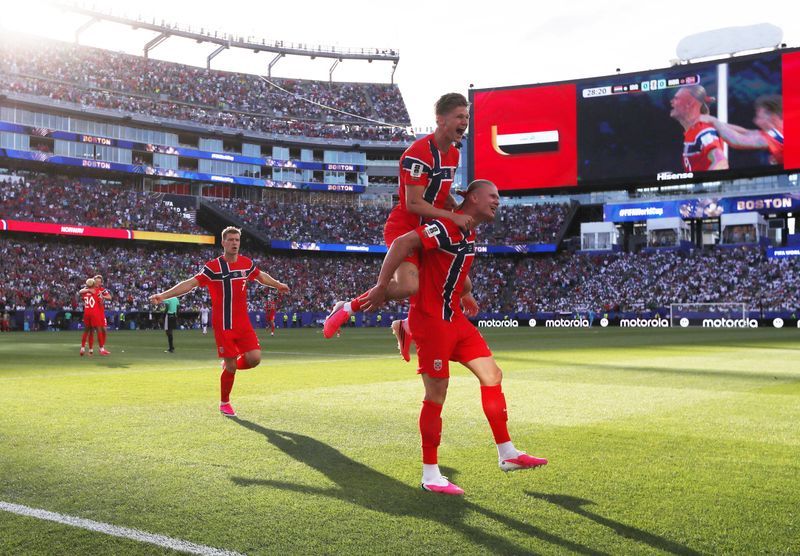
Erling Haaland stamped his mark on football's biggest stage with a commanding two-goal performance that propelled Norway to a 4-1 victory over Iraq on Tuesday, announcing the Scandinavian nation's long-awaited return to the World Cup with emphatic authority. The prolific striker's double in the opening half showcased the clinical finishing that has defined his meteoric rise through Europe's elite competitions, adding to an already remarkable record of scoring on his debuts across the German Bundesliga, English Premier League, Champions League, and now the World Cup finals.
Haaland's emergence as an international force comes at a moment when Norwegian football has rebuilt itself from the disappointment of missing the previous two World Cups. The 23-year-old has become the focal point of the nation's attacking strategy under manager Stale Solbakken, with the team's entire operational framework constructed around his ability to find the net in decisive moments. Even Norwegian Prime Minister Jonas Gahr Stoere acknowledged this dynamic on the eve of the contest, noting that while individual brilliance scores goals, collective teamwork ultimately determines victory, yet the team's philosophy remains centred on maximizing opportunities for their talismanic forward.
Norway's passage through to the knockout stages appeared assured despite a performance that lacked the expected polish and control, particularly in midfield where captain Martin Odegaard failed to impose himself on proceedings with his customary influence. The team committed numerous turnovers and executed wayward passes that threatened to derail their momentum, yet Haaland's predatory instincts compensated for these lapses, with his opening goal arriving from a clinical finish off David Moller Wolfe's cross. His second exemplified the sort of pressing that modern elite strikers employ, as his harassment of Iraq's defensive line forced a poor backpass before he managed to deflect the goalkeeper's clearance attempt into the net.
The defensive vulnerability that allowed Iraq to briefly equalize through Aymen Hussein served as a sobering reminder that Norway cannot rely solely on their attack, particularly against stronger opponents in the tournament's later stages. The goal highlighted a lapse in concentration from the back four, who appeared momentarily distracted despite their side's commanding position. Such lapses against more formidable rivals like France, their principal group rival, could prove costly as the competition progresses.
Norway's position atop their group on goal difference reflected the peculiar nature of simultaneous group-stage matches, with their three points matched numerically by France following the European champions' 3-1 victory over Senegal on the same day. This clustering of opening results demonstrates how quickly the tournament landscape can shift, with little separating serious contenders and the field. The goalkeeper and defensive questions that emerged during Iraq's spirited response will require addressing before more demanding fixtures arrive.
Haaland's characteristic reticence with media obligations persisted even amid the excitement of his breakthrough World Cup performance, with the striker preferring to allow his goalscoring eloquence to substitute for verbal elaboration. This approach has served him well throughout his career, establishing a professional identity focused entirely on results rather than personality cultivation. His understated demeanour contrasts sharply with the enormous expectations that Norwegian supporters have projected onto his shoulders, yet he has consistently delivered when the pressure intensifies.
The psychological significance of this victory extends beyond the three points and improved goal difference, representing a genuine homecoming for Norwegian football after nearly three decades of exclusion from the world's premier tournament. The nation's supporters endured the frustration of watching World Cups from home since 1998, when Norway last competed at this level, making this return emotionally resonant across the entire country. The performance, while imperfect, nonetheless satisfied the fundamental requirement of winning a tournament opener against opposition that lacked the quality to exploit Norway's occasional defensive frailties.
Haaland's own assessment of the match acknowledged both the relief of securing the expected victory and the recognition that significantly improved performances would prove essential in subsequent encounters. His observation that Norway would require considerable advancement in their overall play suggested realistic self-awareness despite the convincing scoreline, demonstrating the mental discipline that characterizes successful elite athletes. The striker's commitment to continuous improvement rather than complacency following a successful debut provides the foundation for his maintaining excellence throughout the tournament.
For Norwegian fans, many of whom had never experienced a World Cup involving their national team at the senior level, the prospect of partying late into their local evening reflected the genuine elation of renewed participation in global competition. The emotional release of ending such a lengthy absence from the tournament, combined with a winning start, created the conditions for genuine celebration. Haaland's acknowledgement of this sentiment, delivered with characteristic understatement, captured the broader significance of Norway's reemergence on the world football stage, suggesting that the nation's football journey has entered an unexpectedly optimistic new chapter.