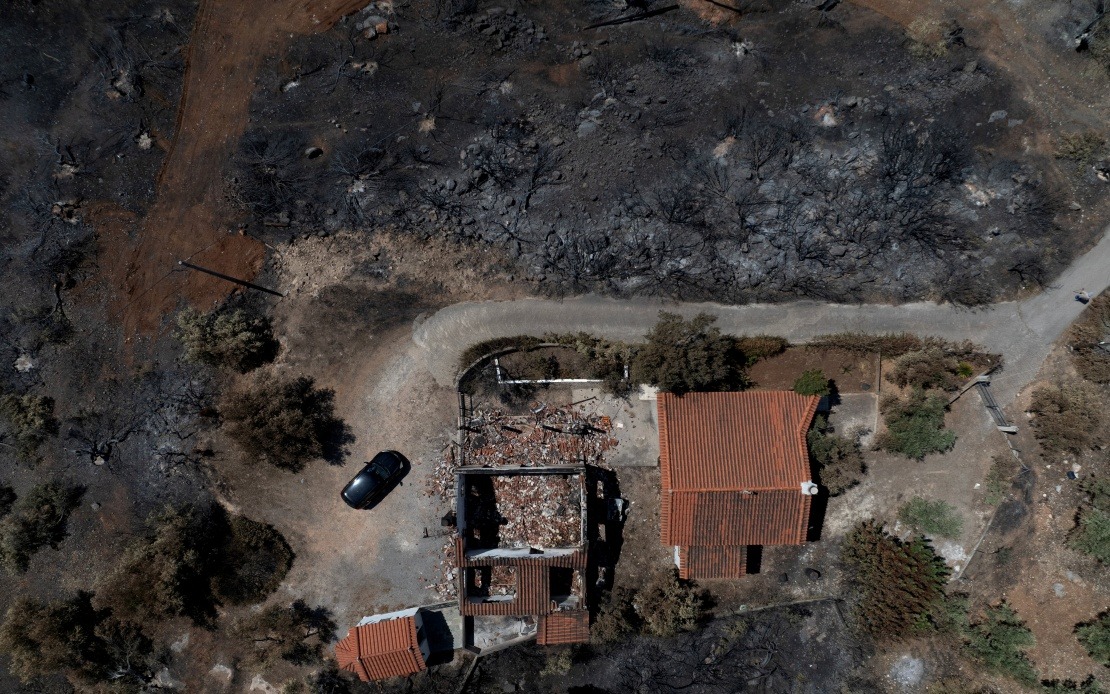
Greece has escalated its wildfire response to the highest alert level, declaring a "red alert" for the regions of Attica, Viotia and Evia on Thursday as meteorological conditions create an exceptionally dangerous fire environment. The General Secretariat for Civil Protection, which operates under the oversight of the Climate Crisis and Civil Protection Ministry, elevated the wildfire risk classification to Category 4 for August 6, signalling conditions of "very high" severity that require maximum emergency preparedness. This decision puts the country's largest metropolitan area, Athens, along with two other densely populated and forested regions, under strict fire management protocols.
The alert mechanism represents the most comprehensive emergency response available to Greek authorities, triggering a cascade of coordinated actions across multiple agencies. Under the red alert designation, the National Civil Protection Mechanism shifts into full operational mode, deploying personnel from the fire service, police forces, and armed forces units to conduct systematic patrols across both ground and aerial domains. These patrols focus particularly on forests and areas susceptible to rapid fire spread, where dry vegetation and heat create optimal conditions for ignition and propagation. The visible presence of emergency personnel serves both as a practical deterrent and as evidence of state readiness to suppress fires before they escalate.
As part of the alert protocol, authorities have imposed preventive restrictions on vehicle movement and public access to forests and other environmentally sensitive zones within the three regions. These measures aim to eliminate potential ignition sources in high-risk areas, recognising that human activity—whether deliberate or inadvertent—remains a leading cause of wildfire outbreaks during extreme weather periods. Residents have been explicitly urged to refrain from any activities that might generate sparks or flames, including barbecuing, discarding cigarettes carelessly, or operating machinery in dry grass areas. Such appeals to public responsibility become especially critical during periods when emergency resources are stretched thin and even small fires can rapidly spiral beyond containment capacity.
The heightened alert comes on the heels of successful suppression efforts targeting a wildfire that erupted near Koropi, a municipality located southeast of the capital. The blaze originated in low vegetation within the Driggia area at approximately 1:45 pm local time and prompted a substantial mobilisation of firefighting resources. At least 52 firefighters, encompassing three specialised forest commando units trained in challenging terrain operations, responded alongside fourteen vehicles equipped for ground-based suppression. The aerial dimension of the response proved particularly crucial, with four helicopters and two water-dropping aircraft coordinating a multi-pronged assault on the flames. One additional helicopter served a supervisory function, relaying real-time information to ground commanders and helping optimise the placement of water drops.
The technological dimension of this response reflects evolution in Greece's firefighting capabilities. Thermal and optical drone cameras provided operations centres with continuous monitoring of fire behaviour, heat distribution, and smoke spread patterns, enabling commanders to allocate resources with greater precision. Local authorities contributed water tankers that supplied additional hydration reserves for ground crews, while an arson investigation team was dispatched to examine the fire's origins and determine whether human intervention—whether accidental or criminal—had sparked the blaze. This investigative component remains essential for understanding fire causation patterns across the country and informing future prevention strategies.
Beyond the Koropi incident, firefighters continued battling a significantly larger wildfire that originated in Viotia the previous week and has since expanded across district boundaries into western Attica. According to satellite data obtained from the European Union's Copernicus monitoring system, this major fire has consumed approximately 14,424 hectares, equivalent to 35,642 acres, making it a major conflagration by regional standards. The scale of destruction illustrates how rapidly wildfires can expand under unfavourable weather conditions and how swiftly suppression efforts can become overwhelmed. This particular fire's trajectory demonstrates the interconnectedness of the regions now under red alert, as burning in one area can generate conditions conducive to fire spread in adjacent territories.
The human cost of these firefighting operations was tragically underscored during weekend operations against the larger Viotia-Attica blaze. A collision between two aerial firefighting helicopters resulted in the deaths of a Danish helicopter pilot and a Greek aerial coordinator. This incident, occurring during Sunday's operations, represents a sobering reminder of the dangers inherent in aerial firefighting during complex, fast-moving fire situations. Helicopter operations typically occur in smoke-filled, turbulent air currents where visibility is severely compromised, and coordinating multiple aircraft in such conditions demands extraordinary skill and carries substantial risk. The fatalities have prompted likely reviews of aerial firefighting protocols and safety procedures within Greece's emergency response framework.
For Malaysia and other Southeast Asian nations monitoring these developments, Greece's wildfire crisis offers instructive parallels to regional fire management challenges. While Southeast Asia's tropical climate differs markedly from Mediterranean conditions, the region has experienced increasingly severe transboundary haze events, particularly during drought periods when vegetation moisture content declines dangerously. Greece's deployment of sophisticated monitoring systems, coordinated multi-agency response structures, and emphasis on public cooperation in prevention measures reflect best practices adaptable to Southeast Asian contexts. The willingness to declare maximum alerts and impose restrictions, even with associated economic disruption, prioritises life safety and property protection over short-term convenience—a principle of growing relevance as climate patterns intensify.
The convergence of extreme weather, large-scale firefighting operations, and tragic loss of life underscores how wildfire management has evolved from a purely operational challenge into a complex emergency that engages technical, human, and political dimensions simultaneously. Greece's response demonstrates that even developed European nations with advanced resources face considerable challenges when natural conditions align unfavourably, and that preparedness requires not merely equipment and personnel, but sophisticated coordination frameworks and public engagement. As global temperatures continue rising and fire seasons lengthen across multiple continents, the operational lessons embedded in Greek authorities' response to these events acquire increasing salience for fire-prone regions worldwide.

