Authorities in Greece have declared a state of emergency in the Agios Vasileios municipality of Rethymno on Crete, the nation's largest island, following the outbreak of a major wildfire that has forced the evacuation of roughly 8,000 people including both residents and holidaymakers. The blaze, which intensified through late July, represents the country's most pressing active fire emergency in recent times, with flames stretching across a front exceeding 15 kilometres in length according to the Greek national broadcaster ERT.
The Rethymno fire has proven particularly challenging to contain given its geographical scope and the volatile conditions surrounding it. A secondary fire front emerged near the village of Asomatos and advanced towards Preveli, a celebrated coastal destination renowned for its picturesque beach and established tourism infrastructure. Meanwhile, firefighting teams focused their efforts on containing the original blaze that threatened the Agios Vasileios area. The simultaneous emergence of multiple fire fronts has stretched emergency response resources and complicated evacuation logistics across the southern portion of the Mediterranean's largest Greek island.
Weather conditions have emerged as the primary obstacle to suppressing the flames. Winds gusting at speeds up to 125 kilometres per hour combined with visibility reduced to near-zero levels have made aerial operations impossible. Water-dropping aircraft and helicopters, typically critical assets in Mediterranean wildfire suppression, remained grounded throughout the crisis as meteorological conditions rendered these missions too hazardous to execute. This limitation has forced authorities to rely almost entirely on ground-based firefighting teams, substantially reducing their operational capacity.
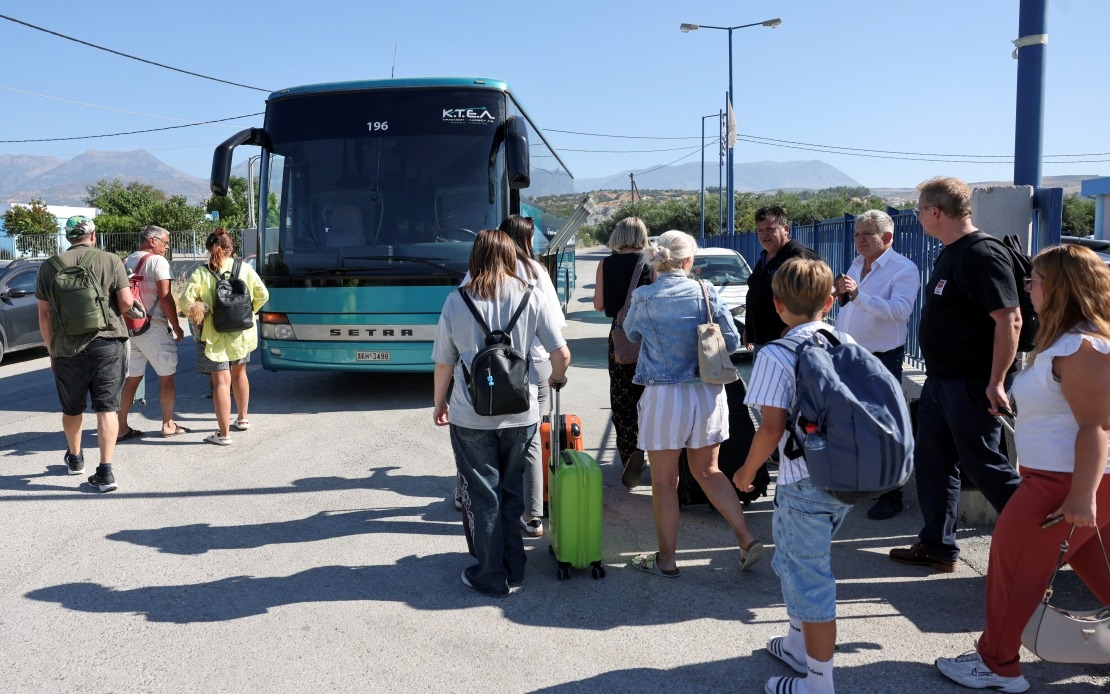
The evacuation process unfolded under considerable pressure. Greek authorities implemented successive emergency alerts to encourage residents and tourists to leave affected zones immediately. Approximately 700 evacuees spent the night in an indoor sports facility while others sought shelter with family members or relocated to hotel accommodation in safer regions. The logistical challenge of moving thousands of people, many of them unfamiliar with the terrain, demonstrated the scale of the emergency and the authorities' commitment to preventing casualties.
A particularly dramatic rescue operation occurred along the Preveli coastline, where maritime authorities successfully extracted 51 people stranded in the coastal zone. The Hellenic Coast Guard deployed a patrol vessel supported by two privately-operated boats to transport the evacuees across challenging seas to Agia Galini, a seaside settlement further west along Crete's southern shoreline. The maritime evacuation highlighted the dual nature of the crisis, as ground-based fire zones forced some residents toward the sea while treacherous conditions at sea complicated rescue efforts.
The firefighting response mobilised substantial ground resources despite the inability to conduct aerial operations. More than 190 firefighters, accompanied by multiple fire engines, specialised forest firefighting units, municipal authorities, and volunteer personnel, were positioned across the various active fire zones. Despite these numbers and their professional expertise, the combination of extreme winds and the fire's rapid spread across multiple fronts limited their capacity to achieve significant containment.
The material devastation has been considerable and broadly distributed. Agricultural areas including farmland and cultivated fields have been consumed by flames, alongside grazing pastures essential to local livestock operations. Residential properties have been damaged or destroyed, compounding the human toll beyond immediate evacuation needs. Livestock losses have added to farmers' economic hardship, affecting communities already vulnerable to seasonal agricultural challenges.
The underlying cause of the wildfire remains under investigation by Greek authorities, though meteorological patterns suggest the extreme wind conditions may have contributed substantially to its rapid propagation and the difficulty in controlling its advancement. Such investigations are critical for understanding whether factors beyond weather contributed to the emergency and to informing future fire prevention strategies across the island.
Crete's status as a major European tourism destination amplifies the significance of this crisis. The island attracts hundreds of thousands of international visitors annually, and tourist infrastructure throughout southern regions faces disruption from both the immediate fire threat and evacuation procedures. Businesses dependent on summer tourism have suffered direct interruption of operations, with implications extending into autumn bookings and the region's economic vitality.
Meteorological forecasts indicate that strong winds are expected to persist, meaning the wildfire risk across Crete remains elevated. The island has been placed under a very high wildfire risk warning, indicating that conditions remain conducive to the initiation and rapid spread of additional fires. This reality underscores the potential for further emergencies as summer weather patterns continue to dominate the Mediterranean region.
For Southeast Asian observers, the Crete situation exemplifies vulnerabilities that extend across Mediterranean and subtropical regions experiencing climate stress. Islands dependent on tourism, like several destinations throughout Southeast Asia, face similar exposure to large-scale fire emergencies that can rapidly overwhelm local infrastructure and force mass evacuations. The challenges Greece faces in coordinating maritime rescues, managing displaced populations, and operating under extreme wind conditions parallel scenarios that vulnerable communities across the region may encounter with increasing frequency.

